My Second Week Of Teaching Hebrew In Laqiya: Elections
Since we teach at the junior high school in Laqiya on Mondays, our lesson this week took place yesterday, the day before the general election. Since we have no common language, either literally or symbolically, it is hard to explain the different concepts involved in voting. Fortunately, the coordinators of our program equipped us with the necessary materials.
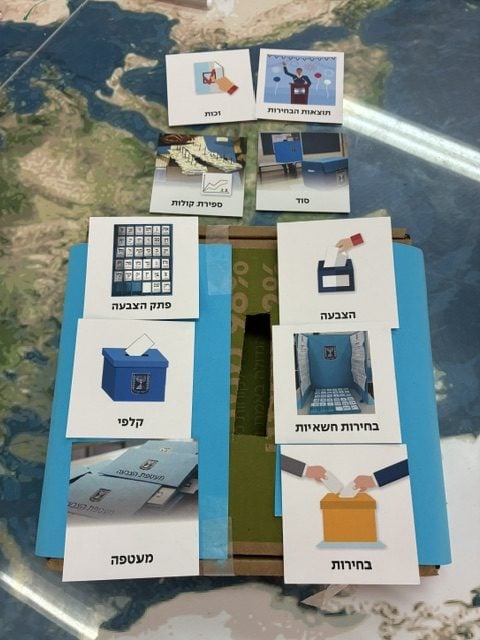
We were given an introductory guide containing key words printed on attractive cards, with the Hebrew word on one side and its Arabic translation on the other. We also received envelopes and ballot papers that we could put into a box that each of us had brought from home.
I am not sure how interested Hebrew-speaking children are in the democratic process, but my students gave me blank looks when I tried to explain the concept of elections in Israel. I tried a different approach and focused on the idea of making a choice and selecting just one item to indicate one’s preference. I apologized to the seventh- and eighth-graders, explaining that we would be playing a rather childish game.
I gave each student a page of fruit stickers and asked them to choose their favorite fruit, stick it on a ballot paper, fold the paper in half, and put it into the ballot box. Although I explained that each student had to choose just one fruit, some couldn’t make up their minds and chose two. We had to disqualify those votes and hold the vote again.
Then, in one group, there was no clear winner, so we had to vote again. In the third group, when there was no clear winner, the students decided to make a deal and agreed that they would all vote for the same fruit. Since they were speaking among themselves in Arabic, I was surprised to discover that they had all voted for the same lucky fruit. We laughed, but I explained that deals like these are illegal and invalidate an election. If this happened in a real election, it could invalidate the results at the entire polling station.
Although it seemed that discussing real-life elections in Israel was beyond my students’ grasp, they understood the concept of an election, as they had voted the day before—not coincidentally, but quite deliberately—to elect their student council. One of my students was a candidate, and one of the promises in her platform was to organize more day trips for her class.
We were very pleasantly surprised when the eighth-graders prepared a lovely breakfast for the volunteers. Their Hebrew still needs a lot of work, but it is a pleasure to work with such kind and appreciative students.
And as for the real elections in Israel, I pray for change and for peace with our neighbors.