
Clear analysis of Israel's politics, security and history
Nakba: A Catastrophic End to a ‘Judenrein’ Dream
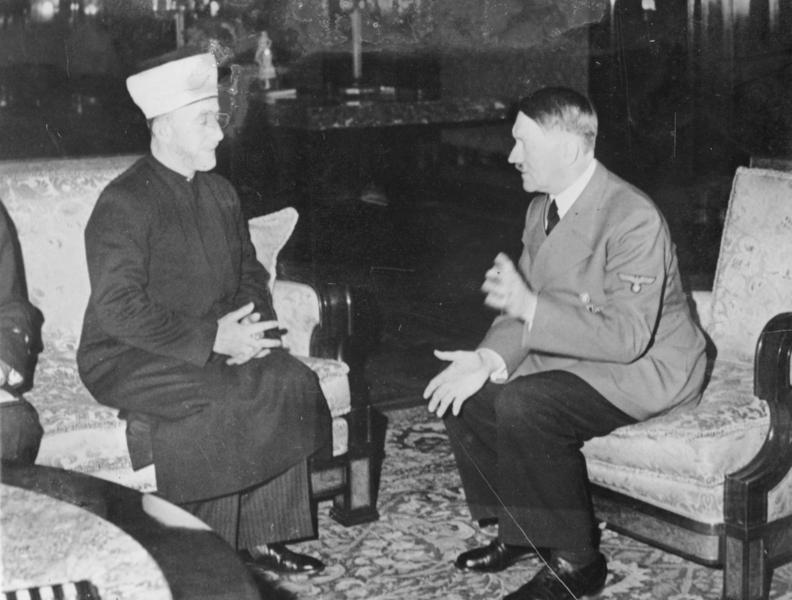
Haj Amin al-Husseini meeting Adolf Hitler in Berlin, 1941. Bundesarchiv, Bild 146-1987-004-09A (via Wikimedia Commons)
In Arabic, Nakba simply means catastrophe. The term entered political usage after the 1948 war to describe the shock and trauma of its outcome. At the time, it referred to the catastrophic failure of a war launched to eliminate any possibility of Jewish statehood and, in much of the Arab leadership’s rhetoric, Jewish existence on the land. That failure instead resulted in the survival and consolidation of a Jewish state, and the displacement of thousands of Arab civilians.
Years later, the meaning was deliberately inverted as part of a broader effort to rewrite history. What began as a description of Arab military and political failure was transformed into a story of Jewish colonialism and ethnic cleansing. The “catastrophe” was no longer the defeat of those who sought to eliminate Jewish sovereignty, but a claim that Jews carried out a brutal campaign of massacre and ethnic cleansing as white colonial settlers.
This inverted version of reality was extended even further by self-appointed social media “history experts”, with a popular modern narrative claiming that Jews were welcomed by Arabs with open arms after the Holocaust, only to betray that hospitality through violence and expulsion.
Pre-1948 Violence And The Origins Of Jewish Armed Self-Defence
The phrase “history didn’t start on October 7” is frequently invoked by pro-Palestinian activists, often pointing to 1948 as the supposed beginning of the conflict. In reality, the events of 1948 followed decades of violence during the period of British rule in British Mandate Palestine.
From the early 1920s onward, violence against Jewish communities intensified and became more organised, with repeated riots and attacks. In April 1920, Arab mobs assaulted Jewish neighbourhoods in Jerusalem during the Nabi Musa riots. In May 1921, further attacks in Jaffa and surrounding areas left dozens of Jews dead. In 1929, violence spread across British Mandate Palestine, culminating in the Hebron massacre, where sixty-seven Jews were murdered and a centuries-old Jewish community was destroyed.
Jewish defence organisations emerged in direct response. The Haganah was formed in 1920 as repeated attacks made clear that Jewish communities could not rely on British protection. Following the 1929 riots, a more militant offshoot emerged – the Irgun. It rejected the Haganah’s policy of restraint and advocated armed retaliation in response to continued attacks.
By the late 1930s and 1940s, Jews in British Mandate Palestine faced not only sustained Arab violence, but also British policies that limited organised self-defence and the White Papers, which sharply restricted Jewish immigration during the Holocaust. This led in 1940 to a split within the Jewish underground, with Lehi (the Stern Group) breaking away from the Irgun and directing its attacks primarily against British authorities.
The End Of British Mandate Palestine
In November 1947, the United Nations voted to partition British Mandate Palestine into two states, one Jewish and one Arab. Jewish leaders accepted the plan, despite the proposed Jewish state being territorially fragmented and vulnerable. Arab leaders rejected it outright, refusing to accept any Jewish sovereignty.
From December 1947 until the declaration of Israeli independence in mid-May 1948, the country entered a civil war phase. Fighting took place primarily between Jewish forces led by the Haganah and local Arab militias, but British authorities, though still formally responsible for security, were steadily withdrawing.
The coordinated invasion by neighbouring Arab states, which had been publicly threatened and militarily prepared in advance, would come only after Israel declared independence.
Arab Rhetoric, Ideology, And Intent
Arab political and military leaders framed the conflict of 1947-48 in openly eliminationist terms. This was not a war described as a dispute over borders or political arrangements, but as a campaign to destroy Jewish sovereignty and, in much of the rhetoric of the time, Jewish presence altogether.
Abdul Rahman Azzam, the Secretary-General of the Arab League, stated in October 1947:
This will be a war of extermination and a momentous massacre which will be spoken of like the Mongolian massacres and the Crusades.
Arab radio broadcasts and press reports echoed similar themes. Jewish defeat was presented as inevitable, violent, and total. Civilians were encouraged to believe that Jewish resistance would be crushed quickly, that towns would be cleared in preparation for Arab armies, and that departure would be temporary before an Arab victory and return. These expectations would directly shape civilian behaviour once fighting reached mixed cities.
One of the most influential architects of this rhetoric was Haj Amin al-Husseini, widely regarded by historians as the first true nationalist leader of the Arabs of British Mandate Palestine. As Grand Mufti of Jerusalem and President of the Supreme Muslim Council, he wielded enormous religious, political, and financial authority. Al-Husseini was instrumental in organising and inciting the deadly riots of 1920 and 1929, as well as the Arab Revolt of 1936 to 1939.
During the Second World War, Al-Husseini became an active partner of Nazi Germany, operating from Berlin as head of the Arab Bureau of the Nazi Ministry of Propaganda, working directly under Joseph Goebbels. From there, he broadcast Arabic-language propaganda across the Middle East, explicitly calling on Muslims to kill Jews and portraying their extermination as both a religious duty and a political necessity. He also assisted in recruiting Muslims for Nazi SS units in the Balkans.
This ideological lineage mattered. The objective was not merely to prevent Jewish statehood, but to remove Jewish presence altogether.
That intent becomes clearer when examined beyond the battlefield of 1948 itself. In the years surrounding Israel’s establishment, Jewish communities across the Arab world were rapidly dismantled. Approximately 850,000 Jews were expelled or forced to flee from countries such as Iraq, Egypt, Yemen, Libya, and Syria. Their citizenship was revoked, property confiscated, and communities that had existed for centuries erased.
Taken together, the rhetoric of 1947-48, its Nazi ideological influences, and the regional expulsion of Jews point to the same conclusion. The war was not solely about preventing a Jewish state. It was about realising a vision of a land without Jews. One need not look further than Palestinian-controlled areas today to see what that vision looks like in practice .
Civil War And The Civilian Exodus
As fighting intensified during the civil-war phase of early 1948, Arab civilian departure from towns and cities across British Mandate Palestine followed a clear and repeated pattern. In most locations, civilians did not leave because they were driven out by Jewish forces. Alongside fear, panic, leadership collapse, and general war conditions, many Arabs left because they had already been urged by their own leaders to evacuate in anticipation of a broader Arab military campaign.
Arab political and military leadership presented evacuation as a temporary and rational step. Civilians were told to clear urban centres so that Arab armies could operate freely, with the expectation that Jewish resistance would be crushed and that return would follow swiftly after victory. This guidance was issued openly, repeated through broadcasts and local leadership, and widely believed.
As for fear, it was not driven by combat alone. Arab leaders and media circulated propaganda describing exaggerated or fabricated Jewish atrocities, intended to mobilise Arab forces. Instead, it fuelled panic and accelerated a scale of civilian flight that quickly escaped political control.
In 1953, the Jordanian daily al-Urdun quoted a Deir Yassin refugee who blamed Arab leaders for spreading exaggerated atrocity rumours that “instilled fear and terror” and drove civilians to flee.
At the same time, departure was not the only option presented. In areas that came under Jewish control, Arab civilians were repeatedly urged by Jewish leaders to remain, provided that local militias laid down their weapons and residents accepted living under the emerging Jewish state of Israel. This option was rejected by many, partly due to pressure from local leadership and partly due to fear of being seen as collaborators should Jewish rule prove temporary.
In cities such as Haifa, as combat began, panic spread rapidly among a population that had been primed to expect imminent Arab victory and short-term displacement. Civilians rushed toward ports and roads, often without coordination. British forces, still present but disengaging, facilitated evacuation. Jewish authorities, including municipal leaders and the Haganah, were taken by surprise by the scale and speed of the exodus.
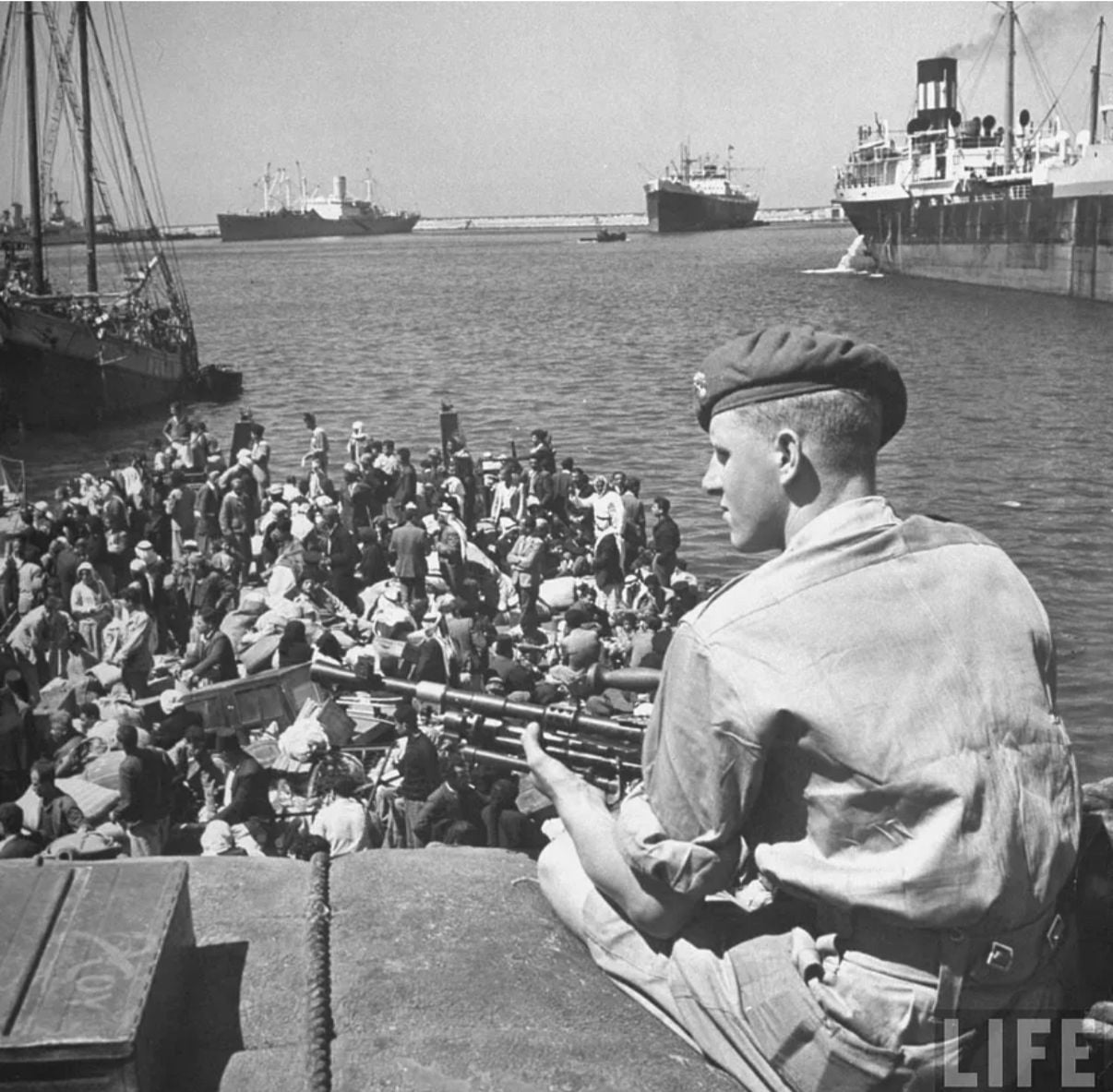
Photo: Dmitri Kessel / LIFE Magazine (via public circulation)
The war also included limited cases in which Jewish forces cleared specific areas for immediate security or strategic reasons. These actions were local responses to battlefield conditions, not the product of a centrally directed removal policy.
By early 1948, Jerusalem’s Jewish population was under siege. Arab forces controlled the main access routes, cutting off food, water, and medical supplies. Convoys attempting to reach the city were repeatedly attacked. In April 1948, the Hadassah medical convoy was ambushed on the road to Jerusalem, resulting in the killing of doctors, nurses, and patients. The aim was explicit: to isolate and starve the city into submission.
In response, Jewish forces moved to secure the road to Jerusalem and nearby villages being used to maintain the blockade. These operations led to the depopulation of some Arab villages along the route in order to break the siege and prevent the collapse of Jerusalem’s Jewish population.
When Arab forces captured the Old City and eastern Jerusalem in May 1948, the entire Jewish population was expelled. Long-established Jewish communities were destroyed, synagogues desecrated, and Jews barred from returning.
Jerusalem was not an exception. Wherever Arab forces gained control during the 1948 war, Jewish communities were entirely removed. Jews were expelled from the Old City of Jerusalem, from Gush Etzion, from Hebron, from Gaza, and from all areas that came under Jordanian or Egyptian rule.
The contrast with areas under Israeli control, where a large Arab population remained and became citizens, is stark.
Israeli Policy And British Confirmation
Claims that Arab civilians were ethnically cleansed in 1948 collapse when set against what Jewish leaders and British observers were saying at the time. In April 1948, Jewish institutions and leaders in Haifa issued public appeals urging Arab residents to remain, despite repeated calls from Arab leadership to evacuate. The Haifa Workers’ Council (Histadrut) published a statement calling on Arab residents to ignore calls from Arab leaders to leave and to remain in the city.
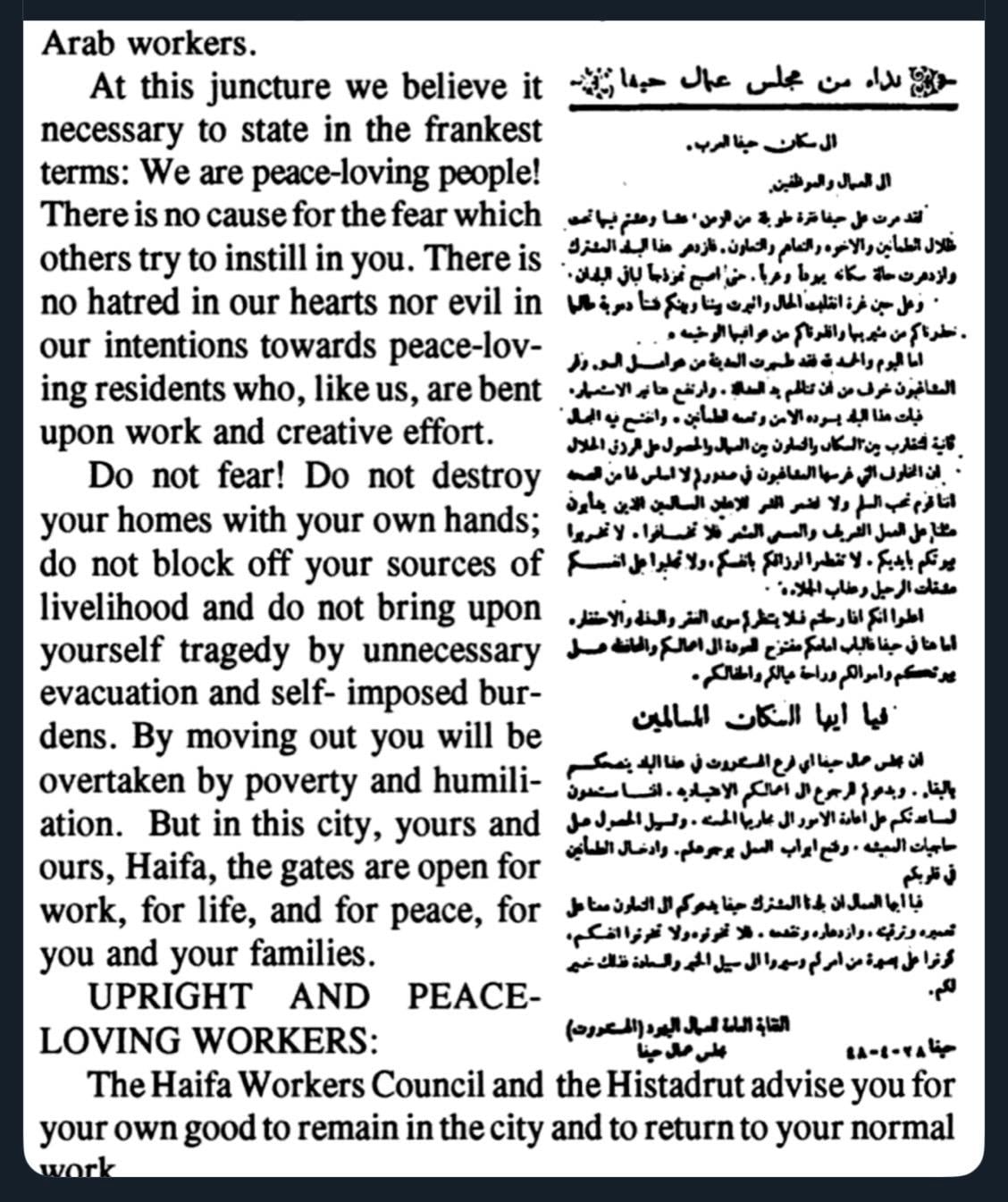
Image shared by @IbnAlwarraq (X)
That appeal was printed on leaflets distributed by the Haganah throughout Arab neighbourhoods and broadcast via loudspeakers mounted on vans. The message warned residents not to flee unnecessarily and urged them to remain in a city described as “both yours and ours.”
Golda Meir later described these events in detail in her memoir My Life. She wrote that as Arab civilians began to flee Haifa, David Ben-Gurion personally instructed her to go to the city at once, ensure that Arabs who remained were treated properly, and persuade those already leaving to return. Meir recalled sitting on the beach for hours and begging Arab residents not to leave. Crucially, she recorded the reason they gave her for refusing. They told her they knew they had nothing to fear from the Jews, but that they left because they were terrified of being regarded as traitors to the “Arab cause.”
This policy was formalised at the moment of Israel’s creation. On 14 May 1948, David Ben-Gurion, reading Israel’s Declaration of Independence, issued a public appeal to the Arab inhabitants of the new state:
WE APPEAL – in the very midst of the onslaught launched against us now for months – to the Arab inhabitants of the State of Israel to preserve peace and participate in the upbuilding of the State on the basis of full and equal citizenship and due representation in all its provisional and permanent institutions.
Independent British sources recorded the same reality. A British military intelligence report on Haifa from April 1948 noted:
Every effort is being made by the Jews to persuade the Arab population to stay and carry on with their normal lives… There is no evidence of any attempt by the Jews to force the Arab population to leave.
According to a British Foreign Office report, cited by historian Efraim Karsh, a British diplomat who visited refugees recorded: “We know who our enemies are,” they would say, referring to their Arab brothers who, they declared, had persuaded them unnecessarily to leave their homes.
Arab Leaders’ Admissions
In the years following the 1948 war, Arab political leaders and Palestinian institutions themselves acknowledged what later became taboo: that a significant part of the Arab civilian displacement resulted from Arab decisions, expectations, and actions, not from a Jewish policy of expulsion.
One of the most direct admissions came from Khalid al-Azm, Prime Minister of Syria during the war. Writing later in his memoirs, he stated:
We ourselves are the ones who encouraged the refugees’ flight… We brought disaster upon them by calling on them to leave their homes so that our armies could enter Palestine and fight.
Similar acknowledgements later appeared within official Palestinian discourse itself. A March 1976 item in the PLO journal Falastin al-Thawra, later cited in the Wall Street Journal, includes a statement attributed to Abu Mazen (Mahmoud Abbas), today President of the Palestinian Authority, conceding that Arab military intervention produced the Palestinian refugee crisis and that Arab forces forced civilians to emigrate. Most strikingly, the statement attributed to Abbas acknowledged the intent surrounding that displacement, stating that Arab radio stations openly broadcast their aim of throwing the Jews into the sea, while promising refugees a return after victory:
For seventeen years the Arab radio stations broadcast their intention of throwing the Jews into the sea and of returning the refugees to their homes. They did not throw the Jews into the sea, nor did they return the refugees to their homes.
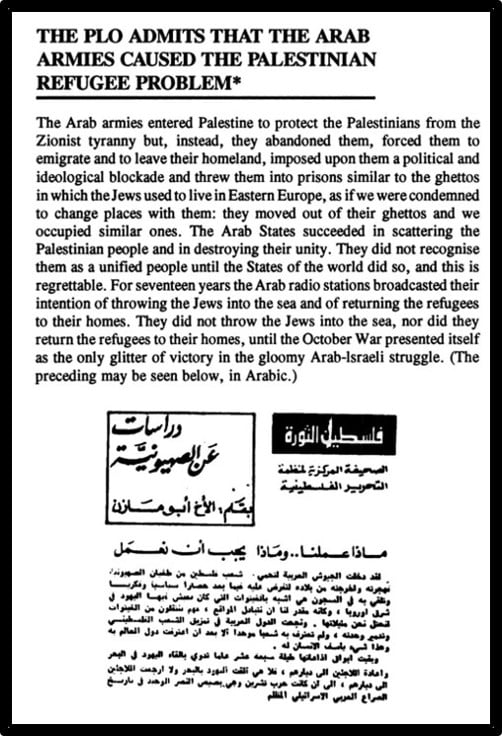
Image shared by @IbnAlwarraq (X)
This admission captures the core of the ‘catastrophe’. The promised victory never came, and the refugees were left stranded by the very leaders who had urged their departure. Acknowledgements of this kind conspicuously absent from contemporary Palestinian discourse.
Conclusion
The Nakba was indeed a catastrophe, but not the type propagated today. It was the outcome of a war launched by Arab leaders who rejected partition, rejected coexistence, and framed the conflict in openly eliminationist terms. Civilians were urged to evacuate in anticipation of victory. They were promised a swift return to a land without Jews. That war failed catastrophically.
What followed was not a tragedy imposed by Jewish design, but the consequences of a gamble lost. Leadership fled. Armies collapsed. Civilians who were told they would return in days found themselves stranded by defeat, and have been used as pawns ever since in an ongoing attempt to reverse a war lost 78 years ago. The fact that Palestinians are the only people in the world whose refugee status is passed down from one generation to the next is testament to that.
Where Arabs remained under Israeli control, they became citizens. Where Arab forces prevailed, Jews were expelled entirely. That contrast is not incidental. It reveals intent.
It is also worth stating plainly what the alternative outcome would have been. Had Israel lost the 1948 war, there would have been no Jewish state and no Jewish sovereignty anywhere between the river and the sea. Jewish communities would have been removed, as they were from every area that fell under Arab control during the war. Nor would there have been a Palestinian state. Gaza would have remained under Egyptian rule, Judea and Samaria under Jordanian control, the northern regions as part of southern Syria, an identity many Arabs of the region then shared, and the remaining territory divided among the victorious Arab armies.
The Nakba was not reinterpreted because new facts emerged, but because responsibility became politically unacceptable. Losing a war launched to erase Jewish sovereignty could not be reconciled with the need to claim permanent victimhood, and so the story was inverted as part of a larger propaganda project to delegitimise the Israeli state. Failed attempts of Jewish annihilation became cries of victimhood. Defeat became a moral indictment of the side that survived.
That is the Nakba. Not ethnic cleansing by Jews, but the catastrophic consequences of a war waged to eliminate them.
Related Topics