
From Kibbutz to the global stage
NASA, Nuclear Propulsion, and the Next 3I/ATLAS
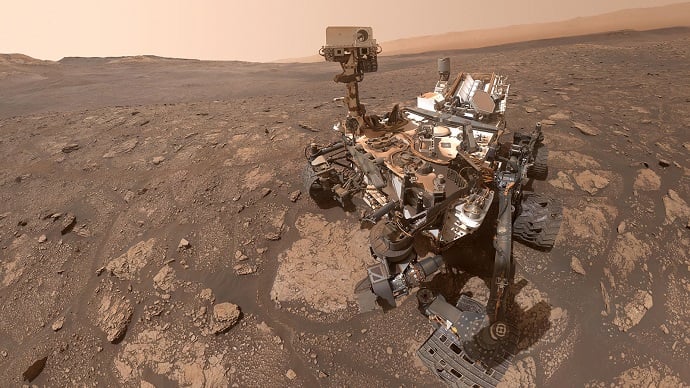
Image: NASA’s nuclear reactor concept designed to power spacecraft on Mars, credit NASA

NASA Must Prepare for International Cooperation and Nuclear Propulsion in Space — Before the Next 3I/ATLAS
“If we fail to cooperate — we may not be there, and perhaps not even here.”
With these words I ended my previous article on NASA’s plan to develop nuclear propulsion for spacecraft, rockets, and orbital bases.
The use of nuclear technology in space remains one of humanity’s most sensitive frontiers.
While nuclear propulsion is not a weapon, a malfunction or hostile act could lead to irreversible consequences.
It All Started with 3I/ATLAS
The story begins with 3I/ATLAS — a mysterious, seven-billion-year-old interstellar traveler that entered our Solar System in June 2025.
Telescopes followed it, scientists speculated, and anomalies began to mount.
As the object passed near Mars, Jupiter, and Venus, it approached the Sun — and suddenly vanished from Earth-based observatories.
On October 2, NASA captured images from a distance of 29 million kilometers but did not release them, citing “administrative difficulties” linked to the U.S. government shutdown.
NASA’s silence has continued ever since — and that silence triggered a media storm.
Silence, Politics, and a New Administrator
While global journalists quoted astronomers from Europe, India, China, and Japan, the U.S. president re-nominated Jared Isaacman, a billionaire pilot and astronaut, as NASA’s new administrator.
Soon after, CNN leaked a 62-page document — Project Athena — outlining an ambitious vision for nuclear propulsion in space.
This was no coincidence.
The discussion had already emerged publicly — here and elsewhere — about the need for mini interstellar probes (“micro-I/ATLAS missions”) capable of exploring deep space. The only realistic path to that goal is through nuclear propulsion.
Growing Interest — and Quiet Frustration
Our recent articles on this subject have reached thousands of readers and dozens of reactions here and international news networks.
They spread through aerospace circles — from Washington, DC, and Baltimore to Los Angeles and San Francisco — where many professionals, facing layoffs, fear NASA’s stagnation more than its ambition.
The Temporary End of the Nuclear Spacecraft
In July 2025, the U.S. Defense Advanced Research Projects Agency (DARPA) announced that it was withdrawing from its joint nuclear propulsion program with NASA — the DRACO project.
Yet sources reveal that NASA’s engineers already have the technical capability to operate nuclear engines in space; what stops them is bureaucracy and political hesitation.
NASA’s projects DRACO and Kilopower were meant to pioneer nuclear power for long-range missions.
In July 2023, Lockheed Martin was selected to build the experimental DRACO spacecraft, with a launch planned for 2027 — now postponed indefinitely.
Meanwhile, China, Russia, and India are pushing forward, while the West, afraid to ignite a new arms race, chooses diplomatic silence.
“NASA Is Afraid of Nukes Instead of Respecting Them”
In response to our coverage, a senior engineer supporting NASA, the U.S. Space Force, and the Department of Defense on nuclear propulsion wrote:
“With all due respect — we already know everything about nuclear weapons.
If nuclear power is an enabler, we must build and test.
NASA needs to step up and lead.
They are afraid of nukes instead of respecting them.”
When I asked about innovation, responsibility, and public trust, he replied simply:
“None of them is self-evident.”
The Reality We Can’t Avoid
Nuclear propulsion in space is no longer a theoretical option — it is a necessity.
Without it, deep-space research will stagnate.
With it, humanity can face the next interstellar visitors — like 3I/ATLAS — that advanced telescopes are likely to detect more frequently.
The recent incident involving a Chinese spacecraft struck by orbital debris, leaving two astronauts trapped, highlights the growing fragility of human spaceflight.
What began in the 1960s as a space race between the U.S. and the Soviet Union must now evolve, in the second quarter of the 21st century, into a “Space Authority of Earth’s Inhabitants.”
Only international cooperation, transparency, and trust can prevent future disasters — and open the path toward safe exploration of the universe.
Image: NASA’s nuclear reactor concept designed to power spacecraft on Mars
.
Related Topics
Related Posts