
Navi Pillay’s Nobel Win Is Dripping with Israeli Blood
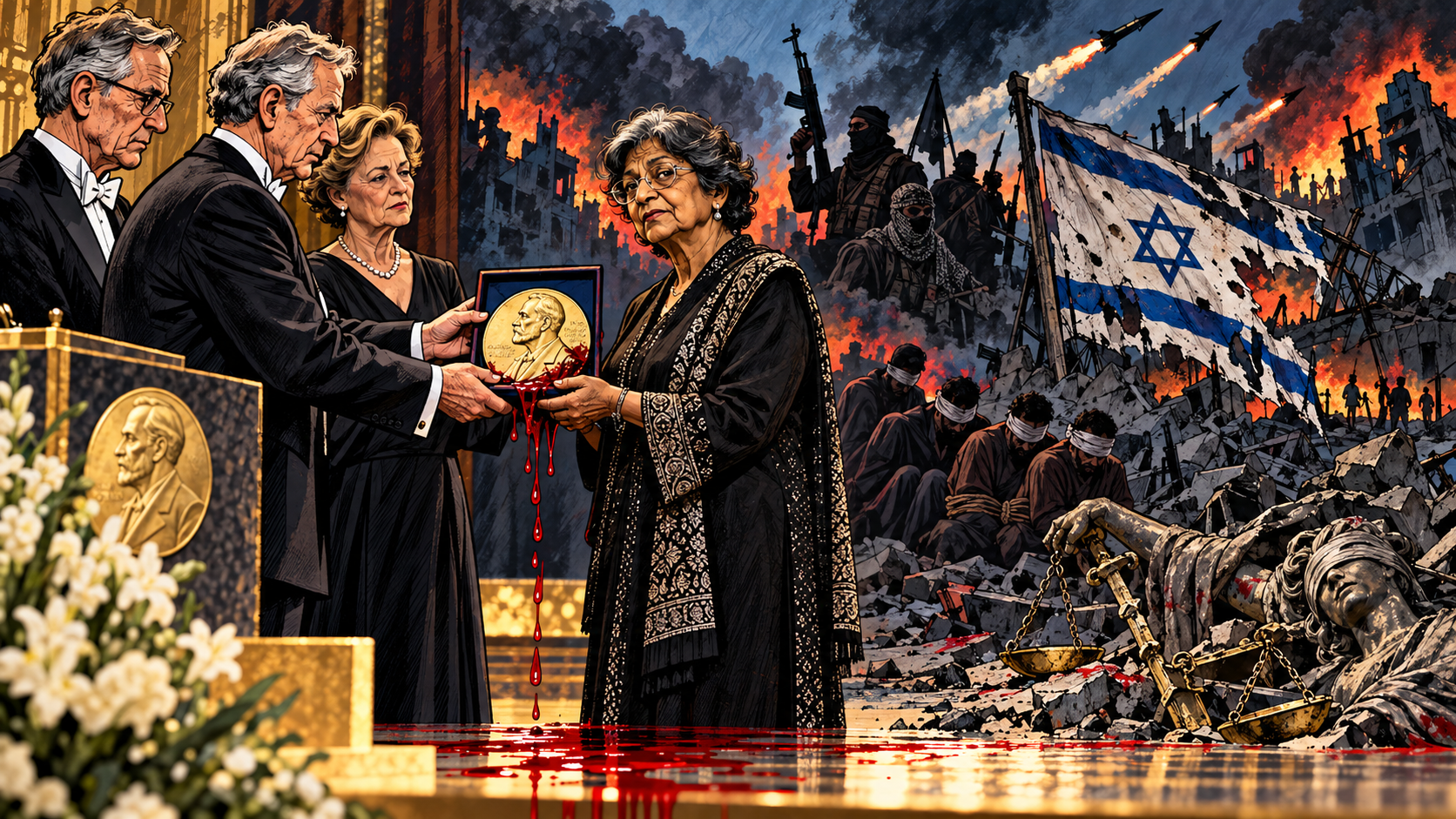
“When you have a whole population oppressed for so long with no remedies, no relief, they are actually forced to resort to armed struggle.”
Those were the words of Navi Pillay in an Al Jazeera interview on October 28, 2023, justifying Palestinian armed violence just three weeks after Hamas carried out the deadliest massacre of Jews since the Holocaust, murdering approximately 1,200 people and abducting 251 hostages. As Pillay spoke, hundreds of those hostages remained trapped in Gaza, enduring conditions survivors would later describe in harrowing accounts of starvation, beatings, psychological abuse, and torture. Israel was still burying its dead, and families were desperately searching for their loved ones. Yet a leading UN investigator was already framing the slaughter as an inevitability.
What Ms. Pillay omitted is that Hamas had sixteen years to choose a different path. In 2005, Israel evacuated every Jewish settlement from Gaza, removing thousands of its own citizens and withdrawing its permanent ground forces. Even the Israeli Jewish dead buried in Gush Katif were exhumed, all 48 graves relocated so their remains could be brought home for reburial. Not even the dead were left behind.
When Hamas violently seized control of Gaza in 2007, its leaders had an opportunity to build a different future. Despite continuing Israeli and Egyptian restrictions, including the blockade, Hamas could have prioritized civilian infrastructure, education, and economic development. Instead, it invested enormous resources in terror tunnels, rockets, and preparations for war. For more than fifteen years, Hamas and other armed groups repeatedly targeted Israeli communities, forcing families into bomb shelters and children to grow up under the threat of attack. The international community issued condemnations, yet effectively forced Iseael to live with this slow-burning war, treating the targeting of Israeli civilians as background noise rather than a threat demanding sustained action. This international complacency helped allow the danger to persist until October 7, 2023, when Hamas unleashed a massacre of unimaginable brutality. Hamas had choices, and the international community had a duty to hold it accountable. The deliberate slaughter of innocent people was a calculated decision, one that no grievance can ever justify.
On October 9, 2026, just two days after Israel commemorated the third anniversary of that massacre, the Norwegian Nobel Committee decided that Navi Pillay should be the recipient of the Nobel Peace Prize. The decision was a visceral insult to the victims and their families. While Pillay also stated that armed struggle must comply with international law, her suggestion that Palestinians were forced into violence raises a fundamental moral question:
When did political grievances remove responsibility from those who deliberately murder civilians? The implication that such violence was inevitable is precisely what makes her words so offensive.
Pillay’s broader record raises serious questions about her impartiality. Before chairing the United Nations Commission of Inquiry into Israel and the Palestinian territories, she signed a 2020 appeal advocating sanctions against Israel. In 2022, when fellow commissioner Miloon Kothari invoked antisemitic tropes about the “Jewish lobby” and questioned Israel’s membership in the United Nations, Pillay aggressively defended him, claiming his remarks had been taken out of context and misquoted. Kothari subsequently apologized, acknowledging that his language was inappropriate and offensive. These controversies, together with the commission’s disputed findings against Israel, have undermined confidence in its impartiality.
The World Jewish Congress and UN Watch condemned Pillay’s Nobel selection, citing her record and the troubling implications of honoring her. The Nobel Committee instead emphasized her distinguished career fighting apartheid in South Africa and advancing international criminal law, including her work concerning the Rwandan genocide. Those achievements deserve recognition, but a distinguished past does not grant a lifetime license to excuse terrorism or place one’s judgment beyond scrutiny.
There is nothing inherently antisemitic about criticizing Israeli policy, investigating its military actions, or advocating for Palestinian rights. But human rights must be universal, and the language of justice must never be twisted to legitimize atrocities. Jewish children murdered in their homes, women subjected to documented sexual violence, elderly captives dragged into Gaza, and Israeli soldiers who sacrificed their lives defending their country deserve the same moral clarity afforded to victims anywhere else on earth.
The suffering of Jews cannot be treated as an exception to the principles international institutions claim to defend.
The Nobel Peace Prize is meant to symbolize humanity’s highest aspirations: peace, accountability, impartiality, and the equal value of human life. By overlooking Pillay’s troubling rhetoric in the immediate aftermath of October 7 and the controversies surrounding her record, the Norwegian Nobel Committee failed to uphold those principles. It chose to honor a woman whose words appeared to rationalize armed violence while hundreds of innocent people were suffering in captivity.
Navi Pillay should never have been awarded the Nobel Peace Prize. Coming just two days after the third anniversary of October 7, her selection was not merely an error in judgment.
It was a moral disgrace.