
The Third Story
Navigating the waters of strife: Why anti-Zionism is antisemitism
(AI)
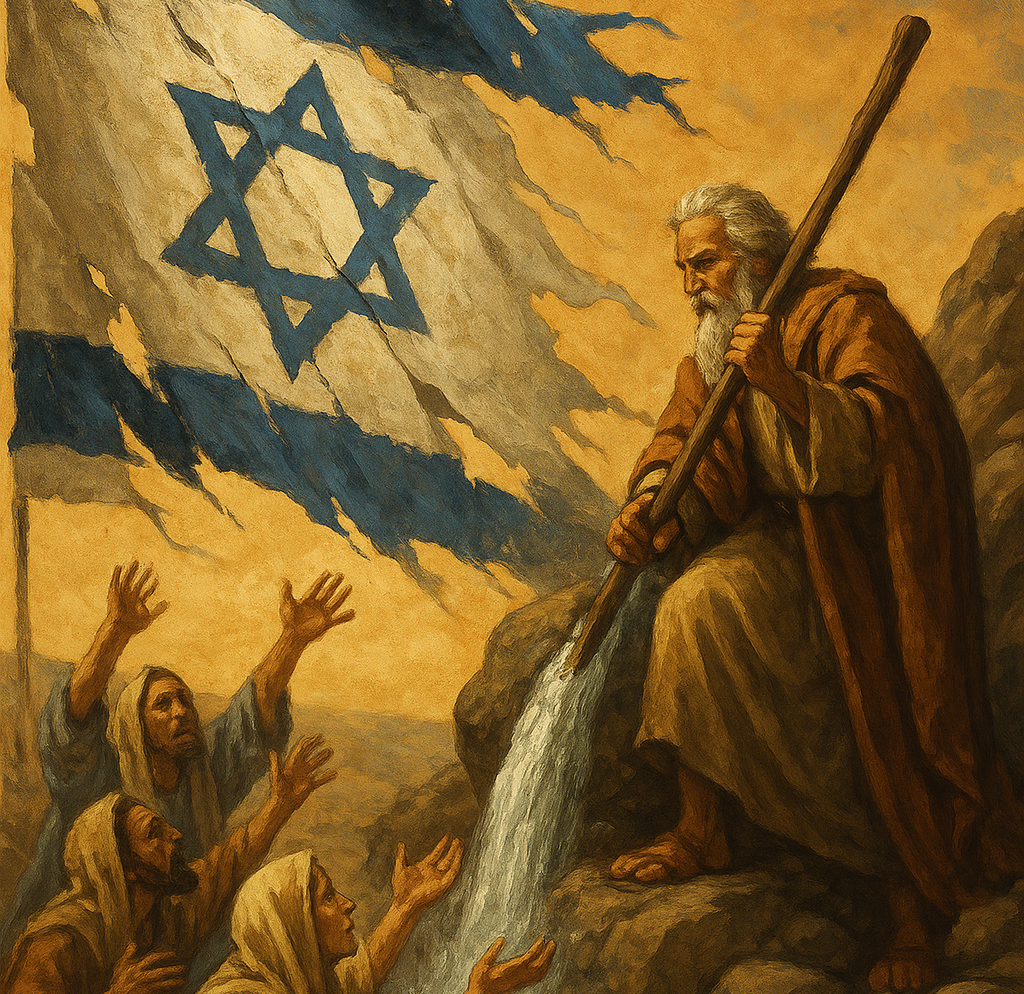
As we turn to Parashat Chukat this week, we recall Moses’ fateful error at Mei Meriva (a location in the wilderness referred to as the “Waters of Strife”) where instead of speaking to the rock as commanded, Moses struck it. This seemingly minor deviation from divine instruction led to profound consequences, preventing Moses and Aaron from entering the Land of Israel. This narrative serves as a powerful reminder for us today: even when driven by righteous intentions, a deviation from a clear, historically grounded path can lead to unforeseen and severe outcomes. This ancient lesson offers a crucial lens through which to examine the contemporary discourse around Israel and the troubling claim that one can be staunchly anti-Zionist without being antisemitic.
In an increasingly polarized world, the lines between legitimate criticism and outright bigotry are often blurred, intentionally or otherwise. Nowhere is this more apparent than in the discourse surrounding Israel, where a disturbing trend has emerged: the notion that one can be staunchly anti-Zionist without being antisemitic. In the 21st century, this claim is not merely disingenuous; it is, in most practical applications, impossible to uphold.
When the existence of the world’s only Jewish state, Israel – the fulfillment of the Jewish people’s millennia-old yearning for self-determination in their ancestral homeland – is delegitimized, when its right to exist is questioned or denied, and when calls for its eradication are voiced, it ceases to be a critique of policy and becomes an assault on Jewish peoplehood itself. To deny Jews the right to a national home, a right afforded to countless other ethnic and national groups, while simultaneously ignoring or downplaying the historical context of their persecution and the ongoing threats they face, strongly echoes classical antisemitic tropes that seek to deny Jewish agency and collective existence.
It is precisely this dangerous equivocation that we must condemn, particularly when it comes from figures like New York Assemblyman Zohran Mamdani. To profess anti-Zionist views while claiming to be free of antisemitic animus in this climate is to either be woefully ignorant of history and the contemporary manifestations of anti-Jewish hatred, or to deliberately employ a thinly veiled form of bigotry. When an elected official declines to support Israel’s right to exist as a Jewish state, embraces slogans like “globalize the intifada,” and champions the Boycott, Divestment, and Sanctions (BDS) movement – which often targets Jewish individuals and institutions globally – the distinction between anti-Zionism and antisemitism collapses. These are not merely criticisms of Israeli government policies; they are actions that directly or indirectly undermine the security and self-determination of the Jewish people. Mamdani and those who share his stance are, in essence, guilty of precisely the forms of discriminatory denial and dehumanization that they purport to condemn in other contexts, but selectively apply to the Jewish people and their state.
Consider a parallel: Would the United States not be considered anti-Catholic if it were to boycott the Vatican, a sovereign state intricately tied to the identity and spiritual home of Catholics worldwide? Such a move, ostensibly against a political entity, would undoubtedly be perceived by most as an attack on Catholicism itself, given the Vatican’s unique and profound significance to the Catholic faith and its adherents globally. The nation-state of Israel holds a similarly unique and profound connection to the Jewish people, rooted in history, religion, and collective memory. To attack one is to attack the other.
My concern deepens when I observe expressions of condonement for anti-Zionist positions among certain American rabbis and rabbinical students. In an effort to be inclusive and pluralistic they have, in my opinion, gone too far. They seem to have lost touch with the stark reality of the 21st century: for countless Jews today, the very existence of the State of Israel and their unwavering support for Israel and the Israeli people has become their strongest ritual, their most profound expression of Jewish identity. To accuse Israel of genocide is not merely a political critique; it is akin to a modern-day blood libel, echoing centuries of false accusations used to justify violence against Jews. This trend within some progressive Jewish circles risks alienating and undermining the deeply held spiritual and emotional connection that a vast majority of Jews feel towards Israel.
Ultimately, just as the lessons of Mei Meriva underscore the profound consequences of deviating from the essentials of our mission, we are reminded to choose our words and stances with extreme care. When certain Jewish leaders, in their quest for inclusivity, “strike” out with anti-Zionist positions rather than “speaking” with the nuance and steadfastness demanded by our people’s deep connection to Israel, they risk inadvertently sacrificing a fundamental aspect of contemporary Jewish identity and providing support to those who would delegitimize our very existence. The wisdom of the Torah’s teaching calls upon us to uphold clarity and truth in the face of paradox and prejudice, ensuring that our actions, however well-intentioned, do not inadvertently lead us astray from the essential unity and safety of the Jewish people.
Related Topics