
An Engineer’s Perspective on Israel and Jewish Life
NAZA and the Inversion of Evidence
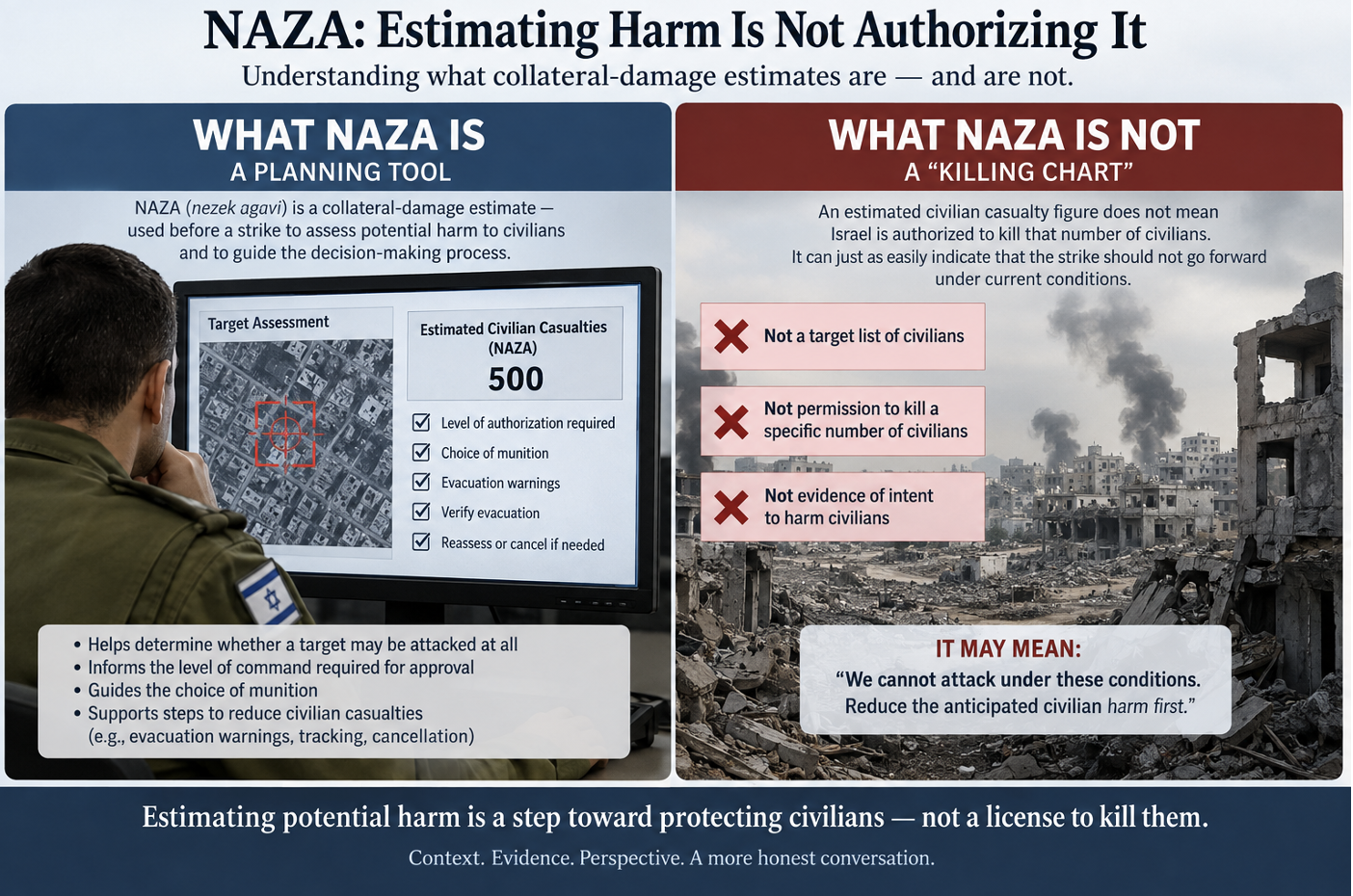
A new Israeli documentary, NAZA, has arrived with an explosive accusation.
Directed by Israeli filmmakers Yuval Abraham and Rachel Szor, two of the four co-directors of the Oscar-winning No Other Land, the film recently won the Special Jury Prize at the Venice Film Festival. Drawing on testimony from 24 anonymous Israeli military and intelligence insiders, it purports to reveal the systems behind Israel’s bombing campaign in Gaza and what the film itself describes as Israel’s “calculated mass killing” of Palestinian civilians.[1]
The title is central to the accusation. NAZA is a Hebrew military acronym for nezek agavi, collateral damage, and refers to an estimate of civilians who could be harmed in an attack on a military target. The film portrays these numbers as evidence of a system willing to knowingly kill large numbers of civilians. One anonymous source claims that a strike was approved with an anticipated civilian toll of 500.[1]
It is a devastating allegation.
But there is a fundamental problem with the argument: estimating potential civilian casualties is not the same as authorizing their deaths.
Indeed, the existence of a collateral-damage estimate can demonstrate precisely the opposite — that civilian harm is being considered before a strike occurs.
What NAZA actually means
Sarit Zehavi, a former IDF intelligence officer, has offered an important perspective largely missing from the controversy. Nearly 20 years ago, she helped establish an IDF unit dealing with warning enemy populations and protecting civilian lives. She says she was personally involved in developing target-approval procedures.[2]
According to Zehavi, the chart highlighted in the film’s promotional material is not a “killing chart.” It is a planning tool.
The estimated collateral damage helps determine whether a target may be attacked at all, which level of command must approve the strike, what munition can be used and what steps must be taken to reduce civilian casualties.
Those steps can include warning civilians to evacuate, tracking whether evacuation has occurred, selecting more precise weapons or canceling the strike altogether.[2]
This distinction is crucial.
If a target sheet says that attacking a particular target under existing conditions could result in 500 civilian casualties, that does not necessarily mean, “We are authorized to kill 500 civilians.”
It may mean: We cannot attack under these conditions. Reduce the anticipated civilian harm first.
The IDF has denied ever planning or carrying out a Gaza strike in which 500 civilian deaths were anticipated.[3]
That denial doesn’t prove that every Israeli targeting decision was correct. Nor does it establish that every allegation in NAZA is false. Anonymous whistleblowers sometimes reveal important truths.
But allegations this serious require careful scrutiny, including understanding what the terminology and procedures being described actually mean.
The terrible arithmetic of urban warfare
None of this diminishes the tragedy of civilian deaths in Gaza.
But civilian casualties in urban warfare must also be understood in context.
UN Secretary-General António Guterres has stated that when explosive weapons are used in populated areas, around 90 percent of those killed or injured are civilians.[4]
That is a horrifying statistic. It is also not specific to Israel.
The UN has also noted that the risk to civilians increases when combatants move among them and place military facilities and equipment near civilian infrastructure.[4]
This does not relieve Israel, or any military, of its obligation to distinguish civilians from combatants and minimize civilian harm. Nor does a high civilian toll establish that every strike causing civilian deaths was justified.
But neither do civilian casualties, even terrible numbers of them, by themselves establish an intention to kill civilians.
That distinction, between tragic consequence and deliberate purpose, is precisely why understanding NAZA matters.
And what about genocide?
The distinction also matters to the gravest accusation against Israel: genocide.
As I wrote recently, genocide is not simply another word for a war in which horrifying numbers of civilians die. Under Article II of the Genocide Convention, it requires specified acts committed with the intent to destroy, in whole or in part, a national, ethnical, racial or religious group.[5]
I do not believe Israel is committing genocide in Gaza.
That conclusion is fiercely disputed, and Israel’s conduct in individual operations remains subject to legal and moral scrutiny. But the question of intent is indispensable to determining whether conduct constitutes genocide.
Israel says its objective is to destroy Hamas, not the Palestinian people. And that is precisely why NAZA is relevant to the debate.
A military system that calculates anticipated civilian casualties before a strike, requires higher levels of authorization as the risk increases, and employs evacuation warnings, precision munitions or cancellation to reduce that risk is evidence that must be considered when evaluating intent.[2]
It does not prove that every strike was lawful.
It does not prove that commanders always made the right decisions.
And it certainly does not make the deaths of innocent Palestinians any less tragic.
But neither can evidence of an effort to anticipate and reduce civilian casualties simply be transformed into evidence of genocidal intent.
Remember al-Ahli Hospital
There is another reason for caution when dramatic accusations emerge from this war.
On October 17, 2023, an explosion ripped through the grounds of al-Ahli Arab Hospital in Gaza.
Palestinian authorities blamed an Israeli airstrike and reported that hundreds had been killed. That accusation rapidly became worldwide news.
But subsequent investigation pointed in a very different direction.
Human Rights Watch examined videos, photographs, satellite imagery, the crater, fragmentation patterns and witness testimony and concluded that the evidence pointed to an apparent rocket-propelled munition of a type commonly used by Palestinian armed groups. It found a large Israeli air-dropped bomb highly unlikely, while appropriately stating that further investigation was necessary to determine who launched the rocket.[6]
The initial accusation against Israel raced around the world.
The correction never had comparable impact.
That episode should have taught journalists, and all of us, something about reporting war in real time.
Governments can be wrong. Militaries can be wrong. Palestinian authorities can be wrong. Anonymous sources can be wrong.
Skepticism must operate in both directions.
Scrutinize Israel, but scrutinize the accusation too
Israel’s conduct in Gaza deserves serious scrutiny. Decisions resulting in civilian deaths should be investigated. Rules of engagement can be questioned. Individual strikes can be examined. If mistakes or violations occurred, they should not be hidden behind the fog of war.
But scrutiny is not the same thing as presumption.
The filmmakers behind NAZA present their subject as a system in which anticipated civilian casualties became part of the machinery of war. Yet the very calculation they highlight, the estimation of potential collateral damage, exists, according to someone who helped develop the procedures, at least in part because civilian casualties are supposed to be anticipated before a weapon is released.[2]
That doesn’t prove the system always worked.
It doesn’t prove that commanders always made the right decisions.
But if we are going to judge the morality of a military targeting system, we should first understand how that system works.
Journalists should test Israeli explanations rigorously. But the same evidentiary standard must apply to anonymous allegations, casualty claims and interpretations of military terminology that support the opposite narrative.
War produces enough genuine horrors. We should not manufacture additional ones by turning evidence of an effort to anticipate and mitigate civilian harm into evidence of an intention to cause it.
That isn’t scrutiny.
It is an inversion of the evidence.
Sources and References
[1] NAZA and its allegations. La Biennale di Venezia, NAZA, official 83rd Venice International Film Festival listing; Reuters, “Netanyahu says Gaza documentary ‘NAZA’ is ‘shocking incitement,’” September 14, 2026; Associated Press, “An Israeli documentary on the war in Gaza sets off a firestorm at home after Venice award,” September 15, 2026. The Venice listing identifies Yuval Abraham and Rachel Szor as the directors and describes the film as examining systems behind what it calls Israel’s “calculated mass killing” of Palestinian civilians. Reuters and AP describe the anonymous military and intelligence testimony and controversy surrounding the film.
[2] What NAZA means and how collateral-damage estimates are used. Sarit Zehavi, “What ‘Naza’ really means: The truth about collateral damage,” The Times of Israel, September 17, 2026. Zehavi, a former IDF intelligence officer, says she helped establish the unit concerned with civilian warnings and was personally involved in formulating target-approval procedures. She describes collateral-damage estimates as inputs into decisions about authorization, weapons, evacuation and cancellation.
[3] The 500-civilian allegation. Emanuel Fabian, “IDF denies claim in new ‘NAZA’ documentary that it planned Gaza strike with anticipated 500 civilian deaths,” The Times of Israel, September 14, 2026. The IDF denied ever planning or carrying out a strike during the Gaza war in which 500 civilian deaths were anticipated.
[4] Civilian casualties in urban warfare. United Nations Secretary-General António Guterres, remarks to the Security Council open debate on the protection of civilians in armed conflict, January 25, 2022. Guterres stated that when explosive weapons are used in populated areas, around 90 percent of those killed and injured are civilians, and noted that civilian risk rises when combatants move among civilians and place military facilities and equipment near civilian infrastructure.
[5] Genocide and intent. Convention on the Prevention and Punishment of the Crime of Genocide, Article II. The Convention defines genocide as specified acts committed “with intent to destroy, in whole or in part, a national, ethnical, racial or religious group, as such.” See also my earlier Times of Israel essay, “American Jews Ask: How Did We Get Here?” September 4, 2026, for my argument as to why I reject the characterization of Israel’s war against Hamas as genocide.
[6] Al-Ahli Hospital. Human Rights Watch, “Gaza: Findings on October 17 al-Ahli Hospital Explosion,” November 26, 2023. HRW concluded that the evidence pointed to an apparent rocket-propelled munition of the type commonly used by Palestinian armed groups and found a large Israeli air-dropped bomb highly unlikely, while emphasizing that further investigation was necessary to determine who launched the rocket.
Related Topics
Related Posts