
Netanyahu’s Balkan Ally Wants to Honor an Antisemitic WWII Figure
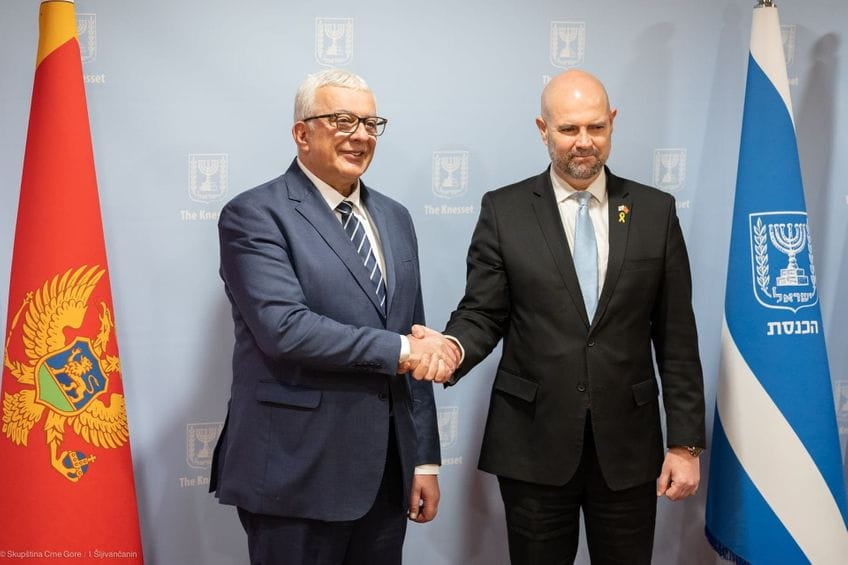
Benjamin Netanyahu has spent years cultivating friendships with right-wing nationalist leaders around the world, including politicians whose movements have troubling histories of antisemitism. Montenegro, a small Balkan country that has become an increasingly popular destination for Israeli tourists, offers a particularly revealing example.
On November 6, Jelena Božović, a lawmaker and deputy leader of New Serb Democracy, proposed a monument in the town of Berane to Divna Veković, a Serbian physician and nationalist intellectual from Montenegro. The party is led by Andrija Mandić, Montenegro’s parliamentary speaker and one of Israel’s most visible political interlocutors in the country.
What Božović left out was Veković’s wartime record. In a December 1942 article in an Italian occupation-era newspaper, Veković praised Chetnik commander Pavle Đurišić, whose forces collaborated with Axis occupiers, and used the antisemitic expression “Jewish bloodsuckers.” Montenegro’s Culture Ministry already rejected an effort to name a Berane street after her in 2022, citing her links to the Chetnik movement. Antifascist organizations condemned the new proposal, while a historian described it as an attempt to rehabilitate that movement through selective remembrance.
Why, then, has Israel’s government embraced political figures whose parties continue to promote such selective versions of history?
At first glance, Montenegro is mainly a tourism story for Israel. In 2025, 110,249 Israeli tourists visited the country, almost 50 percent more than the previous year. Many feel welcome there, although the picture is not entirely idyllic: incidents involving Israeli visitors have also raised concerns about growing hostility.
Viewed in the wider Balkan context, however, Montenegro illustrates Israel’s increasingly peculiar choice of friends. In countries such as Bosnia and Herzegovina, Kosovo and Albania, Israel and Jewish organizations had already built significant goodwill, including relationships rooted in the memory of persecution and genocide.
Bosnia is perhaps the clearest example. Emir Suljagić, director of the Srebrenica Memorial Center and himself a survivor, faced criticism for resisting pressure to turn remembrance of the Bosnian genocide into a campaign against Israel after the war in Gaza began. Yet Israel’s regional friendships made his position harder to defend. One of Netanyahu’s most conspicuous Balkan partners is Milorad Dodik, the Bosnian Serb nationalist leader who denies the Srebrenica genocide. In 2024, Israel’s then-ambassador to Serbia also publicly disputed its classification as genocide.
Dodik is a longtime ally of Moscow and close to Serbia’s Aleksandar Vučić and Hungary’s Viktor Orbán. Yet Netanyahu received Dodik in Jerusalem in January 2026, praising his support for Israel. That friendship is more than ceremonial: in September, Israeli and Republika Srpska officials inaugurated a representative office of the Israel Chamber of Commerce in Banja Luka.
In other words, politicians who cultivate Moscow have also become prominent friends of Jerusalem. That may deliver immediate diplomatic support, but it can also distance Israel from people who reject those leaders’ nationalist politics.
Montenegro follows the pattern. After a broad coalition ended Milo Đukanović’s decades-long rule in 2020, Mandić, a Serbian nationalist and longtime associate of Vučić and Dodik, became one of the country’s most influential politicians. He was initially convicted in the case of an alleged Russian-backed coup attempt in 2016, but his acquittal became final in February 2026.
As speaker of parliament, Mandić has cultivated a conspicuously warm relationship with Israeli Ambassador Avivit Bar-Ilan, which he has publicly described in personal terms.
There is also a delicate local dimension. Montenegro has two distinct organized Jewish communities, one led by Nina Ofner Bokan, president of the Jewish Community of Montenegro and a vice president of the World Jewish Congress, and another centered on Chabad Rabbi Ari Edelkopf. Ofner Bokan became Mandić’s official adviser in 2025. In 2021, she publicly defended Justice Minister Vladimir Leposavić amid controversy over his statements about the Srebrenica genocide; he was later dismissed.
It is understandable that Israel seeks allies in a hostile international environment. There is nothing inherently wrong with engaging leaders whose ideological backgrounds are troubling. Rabbi Menachem Mendel Schneerson, the Lubavitcher Rebbe, argued for constructive engagement even with political figures holding prejudiced views, rather than simply shutting them out. And such engagement could possibly change minds and behavior.
But engaging problematic leaders is not the same as granting them political legitimacy while their parties rehabilitate figures associated with antisemitism and wartime collaboration. The Veković proposal illustrates the difference perfectly. If a close friendship with Israeli representatives cannot even encourage Mandić’s party to confront the history of a figure it proposes to honor, what is that friendship achieving?
Israel’s next government, whenever it takes office, will inherit these relationships. It should ask whether they are winning former adversaries over—or merely giving controversial allies the legitimacy they seek, at the cost of alienating Israel’s other friends.