
יהוה הוא פועל ✡︎ Ha'Shem is a Verb.
Nazi Roots of Palestinian ‘Resistance’
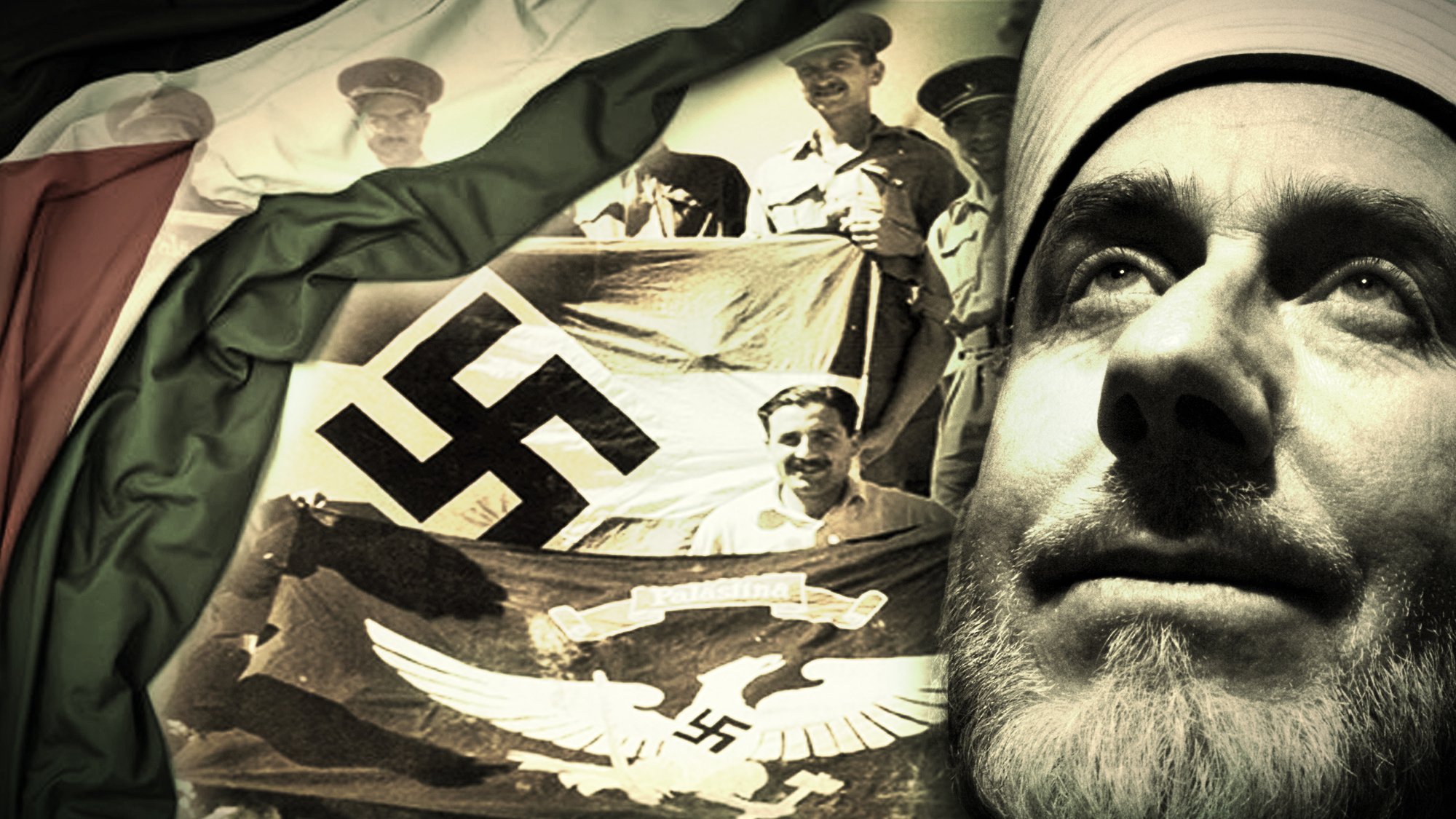
Image used with permission, from the Hashlamah Project.
Read the online comments or listen to the college campus chants of any number of well-intended “allies” of Palestine, and you will hear the leftist mantra: “this did not begin on October 7th!”
The declaration rings strangely in Jewish ears – left and right alike. Who ever said that this conflict began on October 7th? It certainly was not the Jewish People. For many of those chanting cleverly-rhymed protest stanzas couplets, this statement is a “gotcha” talking-point in white-knight straw-man argumentation.
First and foremost, it must be understood that absolutely no Jew in their right mind believes that any of this started on October 7th. Neither do we believe, however, as so many misguided youths seem to, that it began in 1948 either.
Yes, certainly, on 14 May 1948, the day the British Mandate over Palestine expired, the Jewish People’s Council gathered at the Tel Aviv Museum, and approved a proclamation, which declared “the establishment of a Jewish state in Eretz-Israel, to be known as the State of Israel.”
Was there any associated declaration that even one Arab must leave their homes to make room for Jews? No. So to whom would such a thing be a “Nakba“?
Who Was Ethnically-Cleansing Whom?
The reality is that for months preceding this, even into 1947, there were active battles raging against the Jewish people, in an effort to ethnically cleanse the Land not of the Arabs, but of the Jews of Mandate Palestine. In 1948, the Pan-Arab nationalist attempt to metaphorically drive the Jewish People into the Sea was made official.
Indeed, this was the phraseology vociferously employed, less than two decades later, on the eve of the 1967 Six-Day War. Ahmad ash-Shuqayri (1908-1908), the founder of the PLO (Palestinian Liberation Organization), would find himself blamed for the humiliating Pan-Arab defeat by Israel in only six-days, due in large part to such pompous rhetoric, which “said the quiet part out loud” — so to speak — that the Israeli people were in fact fighting for nothing short of survival, not a war of aggression.
Jordanian historian Samir Mutawi posited that “Nasser’s closure of the straits” the Straits of Tiran, on May 22, 1967, “and Shuqayri’s bellicose statement — that the time had come to annihilate the State of Israel and that the Arabs would throw the Jews into the sea — had alienated world opinion.”
Sa’ad Jum’a, the Jordanian prime minister during the Six-Day War, in fact called this defeat “An-Nakba” — long before anyone seemed to be using the term for the previous 1948 defeat. Shuqayri, he wrote, “objectively” is “one of the direct causes for the Nakba” of the Arab defeat in the Six-Day War.[1]
He had the appearance and bearings to play a role perfectly suited to him in the Nakba of the Arab world and in Arab disputes, and unfortunately he fulfilled this function with alacrity and expertise. When the Arab nation and Arab leaders stood before the bitter facts, after the campaign of humiliation and shame . . . [and] when a new period dawned. . . Shuqayri no longer had a place [in it], and he vanished from the stage. Some people can be likened to a drum—when you strike it, it produces a clamor and din because of its emptiness.
The Arab world accused him of contributing to its defeat with his radical declarations against Israel before the war, which had resulted in the world favoring Israel. Shuqayri thus served as a scapegoat for the Arab defeat in the war, a position eagerly seized upon by his enemies and opponents. Sa’ad Jum’a, Jordanian prime minister during the Six-Day War wrote:
My opinion of Shuqayri—objectively—is that he is one of the direct causes for the catastrophe [the Arab defeat in the Six-Day War]. He had the appearance and bearings to play a role perfectly suited to him in the catastrophe of the Arab world and in Arab disputes, and unfortunately he fulfilled this function with alacrity and expertise. When the Arab nation and Arab leaders stood before the bitter facts, after the campaign of humiliation and shame . . . [and] when a new period dawned. . . Shuqayri no longer had a place [in it], and he vanished from the stage. Some people can be likened to a drum—when you strike it, it produces a clamor and din because of its emptiness.
Before this most humiliating defeat in 1967, a similar Pan-Arab coalition had fared somewhat better, while still losing the war they started, in response to Israel’s Declaration of Independence on 14 May 1948. After the new state was declared, the armies of six Arab countries — Egypt, Syria, Jordan, Lebanon, Saudi Arabia and Iraq — came together to declare war.
This Pan-Arab union formed with the local “Palestinian” militia forces led by Hajj Amin Al-Husayni, the Nazi Grandmufti of Jerusalem, who had for a decade and a half been directly funded by Adolf Hitler. The attack against the nascent Jewish state was waged from all directions and without hesitation. At this time, however, there was not one Arab who had been expelled from their homes and not one centimeter of land was taken from anyone.
It must be remembered, there was not any sort of Arab Palestinian State — ever. There was a British Mandate of Palestine since 1917. Before that, it was the Turkish Ottoman ruled — and largely desolate — province of Syria-Palestina.
In 1921, a full 72% of that British-ruled Palestinian land was stolen by the new King of what became the Trans-Jordan.
In spite of the non-aggression of the Jewish People in the Land, in spite of the fact that nothing was stolen from anyone, and that there was no declaration that any Arab would be removed or have their homes confiscated — in spite of all of this this — the Pan-Arab Nationalist coalition united with the sole purpose of expelling the Jewish People from the historical Land of Israel.
Oh, the Humanity!
The attempted ethnic cleansing failed — or rather, only partially-succeeded. In the aftermath of 1948, Jordan very much did remove Jews from the West Bank. Cities like Hebron, which had been largely Jewish for thousands of years, were ethnically cleansed of Jews overnight. Cities, now dubbed “settlements,” like Gush Etzion, which were built on barren land and purchased from Arabs with legal bills of sale and land deeds, were stolen by the Jordanian state.
The Jews of Gush Etzion today are referred to as “illegal settlers” for having the “audacity” to return to that legally-purchased city, following the Israeli victory of the Six Day War.
Those who sought Jewish expulsion from the Land of Jewish ethnogenesis, referred to the aftermath of their attempts — first in 1948 and then in 1967 — as the “Nakba.”
This Nakba, which means “catastrophe” in Arabic, it is popularly explained, refers to the mass displacement and dispossession of Palestinians during the 1948 Arab-Israeli war. But this term “displacement” is somewhat weaselly.
Indeed, if a group of Arabs attacked a scrawny yeshiva bocher, only to find out the hard way that he was a martial arts expert, then the humiliated instigators indeed would see their defeat as a “Nakba.”
If, after running away from the humiliating defeat, whatever shoes, coats and hats of the attackers, which fell off in the struggle, were taken by the young yid, then these parents of the bullies indeed might claim that this was “not fair.” They might even argue that it was the “greedy” Jew who had “stolen” it from their aggressing children.
Reality, however, was no school-yard brawl. The Arab-Israeli war of 1948 was a fight for our very existence. This was a fight to survive, coming immediately on the heels of the Nazi Holocaust, and in fact being led by a close Nazi friend of Adolf Hitler, Hajj Amin Al-Husayni, the Nazi Grandmufti of Jerusalem. Any Nazi ally of Hitler, having just suffered the loss of the Führer of the Third Reich, then similarly finding their own attempts at anti-Jewish genocide thwarted, would naturally view such failures as a “catastrophe” or “Nakba.”
Most of those River-To-The-Sea-ing university campuses around the world have no idea about any of this. There is a reason they are not being told these important details: because as they say “the devil is in the details.” In this case, that devil, that shaytan, is Hajj Amin Al-Husayni and his Nazi Palestinian militias — what we would today rightly call a “terrorist” organization.
Who Was This Nazi Leader of the Palestinian “Resistance”?
To be sure this did not start in 1948 — on that much we can agree with the nations. There was indeed a long history of Islamicate[3] oppression of the Jewish people under the Abbasids, who responded to Iṣfahani assertions of Jewish independence movements with military force (8th century CE)
Indeed, the Caliphate would do the same with the forced conversions and accompanying violence and murder of the Al-Mohades in Andalusia.[4] The tarnished record of the Shi`ah Fatimids in North Africa, the Zaydi “Fivers” in Yemen, and later the Alladad era legislation designed to humiliate and oppress Persian Jews, finally culminating in the Meshad massacre (1839), thus dispelling any misconceptions that this anti-Jewish violence and coercion was merely a Sunni phenomenon.[5]
This, of course, is to say nothing of early massacres against Jewish natives and immigrants alike in Ottoman Syria-Palestina,[6] which indeed seem to have had an uptick after the immigration of the Husayni Clan in the 1830s. It was from this foreign, Hijazi family that the aforementioned “Grand” Muftī of Jerusalem, Hajj `Amin Al-Husayni, of Jerusalem emerged.
Thus, on one hand we have a historically rocky relationship between Jews and Arabs since the birth of the Dynastic Caliphate system and the trademarking of “Islam” as a separate religious identity[7] from the milieu of Post-Himyarite Arabian Jewish sectarianism from which it emerged.
On the other hand, the 20th Century saw a new hybrid form of Salafī-Wahhabism grafted onto the previously secular Arab nationalism. The man who grafted these previously conflicting ideologies was Rashid Rida. The disciple of the arguable founder Modern Salafīsm, Muhammad `Abduh, Rashīd Riḍā had a number of prominent disciples. One of the most infamous of these was the “Grand” Mufti of Jerusalem, Ḥajj `Amin Al-Husayni.
So just who was this Nazi Leader of the Palestinian “Resistance”? Husayni first rose to power offering compliance with the British Mandate. In an apparent pattern of deceit, he quickly emerged as a constant saboteur of peace between Arabs and Jews during the Mandate.[8]
In 2007, during a three-years period of engagement to a Palestinian woman from Ramallah (the West Bank of Jordan when her parents left), I attempted to explain the , relative to this meta conflict. She was astonished.
“I have never even heard of Hajj `Amin Al-Husayni Why should he matter?” she exclaimed in frustration.
“He matters because while your parents and culture never told you about him — because they didn’t want you to know who picked this fight and why — the Jewish people are not the least bit unaware of him nor of his literal Nazi ideology that drove resistance to Jewish presence in this Holy Land,” I explained.
Needless to say, it was over before the honeymoon began. Even while remaining friends for many years, eventually I had no choice but to disconnect after she refused to voice any public opposition whatsoever to the Hamas Pogrom of October 7th, even while privately she would maintain that “this is not what Palestinians want.”
Words of support are all fine and dandy, as they say. But if you can’t voice an alliance with Jewish civilians, and our rights to not be raped, tortured, kidnapped and murdered by an openly-fascist Caliphatist terror cult, then you are not an ally, you are at best a fair-weather friend.
If October 7th has shown us anything as a people, is that the Sanskrit verse, or shloka, often cited as originating from Benjamin Disraeli (1804 – 1881) or Lord Palmerston (1784 – 1865) are all too true:
Neither friendship nor enmity lasts forever. He who is a friend today may become an enemy tomorrow, and he who is an enemy today may become a friend tomorrow. Therefore, understanding what is in one’s best interest, one should act accordingly (न चिरं वैरं न चिरं स्नेहः । योऽद्य मित्रं स शत्रुः । योऽद्य शत्रुः स मित्रम् । अत एव हितं ज्ञात्वा कार्यमेव समाचरेत्).”
Many of us who have been historically more left-leaning, learned the hard way that we must remain adaptable and always prioritize our own well-being and interests, even while we are hopeful for peace and coexistence with those who will accept it.
For a more robust biographically sketch of the man who, in his dealings with the Third Reich, was known as der Großmufti, the interested reader should refer to .
Endnotes
[1] Sa’ad Jum’a, “The Collusion and the Fatal Battle,” in: Efraim Kam (ed.), Husayn Goes to War: The Six-Day War in Jordanian Eyes (Tel-Aviv, 1974) 285 [Hebrew]
[2] Samir A. Mutawi, Jordan in the 1967 War (London, 1987) 99. King Hussein should be mentioned, with respect to his book, My War with Israel, narrated to the French journalists Viki Vance and Pierre Laoure, Hussein says: “Shuqayri left Amman on Saturday, June 3 [1967], still wearing his Mao tunic. He went to Jerusalem to hold a press conference, and delivered one of his poisonous statements that were so beneficial to Israeli propaganda.” In a footnote the authors added details on Shuqayri: “On the stage of the UN [as Saudi ambassador] he was heard to threaten to ‘throw the Jews into the sea,’ a sentence that greatly incited moderate world opinion against the Arabs.”
[3] This important term comes from the historian Marshall Hodgson who defined Islāmicate as that which “…would refer not directly to the religion, Islam, itself, but to the social and cultural complex historically associated with Islam and the Muslims, both among Muslims themselves and even when found among non-Muslims.”(Venture of Islām, v. 1, p. 59). This designation for Andalusia is employed here as there was not a homogenous period permeating the history of Muslim Spain in such a manner that it can be characterized as “Islāmic,” in a literal sense, as a whole.
In 1830, the Jews of Tabriz were massacred; the same year saw a forcible conversion of the Jews of Shiraz, In addition to the Allahdad incident mentioned above in 1839. European travelers reported that the Jews of Tabriz and Shiraz continued to practice Judaism in secret despite a fear of further persecutions. Famous Iranian-Jewish teachers such as Mullah Daoud Chadi continued to teach and preach Judaism, inspiring Jews throughout the nation. Jews of Barforush were forcibly converted in 1866. When the French and British ambassadors intervened to allow them to practice their traditional religion, a mob killed 18 Jews of Barforush.
[4] Which notably forced the Maimonides family from Andalusia.
[5] See Raphael Patai’s Jadīd al-Islām for a full treatment and record of these repressive laws and of the Meshad massacre of 1839.
[6] Bernard Lewis, The Crisis of Islām: Holy War and Unholy Terror, (Modern Library, 2003), 90-91, 108, 110-111. Here we will find always a Ḥusaynī culpability in the violence.
[7] That is, as a separate religion from the Jewish sectarianism existing in the aftermath of the Himyarite Kingdom that authors like Chaim Rabin, John Wansbrough, and many other scholars see Muhammad as participating in. It is also to differentiate the verbal usage of “Islām” in the Qur’ān from its later use as a noun describing an institutionalized religion rather than a universal, pluralistic activity of submitting to God.
[8] It is essential to our examination of the Muftī, to note that during this time no Jews had deprived Arabs of any land or homes, as would come to typify later complaints against Israel. Jewish immigration first bolstered the Palestinian economy until the global economic depression, arguing here, as C.A. Bayly does in The Birth of the Modern World 1780-1914, that “all local, national, or regional histories must, in important ways… be global histories.” (Baily 2) With an exploding Arab population during the industrial era, it became all too easy to blame the new impoverished Jewish immigrants for buying up precious Arab land. The key personality in this demonization would prove to be the Muftī, Ḥajj `Amīn Al-Ḥusaynī.
Related Topics
Related Posts