
CEO of Time to Stand Up for Israel
Negotiating with Terrorists: Israel’s Cruel Choice
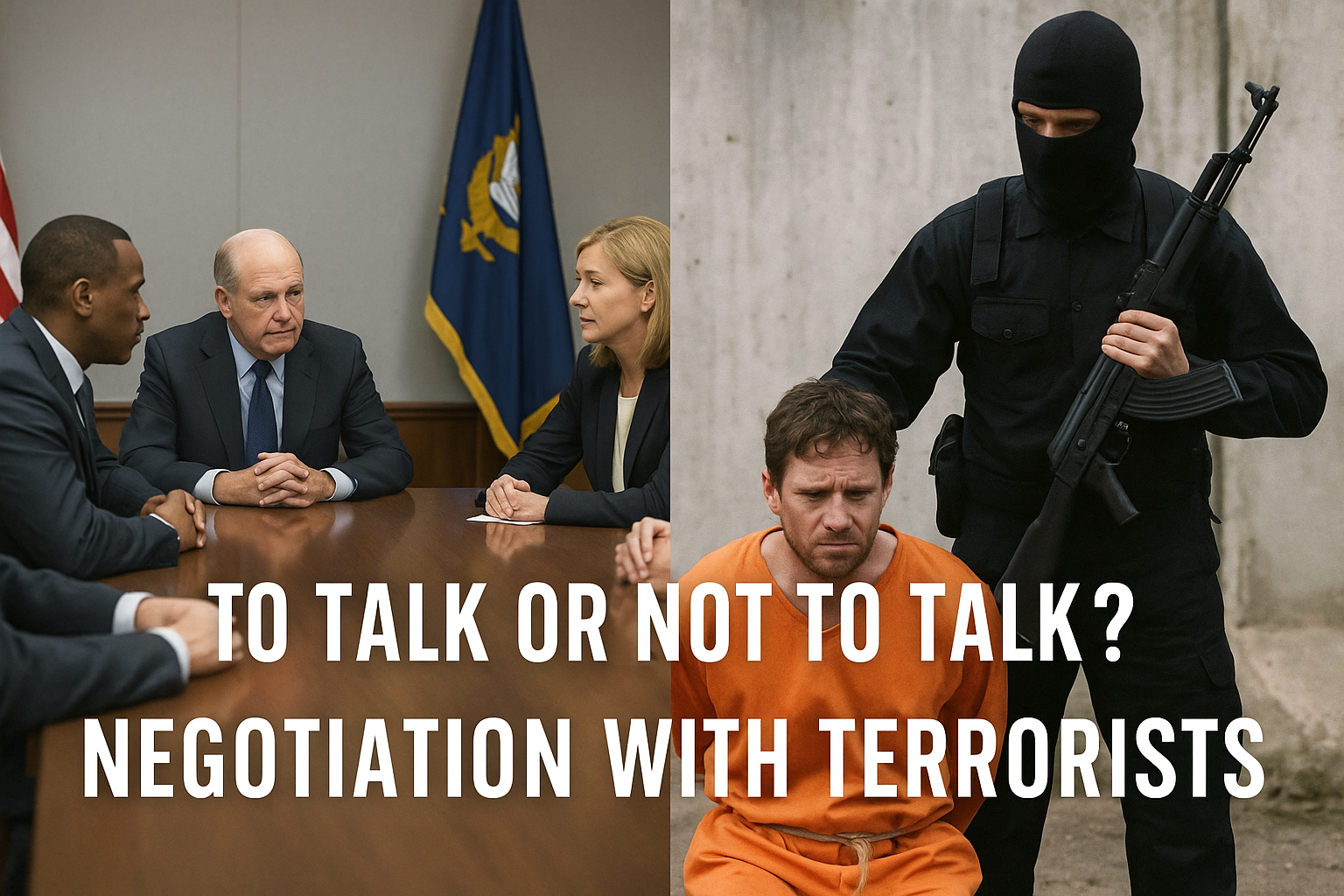
Photo Credits: Sabineb Sterk(AI)
To Talk or Not to Talk?”: The Global Dilemma of Negotiating with Terrorists
As we all know, Hamas took hostages and is using them to negotiate for the release of imprisoned terrorists and to end the war.
Israel has a sacred policy of “bringing everyone home,” but also holds the conviction never to negotiate with terrorists.
This presents a cruel dilemma: what Israel is facing is not just a strategic decision but a moral reckoning.
And whatever the outcome… in the end, there are only losers.
In a world marked by rising extremism and asymmetric warfare, the question of whether to negotiate with terrorists continues to stir passionate debate. Should governments ever sit at the table with those who use violence to achieve political aims? Can dialogue save lives or does it empower brutality?
While popular movies and political slogans often echo the tough stance of “We do not negotiate with terrorists,” reality is far more complex. In the background of many high-stakes global crises, secret deals, backchannel communications, and tactical negotiations unfold, all with the aim of preventing bloodshed, securing hostages, or minimizing broader conflict.
Let’s explore what the international rules say, what governments actually do, and why countries like Israel often find themselves at the center of this moral and strategic dilemma.
No Universal Law—But Many Rules
Contrary to what many believe, there is no single international law that outright bans negotiating with terrorists. The United Nations has passed numerous resolutions against terrorism (notably UNSC Resolution 1373), urging states to combat terror networks, prevent financing, and criminalize support.
Similarly, the International Convention Against the Taking of Hostages (1979) makes hostage-taking a punishable offense under international law. Yet, nowhere does it specifically prohibit negotiation. Rather, it emphasizes prosecution and prevention.
The international framework strongly discourages any action that would fund or legitimize terrorist groups but it leaves room for political discretion.
The “No Concessions” Principle
Countries like the United States, the United Kingdom, and Israel have long embraced a “no concessions” policy, a political commitment not to yield to terrorist demands.
The reasoning is clear:
- It prevents terrorists from gaining political legitimacy.
- It avoids incentivizing future kidnappings or attacks.
- It maintains moral and legal clarity.
Yet, despite the public rhetoric, even these governments have bent the rules when the stakes were high.
Reality Check: Negotiations Do Happen
Governments often negotiate indirectly through third parties such as the Red Cross, Qatar, Egypt, Norway, or the Vatican. These intermediaries allow democratic governments to maintain the appearance of principled consistency, while still pursuing practical outcomes; such as freeing hostages or achieving temporary ceasefires.
Notable Examples:
- Israel’s Deal with Hamas (2011): In a widely publicized and controversial exchange, 1 Israeli soldier (Gilad Shalit) was freed in return for 1,027 Palestinian prisoners, including many convicted of terrorism. The move drew criticism for setting a precedent, but for many Israelis, no price was too high for bringing a soldier home.
- U.S. Talks with the Taliban (2020–2021): Though the Taliban had long been designated a terrorist group, U.S. officials negotiated a withdrawal agreement that ultimately led to the fall of Kabul. Was it diplomacy or capitulation? Opinions vary.
- France and Ransom Payments: Investigative reports have revealed that European governments, including France and Italy, have paid ransom in exchange for citizens’ lives, often under the radar.
Legal and Moral Hazards
While some negotiations save lives, others may fuel terrorism:
- Funding terror: Ransom payments and concessions can provide terror groups with money and motivation.
- Moral erosion: Negotiating may signal weakness or legitimize violent tactics.
- Legal consequences: In some countries, offering “material support” to terrorist organizations, even as part of a negotiation, can be a criminal offense.
The U.S. PATRIOT Act, for example, prohibits any material support to designated terrorist groups, which can include ransom payments or logistical assistance.
Humanitarian Exceptions
Despite tough policies, many states make humanitarian exceptions:
- Allowing medical supplies into a war zone controlled by terrorists.
- Evacuating civilians via negotiated corridors.
- Agreeing to temporary ceasefires to prevent famine or disease.
These are often called “non-political negotiations” and are framed as life-saving measures, not as political deals.
The Israeli Experience: A Case Study in Complexity
Israel is often cited in this debate because of its unique position:
- Surrounded by hostile entities, including terror groups like Hamas and Hezbollah.
- A democratic society with deep moral concern for its soldiers and citizens.
- A target of international scrutiny, often accused of being either too hardline or too soft when it suits critics.
Israel’s official position is to not negotiate with terrorists, yet it has repeatedly made deals, sometimes painful ones, when it meant saving lives or ensuring national security.
The country walks a moral tightrope: upholding principles while facing the brutal realities of asymmetric warfare and hostage diplomacy.
Conclusion: No Easy Answers
Negotiating with terrorists remains one of the thorniest issues in international relations. There is no clear legal line—only a delicate balance between principle and pragmatism, security and morality.
In the end, each case is judged in its own context. And while it’s easy to declare “never negotiate,” those who face real terror, real hostages, and real consequences know: the answers are never simple…
Related Topics
Related Posts