Netanyahu Before His Judges :An Ancient Biblical Tradition ?
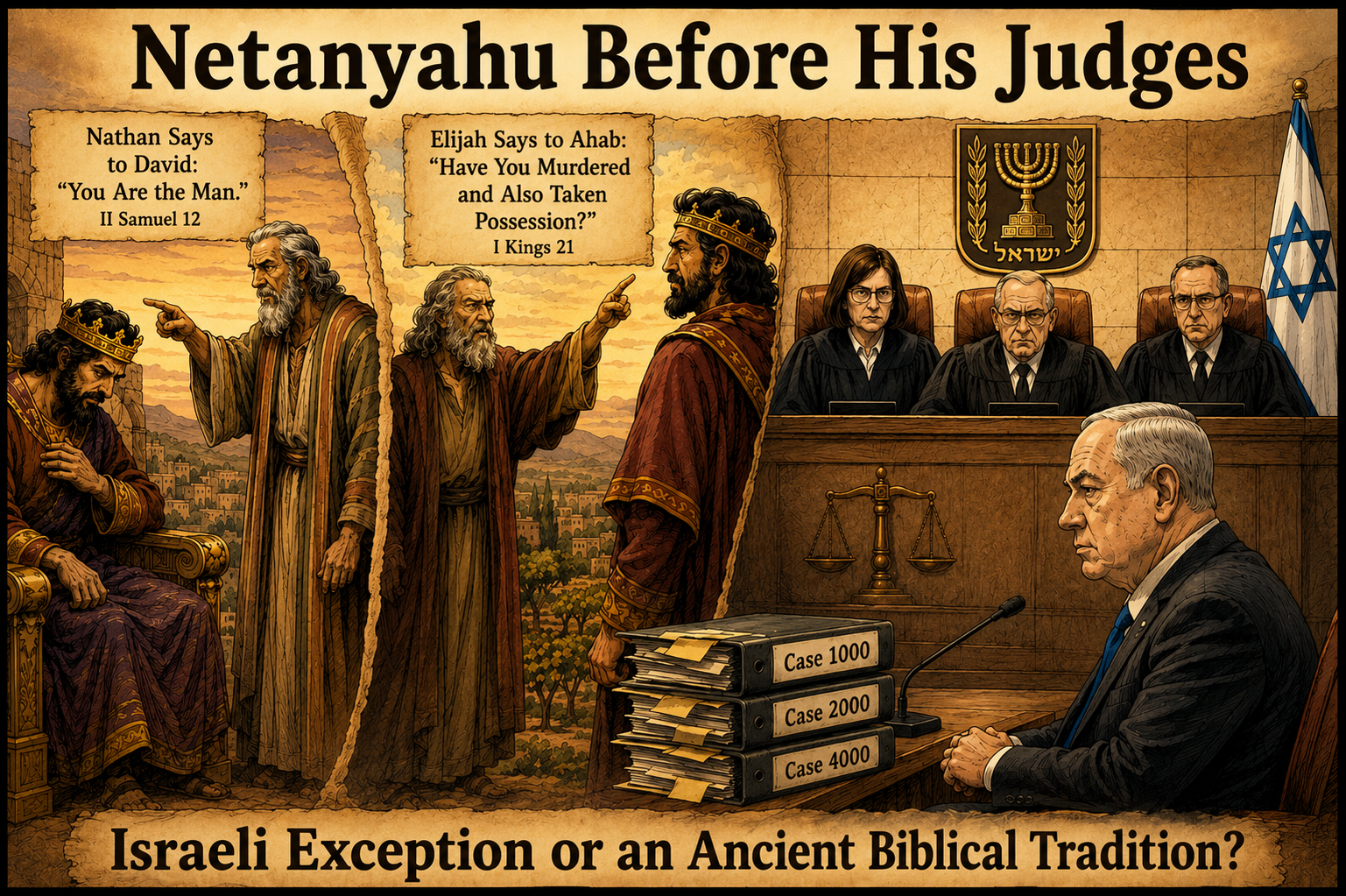
Benjamin Netanyahu’s trial is often portrayed as a democratic anomaly: a sitting Prime Minister appearing before a court while leading the country through a multi-front war, under the scrutiny of the entire world.
For nearly a decade, investigators, prosecutors, defense attorneys, and judges have devoted enormous resources to answering a question that is simple in its wording but extraordinarily difficult to prove: did the Prime Minister use his office to obtain private or political benefits?
The investigations began in 2016. The indictment was filed in 2019. The trial started in 2020. Six years later, no first-instance verdict has yet been delivered.
In most democratic countries, such proceedings against the head of the executive branch would have been suspended until the end of the leader’s term, either through temporary immunity or on grounds of political expediency. In Israel, nothing of the sort occurred.
The police investigated. The prosecution indicted. The judges are judging.
Whether one views Netanyahu as the victim of judicial overreach or as a leader who must answer for his actions, one fact remains: few democracies would have allowed their law-enforcement and judicial institutions to devote so much energy, time, and resources over nearly a decade to examining the conduct of a sitting head of government.
Critics of the trial see it as evidence of a judicial establishment driven not only by legal considerations but also by a desire to influence the country’s political future. Its defenders argue the opposite: that it demonstrates that no public official, however powerful, stands above the law.
Netanyahu’s supporters point to weaknesses that emerged during the proceedings — at times hesitant testimony by key state witnesses, disputes over the chronology of the central meeting in Case 4000, inconclusive discussions in Case 2000, and debatable interpretations of the gifts involved in Case 1000 — as proof that no unlawful exchange of favors has been established beyond a reasonable doubt.
The prosecution replies that the strength of its case does not rest on a single piece of evidence or a decisive witness, but on the convergence of numerous indications whose significance the judges must now assess.
The case also reveals the extraordinary independence of Israel’s police and prosecutorial authorities from political power. In many countries, such an investigation would never have begun or would have been quietly buried. In Israel, it flourished.
Yet this independence raises a broader question about the balance of powers. While the judiciary must be sufficiently independent to investigate the powerful, it must also remain conscious of its responsibilities and act with diligence, proportionality, and restraint.
A legal proceeding that stretches over ten years inevitably raises a legitimate question: does justice still fully serve democracy when it becomes a major source of political paralysis?
At the center of this seemingly endless judicial process stands Netanyahu himself, whose conduct has also attracted attention. He is not a nervous or aggressive defendant, but a calm, methodical, and remarkably disciplined one. Hearing after hearing, he disputes the facts, admits no wrongdoing, criticizes investigative methods, and challenges certain conclusions reached by the prosecution. Yet he continues to appear before the court and has never questioned the legitimacy of the judges’ authority to try him.
His attitude recalls an ancient feature of the Hebrew political tradition.
In most ancient civilizations, the ruler stood above the law. In the Bible, he is subject to it.
King David is confronted and condemned by the prophet Nathan. King Ahab is denounced by Elijah.
The king is not above the law; he remains accountable to an authority greater than his own power.
Of course, the judges sitting in the Jerusalem District Court are neither Nathan nor Elijah. We are no longer in the realm of prophecy but in that of modern criminal law. Yet the same intuition runs through the centuries: power does not exempt one from accountability.
Perhaps that is Israel’s true singularity. Not that a Prime Minister can be tried, but that a Prime Minister can be tried while governing, by institutions independent enough to prosecute him and legitimate enough for him to accept their authority.
But a democracy is not measured solely by its ability to hold the powerful accountable. It is also measured by its ability to do so within a reasonable time.
History may ultimately remember this singular image: a head of government directing a war on multiple fronts, negotiating with world leaders, and appearing before his judges several times a week, while a significant portion of Israel’s police and judicial apparatus remains mobilized for nearly a decade to determine whether the exercise of power crossed the boundaries of legality.
To some, this image reflects a model democracy. To others, it reflects a system that has lost its sense of proportion.
Yet all will acknowledge that it has few, if any, equivalents in the contemporary democratic world.