
Netanyahu blaming Biden is a lie and an audacious act of ingratitude
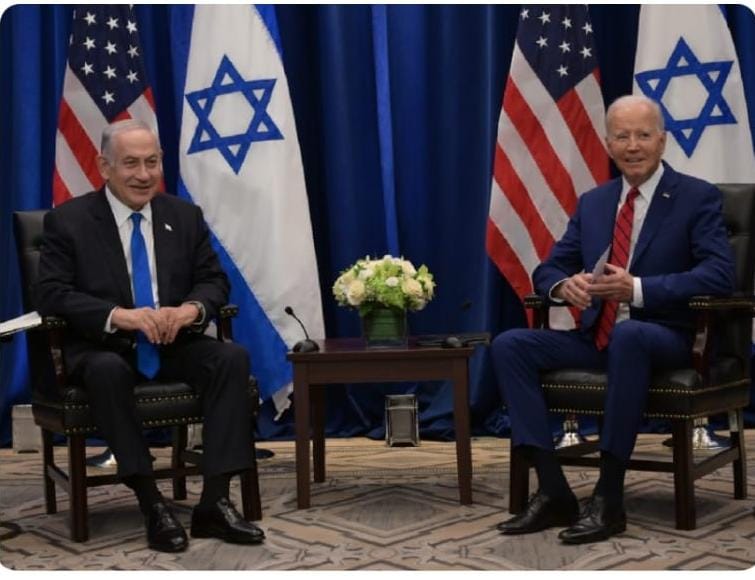
In preparation for this year’s elections, Prime Minister Netanyahu is crafting an alternative history regarding his responsibility for the October 7 massacre and also concerning the steadfast support that the Biden administration provided to Israel in its most difficult moments over the past two years.
Netanyahu’s claim that Israeli soldiers were killed due to an “embargo” imposed by the Biden administration represents a new peak of cynical falsehood – even by Netanyahu’s very low standards. President Biden’s immediate mobilization at the outset of the war, his famous “Don’t” speech warning Iran and Hezbollah against intervention, the deployment of US aircraft carriers to the region, and above all, the massive airlift of American weaponry – amounting to more than $20 billion – helped save us all. But facts have never troubled Netanyahu, as he seeks to build an “Israeli Sparta,” while also scoring points with Trump, who is eager to indulge yet another lie about his predecessor.
The reality, however, is the opposite. While the Biden administration provided Israel with unprecedented levels of military assistance, delaying only a single shipment of heavy bombs out of concern they could lead to a humanitarian disaster in the Rafah area of Gaza, the Trump Administration is leading US-Israel relations toward the reduction and potentially complete termination of US foreign aid to Israel. Just as the Obama administration signed the largest aid agreement in history, the Trump approach points in the opposite direction.
In a recent interview with The Economist, Netanyahu announced his desire to lead a process toward ending US military aid to Israel. He framed this as a decade-long process, but shortly after the interview was published, Senator Lindsey Graham, chair of the Senate Appropriations subcommittee overseeing US security assistance and widely regarded as a strong supporter of Israel, tweeted that he intended to act quickly to accelerate the termination of US military aid to Israel, faster than Netanyahu himself had proposed.
For decades, the United States has provided Israel with billions of dollars – around $4 billion annually since the most recent and largest aid agreement signed under the Obama administration. The primary purpose of these funds is to purchase American military systems. This annual assistance has been supplemented by special grants after each major military campaign and, of course, by the unprecedented support provided during the Gaza war.
US military aid to Israel began in the late 1970s under the Carter administration as part of the Camp David Accords, alongside aid to Egypt. Its purpose was to provide security guarantees and incentives to reinforce fragile peace agreements. That era has long since ended. Today, both Israel and Egypt have independent reasons to preserve the peace treaty.
Meanwhile, Israel’s GDP per capita is comparable to that of America’s wealthiest democratic allies – countries such as France, Germany, the United Kingdom, and Japan. As a result, there is a growing bipartisan sentiment in the United States that Israel does not need $4 billion a year in subsidies from American taxpayers to purchase weapons, particularly when many Americans struggle to afford health insurance and higher education.
Providing Israel with military aid on a scale significantly greater than that given to any other country places a political and public spotlight on the US-Israel relationship and on the nature of American security assistance, especially during periods when Israel treats that aid as a “blank check” – sometimes in ways that run counter to US interests. The focus is not on military cooperation or the critical security partnerships vital to Israel’s defense, but rather on the end of the assumption that such support will be cost-free, as it partly was in the past.
I am not in the habit of praising Netanyahu, but this time it appears he recognized the trends in the United States and chose to announce the move himself before it became an imposed dictate. As a reminder, Netanyahu was also the one who declared in 1998, during his first term as prime minister, that Israel did not need US civilian aid, a wise move at the time.
Up to this point, the logic is sound. Alongside it, however, there is also hypocrisy. When I saw Graham’s tweet, I wondered what would have happened had this issue arisen during the Biden or Obama administrations, or if Kamala Harris were president. We witnessed Netanyahu’s incitement against the Biden administration throughout the war, and even more so now – would he have rushed to claim credit for ending US aid under a Democratic administration? Probably not.
According to reports, Netanyahu arrived at his meeting with Trump at Mar-a-Lago in late December, deeply concerned that a new 10- or 20-year memorandum of understanding involving billions in security assistance would not receive support. Trump is not known for opening his wallet to allies – Ukraine is a case in point. Whether Netanyahu was told explicitly that the aid was over, or whether he preemptively adjusted his position, what is clear is that he feared being embarrassed by Trump and therefore chose to take a central pillar of US-Israel relations off the table.
For years, critics argued that ending military aid would harm Israel and constitute an anti-Israel move. Yet now an Israeli prime minister and a Republican senator who brands himself “pro-Israel” are effectively saying the opposite: Israel does not need it – and the move is being met with silence from within Israel and from the Jewish establishment.
What does this say about us? We bitterly criticize Democratic administrations for their cautious and considerate use of leverage, yet we warmly embrace Republican leaders who impose politically inconvenient measures on our government. This contradiction appears to be connected to the large public in Israel that seems to admire strongman leaders who scorn democratic values and human rights.
What is now required is a courageous statement from leaders of the liberal camp, confronting Netanyahu’s lies and demanding a serious discussion of the implications of reshaping the US-Israel security relationship. The liberal camp must also present a vision for the post-US aid future. Ending the aid may be an essential step –- but only if it is done in a way that strengthens Israel rather than weakens it.