
Netanyahu Can Lose and Still Win
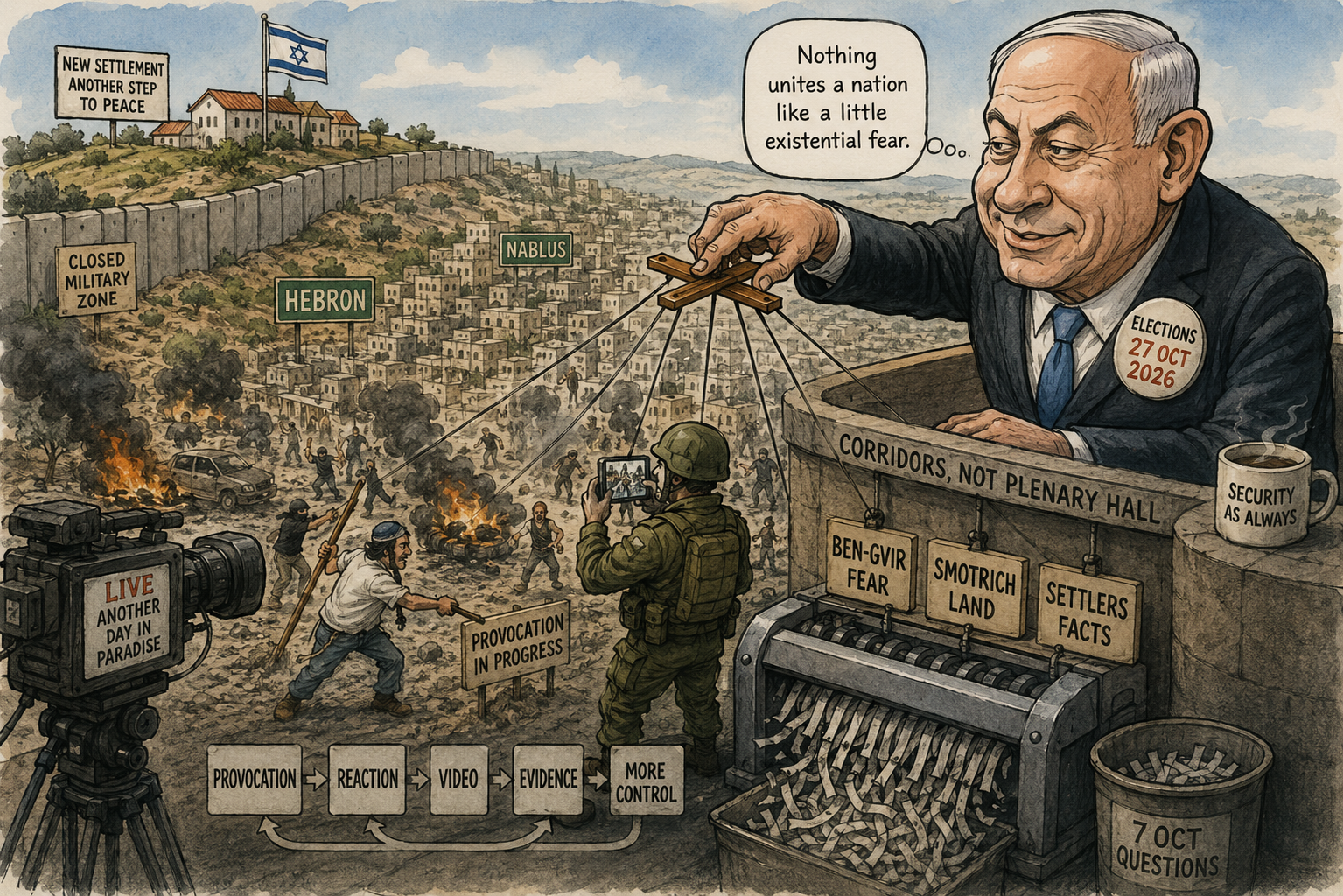
Israel is approaching the October 27 election under conditions of unusual political uncertainty. Likud is under pressure, Netanyahu has no guaranteed path to a majority, and the governing bloc depends on partners whose interests are increasingly difficult to reconcile. At the same time, the West Bank is becoming more volatile: settler violence is intensifying, Palestinian communities are under growing pressure, and politicians on the Israeli right are trying to consolidate territorial and institutional changes before the election. The temptation is to ask whether Netanyahu wants another intifada. But the more disturbing possibility is that escalation may matter less because it could save Netanyahu personally than because it can determine the political field in which even his opponents are forced to compete.
The serious question is therefore not whether one politician secretly desires escalation. There is no basis for claiming that Netanyahu is planning an intifada. The more useful question is what happens when several political actors, for different reasons, discover that escalation serves them better than restraint. Smotrich needs the settler right and is fighting for political survival. Ben-Gvir needs confrontation because confrontation is not merely one of his themes; it is his natural habitat. The settler movement needs time, territorial momentum and facts that become harder to reverse. Netanyahu needs a viable right-wing bloc and eventually 61 seats. No conspiracy is required. Alignment is enough.
If settler pressure increases, if enforcement remains selective, if Palestinian communities react, and if that reaction is then presented as proof that the original security narrative was correct, an efficient political loop appears. Provocation produces reaction, reaction produces evidence, evidence justifies control, and control produces further reaction. Everyone can then claim to be merely responding to the previous stage. Responsibility circulates, while political utility remains remarkably stable.
What makes this more than an abstract scenario is that the security establishment itself is warning about the danger. According to recent reporting, senior IDF officials have warned that the West Bank is approaching a point at which continued settler violence, illegal outposts and weak enforcement could trigger a broader Palestinian response. That matters because it identifies the mechanism without requiring speculation about secret intentions. The risk is not simply that violence exists, but that tolerated or insufficiently restrained violence can generate the very reaction that later becomes evidence for harsher control.
This is where the election matters. An intifada would not merely be a security disaster; it could change the subject of the campaign. Without major escalation, Israeli voters can ask about October 7, the conduct and duration of the Gaza war, the burden on reservists, the Haredi draft crisis, economic pressures, institutional damage and governmental responsibility for catastrophic security failure. With a major uprising in the West Bank, the political vocabulary changes. The question becomes simpler, older and much more comfortable for Netanyahu: who will keep Israel safe?
Netanyahu does not need voters to forget October 7. He only needs another question to become more urgent than the question of responsibility for October 7. For decades, he built his political identity around security, deterrence, existential threat and the claim that only a hard-headed realist understands what Israel faces. A new intifada would not necessarily restore his reputation, but it might restore his preferred political grammar. Elections are often decided not by who has the strongest answer, but by who succeeds in deciding which question is being asked.
Recent developments suggest, however, that even this argument may be too narrow. Gadi Eisenkot, one of Netanyahu’s most serious electoral competitors, has rejected the establishment of a Palestinian state under a government he would form. That does not make Eisenkot another Netanyahu, nor does it erase substantial differences over institutions, governance, the far right or responsibility for October 7. Precisely because those differences remain real, the convergence on the Palestinian question is politically revealing. It suggests that the security-centered grammar of the election may already be shaping not only Netanyahu’s strategy but also the limits within which his opponents believe they can safely oppose him.
The coalition arithmetic makes this even more revealing. Eisenkot is attempting to construct a route to government that could remove Netanyahu even without a conventional majority, while much of the Zionist opposition remains unwilling to depend openly on Ra’am. When Mansour Abbas presented Palestinian statehood as part of the political horizon of a future change bloc, Eisenkot responded by explicitly rejecting that horizon. This is not merely a shift in rhetoric. It shows how the structure of the electoral field can force Netanyahu’s opponents to demonstrate that they remain within boundaries largely defined by the right even when their central political objective is to replace him.
This introduces a more consequential possibility. Netanyahu may not need to win the election if he succeeds in determining the range of answers that remain politically admissible after him. A political order can survive the politician who helped construct it. The more opposition figures feel compelled to prove that they are not “to the left” of Netanyahu on the Palestinian question, the less the election becomes a contest between genuinely different political horizons. It becomes a competition over who can administer an increasingly similar strategic framework more competently.
There may still be profound differences between a government led by Netanyahu and one led by Eisenkot. One may be less dependent on Ben-Gvir and Smotrich, more respectful of institutions and more capable of restoring damaged relations inside Israeli society and abroad. Those differences matter. Yet a change in governing personnel is not necessarily the same thing as a change in political direction. If settlement expansion, territorial fragmentation and rejection of Palestinian sovereignty increasingly fall outside the range of serious electoral disagreement, then Netanyahu’s political legacy may become strongest precisely when his personal power becomes weakest.
The E1 project makes this problem material rather than merely rhetorical. The government has opened bidding for more than 1,200 housing units in E1, with bids due on October 19, just eight days before the election. Critics have described the move as an attempt to bind the hands of the next government. That formulation captures the deeper issue. A departing political order can shape the future not only by normalizing a language of security and sovereignty, but by altering the territorial and institutional conditions under which its successor will be forced to govern.
This is why the West Bank is not merely another campaign issue. It may be functioning as a mechanism that selects which positions can survive inside the Israeli political mainstream while simultaneously narrowing the practical range of choices available after the election. Escalation intensifies fear, fear increases the electoral cost of appearing conciliatory, and that cost pushes competitors toward harder positions. Territorial changes then translate that narrowing of political language into faits accomplis. The result is not merely a rightward campaign. It is a shrinking field of future possibility.
Political analysis must therefore look beyond intention. Corridors matter more than plenary halls. One should watch which settler actions are stopped and which are tolerated, which investigations disappear, which powers are transferred between police, military and civilian authorities, which warnings emerge from the security establishment and which phrases suddenly begin appearing across speeches, interviews and campaign messaging. The relevant question is not whether one person gives one order, but whether the political system begins rewarding behavior that moves many actors in the same direction.
Escalation can become politically useful without ever becoming formally declared policy. It does not require a mastermind; it requires incentives, permissive conditions and actors capable of recognizing opportunity. One group may seek territorial gain, another electoral mobilization, another institutional control and another political survival. Their motives need not be identical for their actions to become mutually reinforcing. Once the system begins rewarding the same direction of movement, intention becomes less important than structure.
Can an intifada save Netanyahu? Perhaps not. It could deepen Israel’s isolation, radicalize another generation of Palestinians, expand military commitments and create consequences no government can control. Politically, however, it could change the subject of the election, consolidate the right, increase the value of its most radical partners and move public attention from governmental responsibility toward external threat. More importantly, it could force Netanyahu’s competitors to prove that they remain safely inside a narrowing consensus on the Palestinian question while inheriting territorial realities that are increasingly difficult to reverse.
The most alarming scenario is therefore no longer merely that escalation could become more useful to Netanyahu’s coalition than restraint. It is that escalation, political convergence and territorial preemption may together determine the terms on which Netanyahu’s opponents are permitted to oppose him. A prime minister can lose an election and still leave behind the political grammar and material constraints in which his successor must govern. If that is what is happening, October 27 will decide more than who replaces whom. It will show whether Israel can still change political direction, or merely change the personnel administering it.
Yochanan Schimmelpfennig