A Moroccan Journalist
Netanyahu Has Reduced His Country to a Militia With a Flag
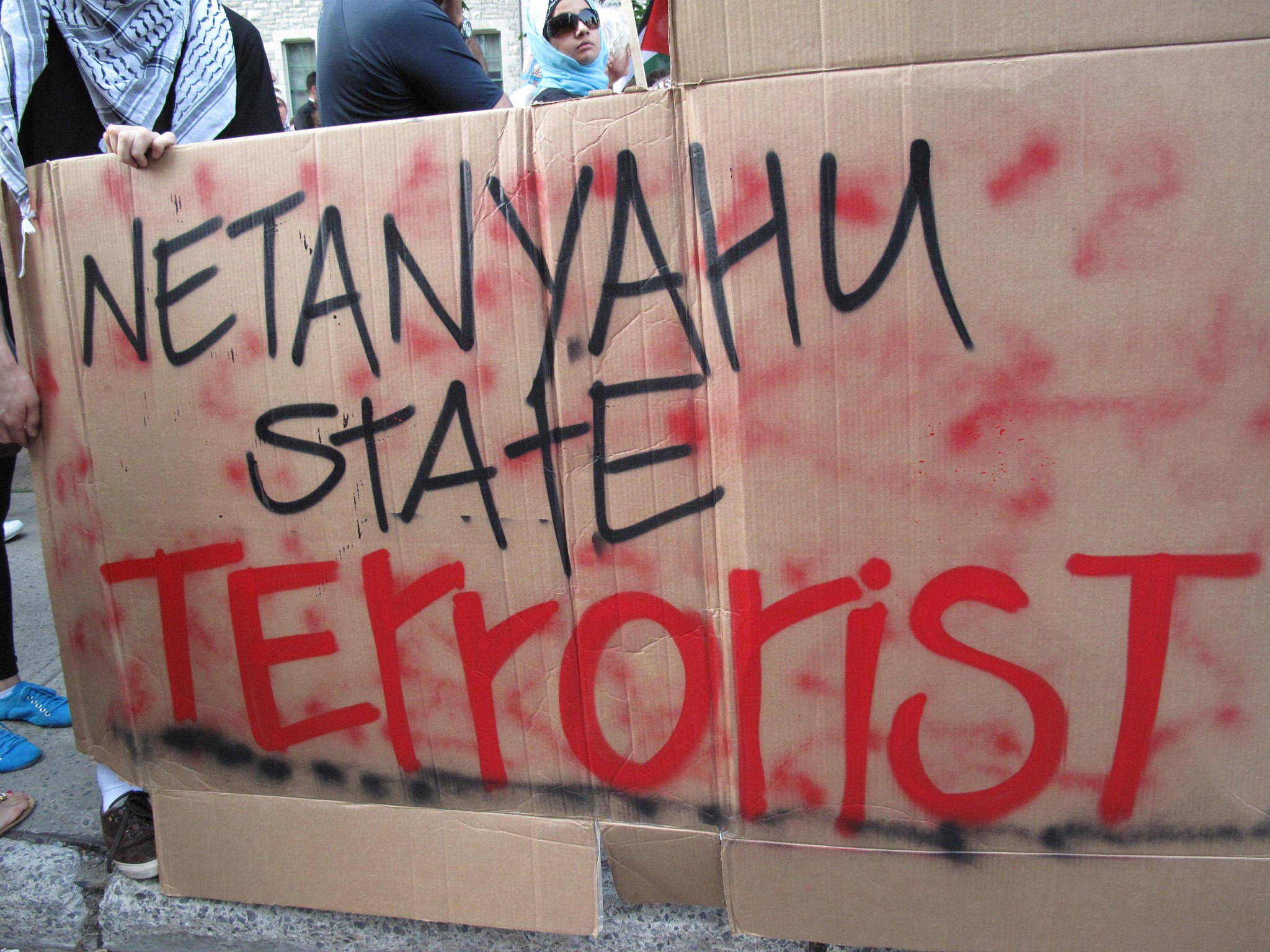
Protesters brandish a cardboard sign denouncing Netanyahu as a “state terrorist” during a street demonstration. (Rebecca W/Flickr)
Israel today projects itself as a besieged democracy, yet its actual conduct illustrates the opposite: a state increasingly unrestrained, methodically ravaging the region under the cover of permanent war. Gaza remains the epicenter of destruction, but the pattern has widened: West Bank incursions, assassinations in Beirut, strikes on Damascus, provocations in Baghdad, interventions in Yemen, and, most recently, targeted operations stretching to Doha itself, a move that shocked even those Arab capitals that had grown accustomed to Israel’s “long arm” tactics.
What may seem like disparate escalations are in reality deeply connected, forming a deliberate architecture of deflection. By constantly opening new theatres of tension, Israel diverts global and domestic attention away from Gaza, ensuring that the campaign there continues unabated while international focus is scattered across multiple crises. It is less a policy than a doctrine of dispersal: keep the fires burning everywhere so that no single inferno dominates world attention.
This approach reflects a long-standing tradition of instrumentalizing war for internal political survival. Netanyahu epitomizes this logic: every time negotiations inch close to securing a breakthrough on hostages, or when there appears to be momentum toward ending the Gaza war, an “unexpected” provocation or escalation conveniently collapses the process. It is a pattern too systematic to be accidental. In truth, Netanyahu knows that if the war ends, so does his career. Conflict is not merely a strategy, it has become the condition of his political existence.
As a Moroccan, the closest example I can think of is Algeria’s unrelenting fueling of the Western Sahara dispute. For decades, Algeria has used the conflict not out of love for the Sahrawi people or belief in principles of self-determination (the same principle it denies to the Kabyle people), not as a path toward justice or even strategic depth, but purely as a mechanism of regime preservation. Should the conflict vanish, the internal fragility of the Algerian system would stand exposed.
Likewise, Israel’s Likud party has long perfected the art of external diversion. Faced with deepening internal fractures, corruption scandals, and popular discontent, Likud consistently seeks to shift the national conversation outward. By framing existential threats and magnifying foreign enemies, it attempts to channel public frustration away from domestic crises and toward manufactured battles of “national survival.”
This tactic is neither novel nor unique. Spain’s far-right Vox party, for instance, thrives on fueling division, its relentless hostility toward Morocco cloaked in the language of hardline nationalism and anti-immigration rhetoric. Vox weaponizes Morocco as a convenient scapegoat to rally discontented voters, a mirror image of how Likud stokes fear to deflect from its own governance failures.
In both cases, the strategy is transparent: demonize the external “other” to consolidate internal control. Yet far from strengthening legitimacy, such politics of fear and distraction only reveal weakness. They expose governments and parties unable – or unwilling – to provide constructive solutions, relying instead on perpetuating conflict to ensure their own survival. Netanyahu’s calculus is a mirror image: perpetual war is not meant to secure Israel, it is meant to secure Netanyahu.
The alarming part is that this is not the maneuvering of one man in isolation. Israel’s broader political, military, and even cultural elite have normalized this paradigm. If the political establishment tolerates a leader willing to immolate Israel’s moral standing and global reputation to save his skin, then the state ceases to be an outpost of Western democracy and increasingly resembles the very “Third World dictatorships” it derides. The claim that Israel is a beacon of democracy in the Middle East collapses when the elite choose complicity over resistance.
What emerges instead is the anatomy of a garrison-state: a polity where militarism is normalized, dissent is marginalized, and existential crisis is manufactured as a form of governance. In such conditions, the narrative of exceptionalism erodes. The Holocaust, once the ultimate symbol shielding Israel from global criticism and a moral rampart that commanded near-universal sympathy, increasingly fails to function as moral currency outside Western elite circles.
For younger generations across Europe and the United States, the Holocaust is history, not memory. Their moral reflexes are instead shaped by the language of contemporary justice, human rights, and anti-colonial struggles. The paradox is clear: Israel invokes history to justify its present, but the future generations who will shape foreign policy interpret Israel’s present as an unjust repetition of settler-colonial violence.
This generational break intersects with Israel’s tactic of multiplying fronts. By escalating in Lebanon, by striking in Damascus, by assassinating figures in Baghdad, or by provoking Yemen and now even threatening Doha, Israel engages in a cynical dispersal strategy. The world’s attention is forced to chase multiple flashpoints, while Gaza – where Israel’s actions amount to collective punishment on a massive scale – remains under a cloak of distraction. It is a choreography of permanent distraction: when one theatre cools, another is ignited, so that Gaza never becomes the sole object of global outrage.
Yet this is not only an external maneuver. Inside Israel, Jewish unity and the sanctification of the IDF function as ideological glue, with the far-right majority reading each new escalation as a reaffirmation of national strength, a renewal of sacred unity around the military, and a vindication of their worldview. Driven by global isolation and mounting demands for the release of hostages, polls show that the Hebrew state’s population has lost much of its trust in the government. Nonetheless, Netanyahu still retains a stable base – sustained not merely by religious zealots but by a national culture steeped in militarized socialization.
For decades, Israeli schools, media, and political discourse have embedded the notion that militarism is not an aberration but a constitutive part of Israeli identity. It is why even so-called “moderate” governments collapse so quickly; the Bennett-Lapid coalition between 2021 and 2022 lasted barely over a year before disintegrating under pressure. Israeli politics rewards escalation, not compromise. The electorate itself has been socialized to prefer maximalism, producing a democracy that votes again and again for war – returning Netanyahu, the embodiment of the war state, to power in late 2022.
To understand the depth of this structure, one must recall Israel’s history of manipulating Palestinian divisions. It is often overlooked and few acknowledge it openly, but Israel itself facilitated the rise of Hamas in the 1980s as a counterweight to Fatah, deliberately fueling Palestinian factionalism. The intention was simple: a divided Palestinian body politic weakens the possibility of unified resistance and allows Israel to always claim there is “no partner for peace.”
This Machiavellian approach has borne bitter fruit. Today, Palestinian division is Israel’s most useful justification for permanent war – a convenient pretext for ongoing war and a mechanism for sustaining the status quo. In practice, this fragmentation serves to prolong the conflict, consolidate the far-right’s hold on power, and allow Netanyahu to maneuver between crises, and ensures that the “war footing” remains the default mode of governance.
It provides the alibi that negotiations are futile and simultaneously validates the far-right narrative that “security” must always take precedence. Yet here lies the ultimate irony: what Israel once nurtured as a tactic has metastasized into both a justification and a nemesis. Hamas – once deliberately tolerated and indirectly strengthened by Israeli policy – is both the indispensable enemy and the perfect excuse, keeping Israel trapped in a cycle of conflict it cannot escape without unraveling its own political logic. What began as a short-term strategy of divide-and-rule has hardened into a structural necessity for Israeli governance, a poisoned chalice that guarantees endless war.
The historical trajectory makes clear that Israel is drifting toward strategic pariahdom. Tactical agility has long masked strategic decay. Israel may still strike deep into Damascus, assassinate militants in Beirut, or project force across the Red Sea, but the real battlefield is legitimacy, and there it is hemorrhaging ground. The late historian Tony Judt once warned that without a profound change of course, Israel was designed to become a pariah state. The current dynamics confirm the prophecy. Tactical gains – whether normalization deals with Arab regimes or short-term security arrangements – are ephemeral and do not alter the deeper erosion of legitimacy.
Israel can sign accords in Abu Dhabi, Riyadh, or Rabat, but it is losing the one arena that matters most in the long run: global civil society. On Western campuses, in Latin American movements, across African public opinion, Israel is increasingly seen not as a democracy under threat, but as an aggressor insulated by American power. Symbols matter in international politics, and by continuing to rely on the Holocaust as a shield while inflicting suffering upon Palestinians, Israel undermines the symbolic capital upon which its foreign policy once rested.
The most recent Israeli operations, stretching even to Doha, epitomize the dangers of this path. Qatar, long a mediator in hostage talks and a central actor in regional diplomacy, was targeted in rhetoric and action that amount to direct intimidation. By undermining Doha, Israel not only jeopardizes the only real channel through which hostages might be released but also signals to the region that no space, however diplomatic, is safe from its reach. This reckless extension of the conflict proves once again that for Netanyahu, escalation is not a means to an end, it is the end itself.
Thus, the conclusion is unavoidable: Israel ravages the region not because it must, but because its internal political architecture demands it. Netanyahu’s personal survival, the far-right’s ideological hegemony, the cultivated divisions among Palestinians, and the normalization of militarism as identity all combine into a system where war is no longer exceptional but permanent. This makes instability not a byproduct but a political necessity.
This system may produce tactical agility – strikes here, assassinations there, distractions everywhere – but strategically it hollows out Israel’s legitimacy and accelerates its descent toward isolation. In the language of international relations, Israel is burning through its “normative capital,” and once that is depleted, hard power alone cannot sustain legitimacy.
In the end, the gravest danger to Israel is not external enemies, but its own addiction to war as a mode of governance. A state that cannot imagine peace except as surrender will find itself trapped in perpetual conflict, consuming its own moral foundation, until nothing remains but the shell of a nation that once claimed to be a democracy.
Shortly put: Israel survives on the politics of blood!
Related Topics
Related Posts