London based entrepreneur, cybersecurity analyst doing a PhD in AI
Never Again. For Anyone.
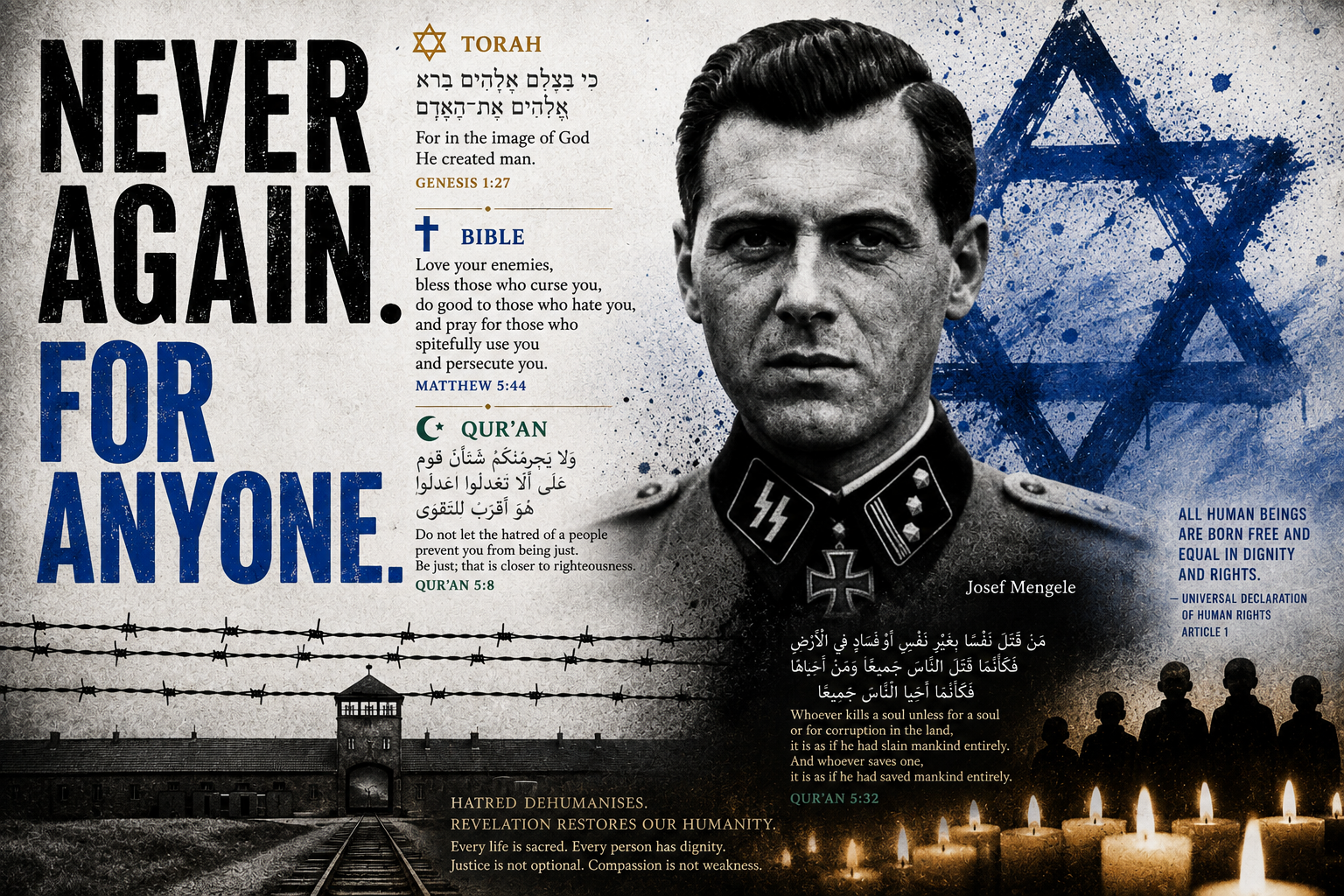
Josef Mengele, Eugenics and What Happens When Science Loses Its Moral Conscience
There is something unsettling about photographs of Josef Mengele.
He does not look like a monster.
He looks educated. He smiles. He looks kind, in some images goofy. A kind doctor, who I would imagine if I was a child and I walked into his chamber, he would give me a lollipop after a vaccine. Someone who looks benevolent. Someone who looks caring.
Because he was. Only the educated part. The rest, he was a monster. A monster more insidious because he didn’t look the part.
The physician who became known as the “Angel of Death” at Auschwitz held doctorates in medicine and anthropology. He studied human genetics, worked within respected academic institutions and participated in the scientific culture of his age.
What nobody can deny is that many leaders like this exist today who are incredibly “seductive” in their speech. He or she will openly tell you – he or she is about to kill a few more 100s or 1000s of people – and have an eloquent justification for it.
And they have been able to consistently “slip under the radar” of enough people for long enough – that many people still revere him or her.
Many of these leaders have a firm stance on some moral issues. Hitler was a great orator as well, doesn’t change what he did. Stalin leapfrogged Soviet Innovation – doesn’t change what he did. Mao organised Chinese society – doesn’t change what he did. And I am going to go out on a limb and say Churchill was a great orator and a great leader. Doesn’t change what he did with regards to the Bengal famine. I am British, and my family comes from Bengal. I will never forgive Churchill for what he did to my part of India.
My reasoning for that is not that Churchill prioritised British life or WW2. It was that India, and Bengal, being the rice bowl of India, kept their social contract towards the empire. If they had caused strife, broken order, caused public rebellion – it’s a whole different issue. These were hard working, honest people, who were still left to die after their productive output was siphoned off somewhere else. And Churchill’s correspondence simply shows disdain for the people, not any moral reasoning.
On a personal note, my grandmother moved from what is now Bangladesh to India during partition, and was alive during the Bengal famine. She would often say, that people were “dropping like flies” on the street. People wouldn’t beg for rice – they would beg for the froth – the water when rice is being cooked. However, this is still an “unpopular opinion” in the UK. Because somehow, these societies still worship “power” and “might” more than “truth and justice”.
Nazism combined several dangerous forces: ancient antisemitism, racial ideology, propaganda, bureaucracy, technological organisation and pseudoscience.
The hallmark of these “institutions” – is there is apparently some “hidden great knowledge” which cannot be tested empirically, examined, but need to be taken at face value because some “great leader” told us so. Islam, Judaism and Christianity are different. They are held to account on standard which is transparent.
Indeed, there were times during the life of Prophet Muhammad saws when he was corrected by God.
ʿAbasa — Qur’an 80:1–10. The Prophet ﷺ was speaking to prominent Quraysh leaders when the blind believer ʿAbd Allāh ibn Umm Maktūm approached seeking instruction. The Prophet ﷺ frowned and turned away, and Allah corrected him: “He frowned and turned away because the blind man came to him…” The passage redirects attention from powerful people toward the sincere seeker.
These contemporary great leaders always wear a nice crisp suit, a tie, speak not saying “I will analyze the data”, “I will consult and try and come up with the best solution” but “this is the truth” and “you will follow me because I am protecting you”. No you are not – you are tanking the economy; and raising gas prices for everyone.
There’s 3 prominent such people (leaders) who I am not mentioning here due to political sensitivities – but we all know who these 3 are causing unnecessary bloodshed.
In Nazi Germany, Human beings increasingly became categories.
Jew.
Roma.
Disabled.
Aryan.
Hereditary burden.
Racially valuable.
Racially undesirable.
This is one of propaganda’s most dangerous achievements.
First change the noun. Then change what may be done to the person behind it.
A child is difficult to murder.
An “inferior specimen” is easier.
A neighbour is difficult to deport.
A “racial threat” is easier.
A disabled person evokes compassion.
An economic “burden” becomes something bureaucrats can calculate.
Approximately 400,000 people were forcibly sterilised under Nazi Germany’s hereditary-health policies. What began as supposedly scientific management of reproduction ultimately existed within the same ideological world that produced mass murder.
Mengele therefore represents something much larger than one monstrous doctor.
He represents what happens when:
“What can we learn about this human being?”
quietly becomes:
“What are we entitled to do to this human being?”
There must be something between those questions.
A moral boundary.
B’Tzelem Elohim
Judaism begins somewhere radically different.
Genesis does not begin human anthropology by separating Aryan from Jew, healthy from disabled, intelligent from unintelligent.
It begins with Adam.
With humanity.
And with an extraordinary proposition:
“God created mankind in His own image.”
Genesis 1:27
The Jewish concept of b’tzelem Elohim — humanity created in the image of God — places human dignity before the state.
An important theological note: Muslims believe that God created Adam, but the Qur’an does not describe humanity as being created “in the image of God” in the manner expressed in Genesis 1:27. Islam maintains an absolute distinction between Creator and creation: “There is nothing like unto Him” (Qur’an 42:11).
The Qur’an nevertheless places itself within the same history of revelation. It confirms the divine origin of the Torah and the Gospel and repeatedly honours the prophets who preceded Muhammad ﷺ, including Abraham, Moses and Jesus. At the same time, Muslims believe that the Qur’an is the final revelation: it confirms what came before it while serving as a muhaymin—a guardian, criterion and final authority over previous scripture (Qur’an 5:48). Where earlier religious law differs from the final Qur’anic dispensation, Muslims therefore follow the Qur’an and the authentic teachings of Muhammad ﷺ as the governing standard.
Before citizenship.
Before intelligence.
Before productivity.
Before race.
The state did not create that dignity.
Therefore the state cannot legitimately revoke it.
And if Judaism is not a path to salvation for all, for Jewish people only, a Just God cannot just leave everyone else to “go to hell” because they were born from the “wrong parent”. Therefore dignity for all people is a reasonable conclusion to make.
The laboratory did not create it.
Therefore the scientist cannot measure it away.
The Torah then makes the principle extraordinarily practical:
“The stranger who resides with you shall be to you as the native among you, and you shall love him as yourself.”
Leviticus 19:34
The stranger is precisely the person tribal instinct encourages us to place outside our moral circle.
The Torah commands the opposite.
Bring him inside it.
What If You Hate Them?
The Qur’an addresses an even harder question.
What happens when the other person is not merely a stranger?
What happens when you hate them?
The Qur’an does not pretend human beings never experience animosity. Nations fight. Communities clash. People wrong one another.
Instead it places a boundary precisely where hatred becomes dangerous:
“Do not let the hatred of a people lead you to injustice. Be just; that is nearer to righteousness.”
Qur’an 5:8
This is an extraordinary moral principle because justice toward our friends proves very little.
Justice toward those we despise is the real test.
The Nazi proposition was effectively:
We believe these people threaten us; therefore ordinary moral restraints no longer apply.
The Qur’anic proposition is almost its mirror image:
Your hatred of another people is precisely when your commitment to justice must become stronger.
An enemy may remain an enemy.
A criminal may remain a criminal.
A state may defend itself.
Justice may require punishment.
But none of those things allows us to erase another person’s humanity.
The Torah similarly commands:
“You shall not pervert justice; you shall not show partiality.”
Deuteronomy 16:19
And Jesus radicalises the principle inwardly:
“Love your enemies and pray for those who persecute you.”
Matthew 5:44
This does not abolish justice or legitimate defence.
It prevents opposition from mutating into dehumanisation.
You can resist someone’s actions without persuading yourself that the person has ceased to be human.
From Race Back to Adam
The Qur’an then attacks racial supremacy at its foundation:
“O mankind! Indeed, We created you from a male and a female and made you peoples and tribes so that you may know one another. Surely the most noble of you in the sight of Allah is the most righteous of you.”
Qur’an 49:13
Notice what remains and what disappears.
Nations remain.
Tribes remain.
Difference remains.
But racial hierarchy disappears.
Human beings may differ biologically, culturally and nationally without those differences establishing different levels of human worth.
The Qur’an relocates ultimate human excellence from ancestry to taqwa — righteousness and consciousness of God.
A skull cannot reveal it.
A genealogy cannot guarantee it.
A racial scientist cannot measure it.
The bureaucrat therefore loses the authority to determine human worth from the body.
One Life, an Entire World
Then comes an extraordinary point of contact between Jewish and Islamic moral memory.
The Mishnah teaches that whoever destroys a single life is regarded as though he destroyed an entire world, while whoever preserves a life is regarded as though he preserved an entire world.
The Qur’an uses strikingly similar imagery — and explicitly introduces it as something prescribed for the Children of Israel:
“Whoever kills a soul, unless for a soul or for corruption in the land, it is as if he had slain mankind entirely; and whoever saves one, it is as if he had saved mankind entirely.”
Qur’an 5:32
For Jews and Muslims reading these traditions beside one another, the resonance should be impossible to miss.
One human life becomes morally immense.
Mengele’s laboratory required precisely the opposite transformation.
The human being had to become smaller.
A number.
A specimen.
A twin.
A Jew.
A Roma child.
An experimental subject.
The prophetic tradition keeps forcing the category back into the person.
A world.
Would Religion Have Prevented Auschwitz?
We should be careful here.
Merely calling a society religious does not make it righteous.
European antisemitism itself had a long history within nominally Christian societies. Religious language has been manipulated to justify persecution, just as scientific language has.
Religion on a census form would not have prevented Auschwitz.
But something stronger can be said.
Had Genesis 1:27, Leviticus 19:34, Deuteronomy 16:19, Matthew 5:44 and Qur’an 5:8 actually governed the moral imagination of society, Mengele’s project becomes impossible to justify.
Not scientifically impossible.
Not technologically impossible.
Morally impossible.
A physician who genuinely believes the person before him bears God-given dignity cannot reduce a child to disposable biological material.
A government genuinely committed to the principle that hatred must never produce injustice cannot place an ethnicity outside ordinary morality.
And a scientist who understands the limits of empirical knowledge knows something essential:
Knowing more about another human being does not give you greater ownership of them.
The Failure Was Not Science
This distinction matters enormously.
Genetics is not Nazism.
Evolutionary biology is not eugenics.
Medicine is not Mengele.
Science has eradicated diseases, relieved suffering and extended human life.
The danger occurs when an illegitimate transition is made:
Observation → judgement → human worth → political power.
Science can discover that a population carries a higher statistical risk of a particular disease.
That knowledge may justify more screening.
It may justify additional healthcare.
It does not logically imply that members of that population possess less human worth.
Science never produced that conclusion.
Ideology inserted it.
Propaganda then disguises the ideology as empirical necessity.
That distinction matters today as genetics, artificial intelligence and data science become extraordinarily powerful.
An algorithm can rank people.
A genome can reveal predispositions.
An AI system can classify populations.
A government can collect enormous quantities of information.
But the ability to classify human beings does not confer the moral authority to determine their worth.
Intelligence Without Wisdom
That may be Mengele’s most important warning.
Intelligence is not goodness.
Education is not wisdom.
Expertise is not conscience.
Data is not morality.
And technological capability is not moral permission.
Mengele possessed intelligence.
What the children standing before him desperately needed him to possess was something else:
A boundary he believed he had no authority to cross.
The Abrahamic traditions repeatedly establish such boundaries.
Genesis tells us humanity bears the image of God.
The Torah tells us to love the stranger.
Jesus tells us not to surrender our humanity even before our enemies.
The Qur’an commands justice precisely when hatred makes justice difficult.
And Jewish and Islamic traditions converge upon the astonishing moral image that saving one human life can resemble saving an entire world.
This is why “Never Again” must ultimately contain a universal principle.
The particularity of the Holocaust must never be erased. Six million Jews were murdered because they were Jews. Roma, disabled people and many others were also persecuted and murdered within the Nazi system.
Remembering that history accurately is itself a moral duty.
But from that particular memory emerges a universal warning.
Never again can ethnicity turn a neighbour into a category.
Never again can propaganda make hatred respectable.
Never again can a laboratory coat make prejudice scientific.
Never again can the suffering of innocent people become acceptable merely because we fear or despise the group to which they belong.
Never again can children become abstractions.
Never again can “them” become a moral category beneath “us.”
Never Again. For Anyone.
Germany before the Holocaust had universities.
It had physicians.
It had engineers.
It had philosophers.
It had scientists.
It possessed one of Europe’s great intellectual traditions.
Knowledge was present.
What catastrophically failed was the moral architecture governing what knowledge was permitted to do.
That is the enduring lesson of Josef Mengele.
We do not need less science.
We need science bounded by conscience.
We should study genetics.
Develop artificial intelligence.
Explore biology.
Cure disease.
Gather data.
Push human knowledge further.
But one question must always remain above the machinery:
Should we?
And behind it stands an older question:
What is a human being?
If human worth depends upon intelligence, the intellectually disabled become worth less.
If it depends upon productivity, the weak become burdens.
If it depends upon race, minorities become contaminants.
If it depends upon citizenship, foreigners become disposable.
If it depends upon whether we consider someone friend or enemy, hatred eventually becomes permission.
But Genesis offers another starting point:
the image of God.
The Qur’an gives us another restraint:
“Do not let the hatred of a people lead you to injustice.”
And Jewish and Islamic moral memory gives us another measure:
one life can contain an entire world.
Before the scientist encounters a specimen, there is a human being.
Before the government encounters a demographic, there is a human being.
Before the soldier encounters an enemy population, there is a human being.
Before the algorithm encounters a datapoint, there is a human being.
Before Jew, Muslim, Christian, atheist, citizen, foreigner, ally or enemy:
there is a human being.
That is the boundary Mengele crossed.
And that is why the words born from the memory of the Holocaust must remain both particular and universal:
Never Again.
For Anyone.
Related Topics
Related Posts