
CEO of Time to Stand Up for Israel
You Cannot Occupy Your Own History
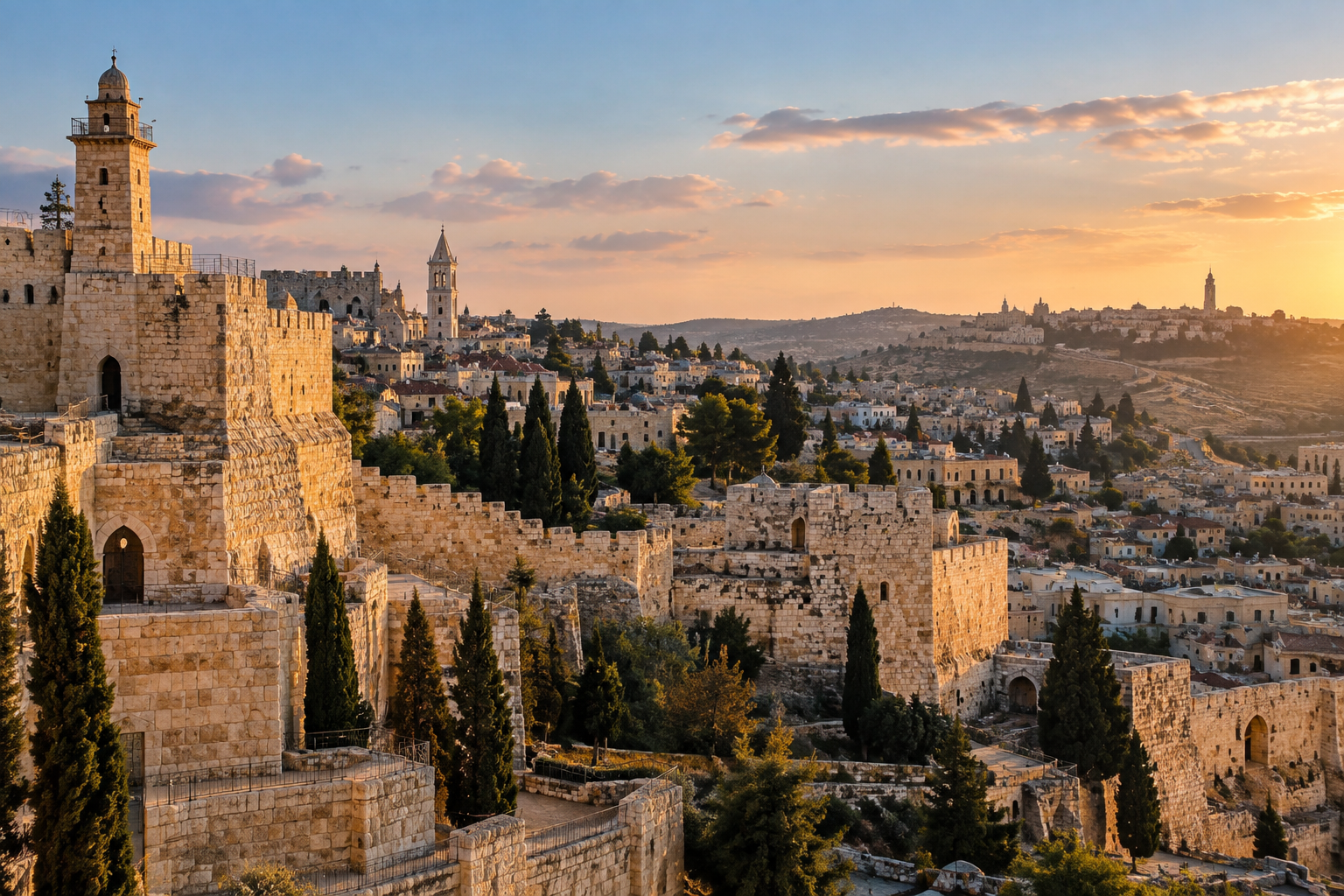
Photo Credits: Sabine Sterk ( AI)
There is something profoundly strange about watching the world debate whether Jews belong in Hebron and Jerusalem as though Jewish history in these cities began sometime in the twentieth century.
It did not.
Long before the modern State of Israel existed, long before the British Mandate, long before modern Palestinian nationalism, and centuries before Islam itself existed, Jerusalem and Hebron were embedded in Jewish history, religion, memory and national identity.
You can debate borders. You can debate governments. You can criticize Israeli policies. You can argue about security arrangements and political agreements. What you cannot honestly do is erase thousands of years of Jewish history simply because that history has become politically inconvenient.
Hebron is one of the clearest examples.
The Hebrew Bible identifies Hebron with Abraham and the purchase of the Cave of Machpelah as a family burial place. It later describes Hebron as the place where David ruled before establishing Jerusalem as his capital. Archaeological evidence also demonstrates ancient Jewish life in the area during later periods.
Jewish attachment to Hebron therefore did not suddenly appear in 1967.
Neither did Jewish residence there.
Jewish communities existed in Hebron during different periods under successive rulers, including Muslim and Ottoman rule. In the nineteenth and early twentieth centuries there was an established Jewish community with synagogues, religious institutions and property.
Then came 1929.
This date destroys one of the most convenient narratives surrounding Hebron because it occurred nineteen years before Israel’s independence and thirty eight years before 1967.
During the Hebron massacre, 67 Jews were murdered and the ancient Jewish community was shattered. Some Arab neighbors courageously protected Jews, something that should also be remembered because history deserves honesty even when honesty complicates our arguments. Survivors were evacuated by the British. Jewish families attempted to return afterward, but the renewed community did not survive the escalating violence of the 1930s.
So when someone presents every Jew living in Hebron today as a foreigner who suddenly appeared after 1967, ask a very simple question.
Where did the Jews murdered in Hebron in 1929 come from?
Were they supposedly occupying a city decades before Israel existed?
And if murdering or expelling a community can erase its historical connection to a place, what principle are we establishing? That ethnic cleansing eventually creates legitimate ownership?
That is an extraordinarily dangerous argument.
Then there is Jerusalem.
Jerusalem stands at the center of Jewish civilization in a way that cannot seriously be reduced to modern Israeli politics. It was the capital associated with the ancient Jewish kingdoms and the location of the First and Second Temples. For approximately two thousand years of dispersion, Jews continued to pray toward Jerusalem and incorporated the city into prayers, mourning rituals, festivals and the Passover declaration of hope for a return to Jerusalem.
A people inventing a connection in the twentieth century does not spend centuries orienting its religious life toward that city.
Jerusalem was not adopted by Zionism. Zionism inherited Jerusalem from Jewish civilization.
Muslims also possess genuine religious connections to Jerusalem, and Arabs have lived in Jerusalem and Hebron for generations. Recognizing those facts costs me nothing. History is not strengthened by pretending other people’s connections do not exist.
But acknowledging an Arab or Islamic connection does not require denying the Jewish one.
That is where the political argument becomes disturbing.
Why must recognition of Arab history so often be accompanied by demands that Jewish sovereignty or even Jewish residence be treated as illegitimate?
Why can a city be sacred to several peoples until Jewish political rights enter the discussion?
Modern “Palestinian” nationalism claims Jerusalem as a capital and Hebron as an important “Palestinian” city. Those claims are part of today’s political conflict and should be discussed as such. Islamic tradition also reveres Jerusalem and Hebron. But neither fact magically deletes what came before.
Islam emerged in the seventh century CE. Jewish Jerusalem was already ancient.
Arab conquest of Jerusalem does not retroactively transform the city’s earlier Jewish history into fiction.
Successive empires controlling a place do not erase the people who lived there before them.
Ancient History and Modern Politics Are Not the Same Question
This is where an important distinction must be made.
Proving an ancient Jewish connection to Jerusalem or Hebron does not, by itself, settle every modern question about borders, citizenship, sovereignty or political arrangements. Archaeology is not a peace treaty, and a biblical reference is not a substitute for modern diplomacy.
But the reverse is equally true.
A modern territorial dispute cannot erase ancient history.
The political status of Hebron today can be debated without pretending Jews have no historical connection to Hebron. The future political arrangements concerning Judea and Samaria can be debated without rewriting Jewish history. Jerusalem’s diplomatic status can be argued over without pretending Jewish attachment to Jerusalem began with Zionism.
These are separate questions, and deliberately mixing them has poisoned the discussion.
The modern Israeli Palestinian conflict involves two populations living in the same geographical space, competing national movements, wars, terrorism, security concerns, failed negotiations and unresolved questions of governance. Those realities are modern. Jewish history in Jerusalem and Hebron is not.
Likewise, saying that Arabs have lived in these cities for generations does not make them personally responsible for medieval conquests, and recognizing Jewish indigeneity does not mean that every Arab living there today is somehow a foreign invader.
That would replace one historical simplification with another.
My argument is different.
No modern “Palestinian” national claim can legitimately require the historical deletion of the Jewish people.
This is particularly important when discussing Jerusalem. Israel has governed a unified Jerusalem since 1967, while the city’s final political status remains one of the central disputes in the conflict. One may support Israeli sovereignty, oppose it, propose alternative arrangements or argue about particular neighborhoods. But none of those positions changes the fact that Jerusalem has been central to Jewish civilization for millennia.
Hebron requires the same intellectual honesty. Whatever political solution anyone advocates for the city today, Jews living there cannot truthfully be described as having invented their connection to Hebron after 1967.
Politics can determine administration.
Negotiations can determine agreements.
Governments can determine policy.
None of them can determine what happened thousands of years ago.
And this is exactly why language matters.
Describe Jews in their ancestral cities exclusively as foreign intruders and suddenly thousands of years disappear from the conversation.
The Jewish connection becomes an inconvenience that must be explained away.
Hebron exposes that contradiction brutally.
Jews lived there before Israel existed. Jews were murdered there before Israel existed. Jews were expelled from there before Israel existed. Yet their eventual return is frequently presented as though foreigners had suddenly discovered an unrelated Arab city.
That is not history. That is history with the first chapters deliberately removed.
Jerusalem presents the same problem on an even greater scale.
You do not have to deny Muslim history to recognize Jewish history. You do not have to remove Arab families from the historical narrative. You do not even have to support every decision made by an Israeli government.
You simply have to apply the same historical standards to Jews that you would apply to everyone else.
There can be discussions about coexistence, administration, security and political compromise. There should be. But those discussions must begin with historical honesty.
Jews do not need to manufacture a connection to Jerusalem.
Jews do not need to manufacture a connection to Hebron.
The connection was already ancient when many of today’s nations did not exist.
The tragedy is that instead of accepting that multiple peoples have connections to these places and asking how those realities can coexist, too much of the international conversation begins by demanding that Jews prove they belong there at all.
Perhaps the better question is not why Jews returned to Jerusalem and Hebron.
After centuries of prayer, persecution, expulsion and longing, the better question is why anyone expected them to forget.
Related Topics
Related Posts