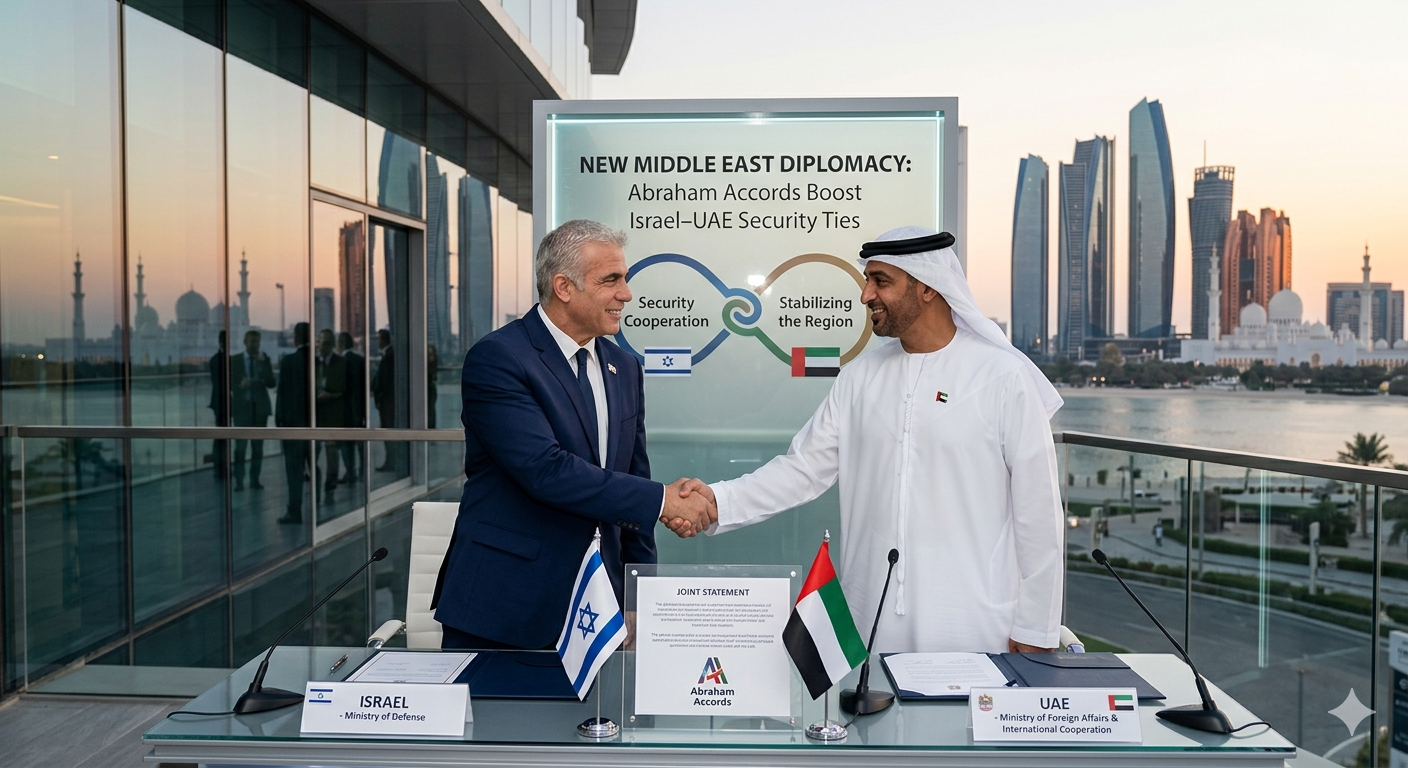
New Middle East Diplomacy: Abraham Accords Boost Israel–UAE Security Ties
The Middle East has long been defined by rivalry, ideological divides, and fragile alliances. Yet, in recent years, a different pattern has begun to emerge one shaped less by confrontation and more by calculated cooperation. At the center of this shift lies the Abraham Accords, a diplomatic breakthrough that has redefined how states in the region engage with one another, particularly in the realm of security.
When Israel and the United Arab Emirates formalized relations in 2020, it was more than a symbolic handshake. It marked the beginning of a pragmatic partnership grounded in shared interests. Both countries, despite their different histories and political narratives, recognized a common reality: the security landscape of the Middle East is evolving rapidly, and no state can navigate it alone.
Security cooperation quickly became one of the most tangible outcomes of this new diplomacy. The UAE, a country that has invested heavily in modernizing its defense capabilities, saw in Israel not only a new partner but also a source of advanced military technology and intelligence expertise. Israel, for its part, viewed the UAE as a strategic ally in the Gulf an anchor for broader regional engagement.
One of the most discussed elements of this cooperation has been the potential deployment of advanced defense systems such as the Iron Dome. Known for its effectiveness in intercepting short-range rockets and aerial threats, Iron Dome represents more than just technology it symbolizes a transfer of trust. Sharing such a system reflects a deepening relationship where security is no longer guarded in isolation but approached collectively.
This growing partnership is not occurring in a vacuum. Regional threats, particularly from non-state actors and missile proliferation, have created a sense of urgency among Gulf states. The rise of drone warfare and ballistic missile capabilities has made traditional defense strategies less effective. In this context, collaboration with a technologically advanced partner like Israel becomes not just beneficial, but necessary.
Beyond hardware, the Abraham Accords have opened doors for intelligence sharing, joint training, and coordinated responses to emerging threats. These are the less visible, yet more enduring, aspects of security cooperation. They build institutional trust, create communication channels, and reduce the risk of miscalculation factors that are critical in a region often shaped by uncertainty.
At the same time, this new diplomacy is not without its complexities. Critics argue that normalization may sideline unresolved political issues, particularly the Palestinian question. Others caution that increased militarization, even under the banner of cooperation, could intensify regional competition. These concerns highlight an important truth: diplomacy in the Middle East is rarely linear, and progress often coexists with tension.
Still, the Abraham Accords have undeniably shifted the conversation. They have introduced a model where former adversaries can become strategic partners, where diplomacy is driven by interests as much as by ideals. For the UAE and Israel, this means redefining security not as a zero-sum game, but as a shared responsibility.
Looking ahead, the durability of this partnership will depend on how well both countries manage expectations and navigate regional dynamics. If sustained, their cooperation could serve as a blueprint for others demonstrating that even in one of the world’s most complex regions, diplomacy can evolve, adapt, and deliver tangible results.
In the end, the story of the Abraham Accords is not just about agreements signed on paper. It is about a changing mindset one that sees opportunity where there was once only division, and that understands security not as isolation, but as collaboration.