Public Speaker & Content Creator
After Six Years of the Abraham Accords, Two Paths for the Middle East
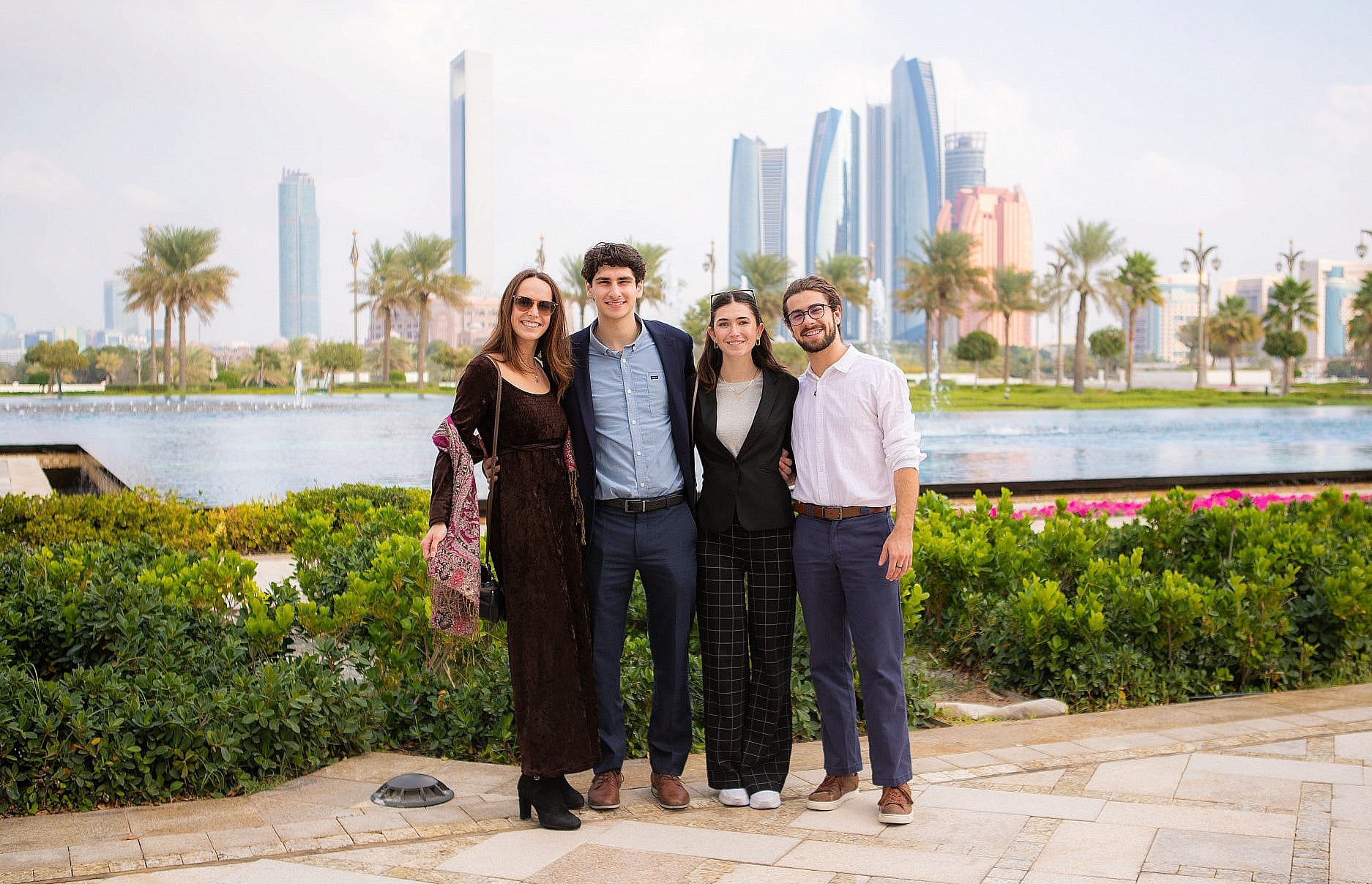
Tessa Veksler (second from right) with Geller International Fellows in Abu Dhabi. (Courtesy)
On January 9th, 2026, I boarded a direct flight from Tel Aviv to Dubai. It still felt remarkable. I did not think, growing up, that such a flight would exist in my lifetime — and six years ago, it didn’t. Until six years ago, you could not fly direct between Israel and the United Arab Emirates. The first direct passenger flight took off on August 31, 2020. Just a month earlier, the idea would have been unthinkable. There was no Israeli embassy in Abu Dhabi, no Emirati embassy in Israel, and no ordinary reason for an Israeli stamp to appear in a passport bound for the Gulf.
On September 15, 2020, the Abraham Accords were signed on the South Lawn of the White House, normalizing relations between Israel, the United Arab Emirates, and Bahrain. Morocco and Sudan followed before the year ended. Four Arab states, in four months, ended a diplomatic quarantine that the region had treated as permanent for decades.
I did not learn what that meant from a communique. I learned it in the region itself, as a member of the inaugural cohort of the Israel on Campus Coalition’s Geller International Fellowship, which each year selects forty undergraduates to study the Israel-UAE relationship and then travel through the two countries for a total of ten days. Being first meant there was no precedent to measure it against — just forty of us, and a region rewriting its own rules in real time. Ten days changed how I saw the Middle East. We sat with Israeli, Emirati, and Saudi voices working to widen the circle of normalization, and what struck me was not any single meeting but the ordinariness of it all. Israelis and Emiratis were building companies together, comparing notes on desalination and desert agriculture, complaining about the same flight delays. I came home and wrote, in the first thing I ever posted publicly about any of this, that I’d been left with hope and inspiration about the future of peace and prosperity in the region. I meant it as a twenty-year-old who had just seen something she didn’t think was possible. I still mean it now. The route between Ben Gurion and Abu Dhabi is now the busiest in Etihad’s entire global network. Peace, six years in, looks less like a signing ceremony and more like a departures board.
But the region has been offered two futures, and both are real. The first was signed in Washington in 2020. The second was chosen on October 7, 2023, and the people who chose it wrote down why. Minutes of a Hamas political bureau meeting held five days before the attack, recovered by Israeli forces in Gaza, record Yahya Sinwar telling his colleagues that the Saudi-Israeli normalization agreement was progressing and would open the door for most of the Arab and Islamic world to follow. He concluded that an extraordinary act was required to stop it, and he cited Hamas’s role in derailing Oslo as the precedent. Five days later, Hamas murdered roughly 1,200 people and dragged more than 250 into Gaza, with the men who carried it out funded and armed for years by the Iranian regime.
The most important thing anyone has said about the Abraham Accords was said by Hamas on October 7. The enemies of normalization understood its potential. The scale of the attack measured the threat that peace represented. The target was not only innocent civilians but the possibility that the rest of the Arab and Muslim world might follow.
Then I came home. At UC Santa Barbara, where I served as student body president, posters reading “Zionists are not welcome” went up around the building that housed my office. Students who call themselves pro-peace treat normalization as a betrayal, and identifying openly as a Zionist can cost you friendships and your safety. I have now seen both worlds up close, and the contrast is hard to unsee. The people in Abu Dhabi building joint ventures with Israelis have made their peace with Jewish self-determination. Many American undergraduates have not.
Six years is not long. Saudi normalization was close enough in the autumn of 2023, with Washington and Riyadh having reached understandings on terms that Hamas thought it was worth a war to prevent. Other countries are watching to see whether the first four were rewarded or abandoned.
This week marks six years since the Accords were signed. I am not the same person who came home from that first trip and sat down to write about what she’d seen. I have watched a war, a campus turn hostile to people like me, and a region keep building anyway. But the hope I felt then has not left me, and I don’t think it should leave anyone who wants to see this region at peace. The Middle East is waiting for the next step in the Abraham Accords, toward a peace between Israel and all of her neighbors. To those who call that idle dreaming: I’d remind them that six years ago, I didn’t think I’d live to see the flight I took this January. I didn’t think I’d live to see any of it.
Related Topics