A Call to the Moral Debate the World Refuses to Face — A Black Jewish Voice Speaks for Israel and Global Jewry
Next Mission of Israel’s 180 Ambassadors: Moral Diplomacy in a Fractured World
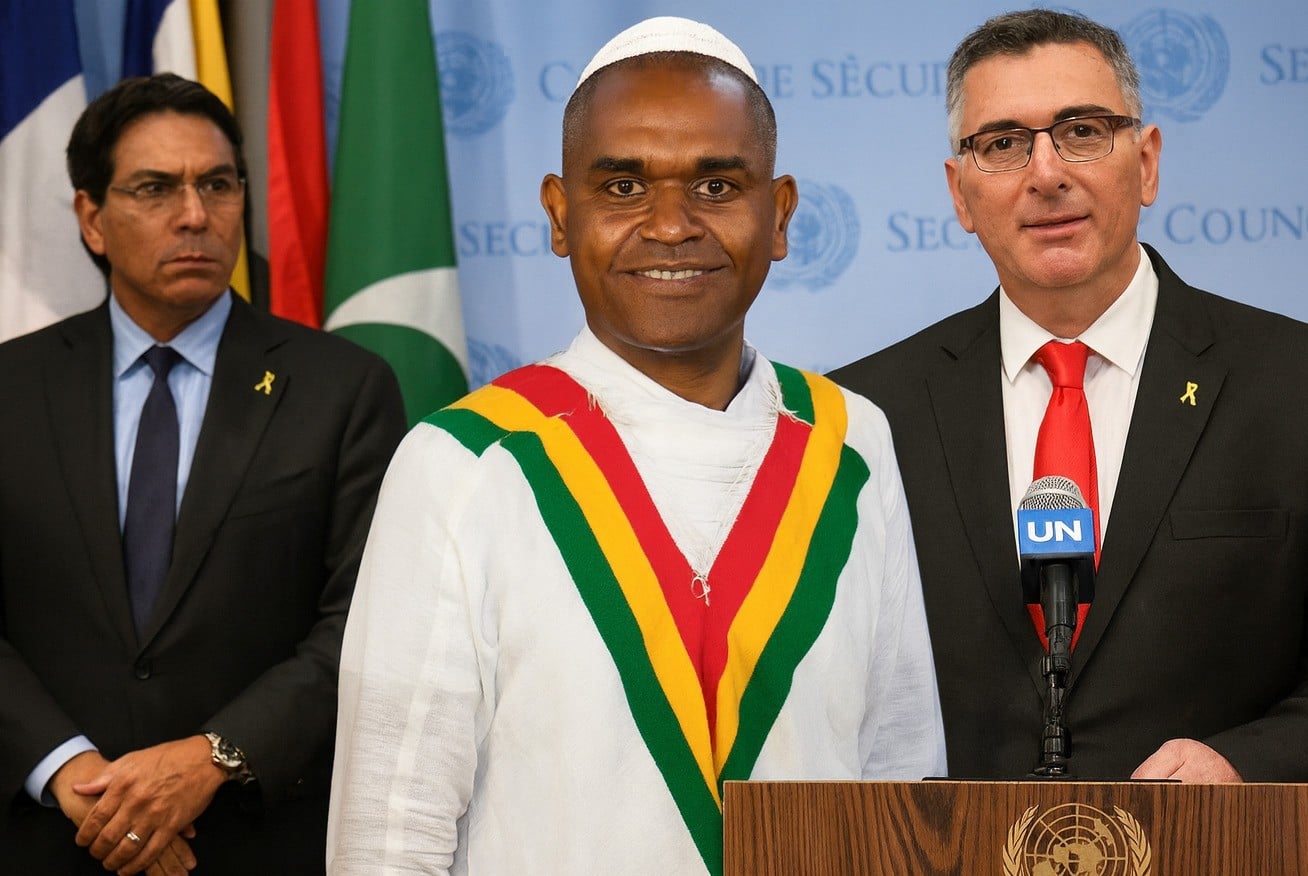
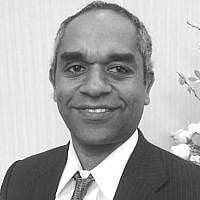
FM Gideon Saar-speaks to journalists as Israeli Amba to the UN Danny Danon looks on ahead of a UN Security Council meeting on the hostages and the Gaza war at the UN hq on August 5 2025 in NYC Photo by Angela Weiss/ Shmuel Legesse at The Sephardic Temple of Cedarhurst in Cedarhurst, N.Y., June 8, 2014. (Photo credit and commercial-use permission: Jeremy Mayer)
By Dr. Shmuel Legesse: Former NYC Supreme Court Investigator/Detective/educator in conflict resolution, restorative peace, and moral diplomacy; Upcoming Author of Moral Diplomacy for a Broken World, inspired by Rabbi Jonathan Sacks
Last week in Jerusalem, 180 ambassadors gathered not to celebrate, but to prepare. In the echo of war, amid the highest surge of antisemitism in living memory, and after the shifting winds of the Abraham Accords, Israel’s diplomats now stand at a crossroads. Their mission is no longer traditional diplomacy; it is moral re-definition.
As an international educator in conflict resolution, restorative peace, and moral diplomacy and as someone who walked from the courts of New York City to the streets of Jerusalem I believe this is the moment Israeli diplomacy must restart not with speeches, but with soul.
For too long, Israel has been framed by narrow images: high-tech, start-ups, a “strong army,” and sometimes contested territorial policies. But the world sees what we show it, and the picture we have painted is incomplete. That narrative sells neither the depth of our history nor the diversity of our people and lately, we are paying the price in slander, delegitimization, and hate. Our diplomats must become living proof of something bigger. They must highlight that Israel is not just a “white-Jewish state,” but a mosaic from Ashkenazi to Ethiopian, Mizrahi to global Jewry. They must tell the story of return, of heritage, of communities like Ethiopian-Jews/Israeli community that carried ancient Judaism across continents, deserts, and seas. They must show the Israel of prayer, toil, vulnerability, and compassion not just conflict.
As Rabbi Jonathan Sacks (z”l) taught, “We must stop feeling defensive about being Jewish and engage with the world with humility but without fear.” That moral humility, not military might, will rebuild trust and respect in the international arena. Let our diplomats make the world fall in love with Israel’s human story before it judges our headlines.
Power politics will always have its place, but in our generation, power alone isn’t enough. The images and weapons that once inspired respect can now inspire resentment. That’s why moral diplomacy diplomacy rooted in conscience, ethics, and collective responsibility must take center stage. True diplomacy is not measured by how many agreements are signed, but by how many lives are dignified. It demands that nations use their influence not only to protect borders, but to defend the image of God within every human being. Our ambassadors should publicly champion pluralism, religious freedom, minority rights, and social solidarity not only for Jews, but for all faiths. They must stand up for diaspora communities facing antisemitism not only with statements, but through education and engagement. They must foster civil-society dialogues and humanitarian partnerships that show Israel not as isolated, but as inspired.
The Abraham Accords proved what diplomacy can achieve when anchored in hope, shared interest, and strategic vision. Yet today, the path forged by treaties is tangled by war, global polarization, and suspicion of Israel’s motives. To preserve their promise, we must build not only policy bridges but human one’s interfaith education, youth exchanges, and cooperation in culture, environment, and technology built on mutual respect rather than political convenience. Only then will the accords endure not as cold contracts, but as warm connections among peoples. But for that to happen, Israel must show itself in full color. As someone who earned a doctorate in International Educational Leadership from a respected university in New York and returned to Israel to serve as a Zionist soul helping to build Jerusalem only to find myself, for the past two years, cleaning the floors of the Foreign Ministry instead of walking its halls I know what it means to face closed doors despite open ideals. And yet, even from that floor, I still look up with pride. I remind myself that once, in our holiest days, the Kohanim in the Temple of Jerusalem also swept its courts and polished its vessels not out of status, but out of love. Service, in any form, is still sacred when it’s done for the sake of Heaven and the people of Israel.
And please, don’t misunderstand me I’m not saying this to the world on CNN; I’m saying it quietly, with love and a mop in hand, to my own country, behind closed doors, as I clean your desk. I am not bitter. I am loyal, proud, and still smiling. But I do believe that if the Jewish state wants to represent the full family of Israel to the world, it must first recognize all its children at home. When our diplomats present Israel to the nations, the Israel they reflect must include every community: Ethiopian Israeli, Mizrahi, Russian Israeli, Sephardi, Ashkenazi, religious and secular, Jew and non-Jew alike. Otherwise, the mirror is distorted, and the world will never see the true, radiant face of the Jewish people.
Since October 7, antisemitism has erupted across continents, reaching levels unseen in generations. It is not enough to condemn hate; we must humanize what hate tries to erase. Our diplomats must personify the resilience and humanity that antisemitism seeks to deny. Let the world not only hear Israel’s story let it meet Israelis in all their diversity and warmth. Let them see that our strength is moral, not racial; covenantal, not colonial. Israel can defeat lies only by living truthfully. That requires humility, empathy, and a willingness to acknowledge our own imperfections. If Israel wants to defeat the myth that it is a colonizer, it must show itself as a home a refuge for every Jew who returns, whether from Morocco or Moscow, Addis Ababa or Amsterdam. Zionism is not occupation; it is restoration of people, of language, of moral purpose.
To the 180 ambassadors who gathered last week: you carry more than passports and talking points. You carry Israel’s soul. Be proud but also be humble. Be strong but also be kind. Let your embassies be not fortresses but gateways to empathy, to truth, to partnership. Remember that moral diplomacy begins not with what you say, but with what you show.
To the people of Israel and to Jews and friends around the world our diplomats represent us, but we must reflect them. We must help them tell a story worthy of our ancestors and our children. We must embody the moral strength we preach. Because Zion is not a slogan, not a start-up, not a strategy. It is a sacred covenant of memory and hope, justice and mercy, return and redemption. And even in our darkest hour, that covenant still burns with light. True diplomacy today must be moral diplomacy: not a contest of nations, but a concert of conscience. As Rabbi Sacks reminded us, “The best defense of the Jewish people is to be the Jewish people.” Let Israel’s ambassadors go forth and show the world that the Jewish story ancient yet alive, particular yet universal, human yet holy still speaks with love, laughter, and unshakable light. And I say this not as a distant observer, but as a Black African, an Ethiopian Jew, and a proud Zionist who has seen both exile and homecoming. I say it with the conviction of faith and the clarity of experience: the strength of Israel is not only in its soldiers or its science it is in its soul. Our mission is not to prove that we belong to the world, but to remind the world that it, too, belongs to God’s moral family. When Israel stands tall, it lifts the conscience of nations. When Israel shines with justice and compassion, it redeems not only its own story, but the hope of humanity itself. So let every ambassador, every citizen, and every friend of Israel carry that light with courage and humility. Let them speak with truth, act with kindness, and remember that moral strength is the highest form of power.
And from Jerusalem the city that unites heaven and earth I say it loudly, proudly, and with love: Am Yisrael Chai! The people of Israel live and through us, the moral light of the world lives too.
Related Topics
Related Posts