
"I'm the spokesman for the OK Boomer generation"
Nine Books that Shaped Who I Am
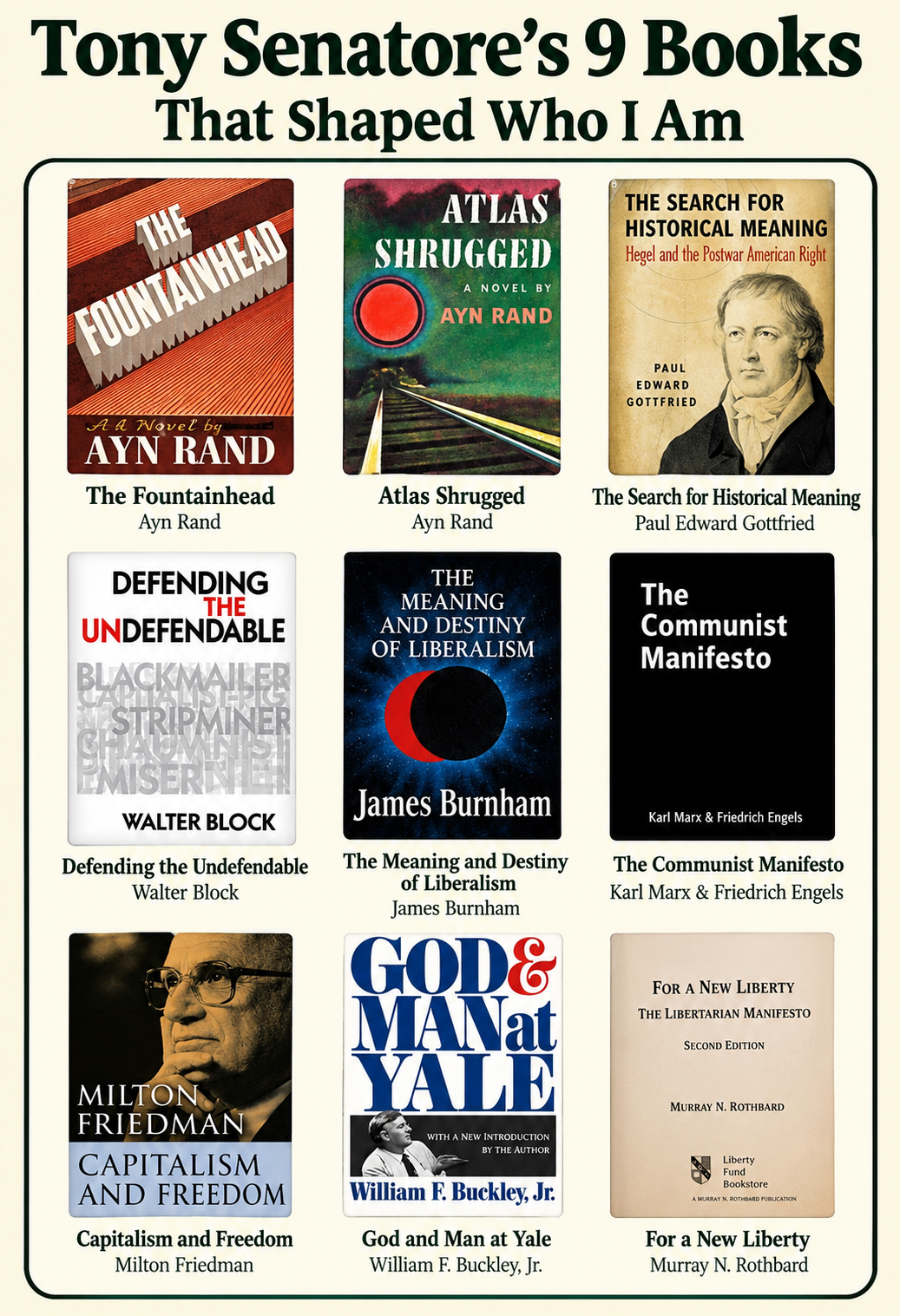
Photo: Tony Senatore: all rights reserved
At one time, books like these formed the backbone of serious intellectual debate. They challenged assumptions, demanded critical thinking, and forced us to confront ideas that shaped the modern world. They weren’t simply books to read; they were arguments to wrestle with, whether or not one ultimately agreed with their authors.
Ayn Rand’s The Fountainhead and Atlas Shrugged challenged us to consider individualism, personal responsibility, and the relationship between the individual and the collective. Paul Edward Gottfried’s The Search for Historical Meaning invited us to examine the historical forces and intellectual traditions that shaped the American Right. Richard Nixon praised Gottfried’s book as his favorite read of 1987. Walter Block’s Defending the Undefendable forced readers to question conventional moral judgments and examine the principles underlying individual liberty. James Burnham’s The Meaning and Destiny of Liberalism explored the evolution and contradictions of liberal political thought. Marx and Engels’ The Communist Manifesto laid out a revolutionary critique of capitalism that continues to influence political movements around the world. Milton Friedman’s Capitalism and Freedom defended free markets and limited government, while William F. Buckley’s God and Man at Yale challenged the ideological direction of American higher education. And Murray Rothbard’s For a New Liberty presented a radical vision of individual liberty and a society organized around voluntary cooperation.
These authors disagreed profoundly. That was precisely the point. Intellectual life meant engaging with competing ideas, understanding their foundations, and making up your own mind. Even Marx, whose ideas I fundamentally question, remains part of the conversation. His continued influence shows how hard it is to understand the modern world without understanding the ideas that shaped it.
But look at where we are today.
Intellectual authority is increasingly being displaced by internet personalities. From Joe Rogan to countless lesser-known influencers, a new generation is learning about politics, history, economics, and philosophy through people whose reach often depends on charisma, appearance, controversy, and the ability to provoke an emotional reaction. Some offer genuine insights, but popularity is not scholarship, and the ability to command an audience is not proof of intellectual depth.
Social media rewards immediacy, outrage, and division. Serious scholarship requires patience, historical knowledge, and a willingness to grapple with arguments that might challenge our most cherished beliefs. One can gain millions of followers without ever engaging seriously with the intellectual traditions that preceded us.
The danger is that younger generations may inherit others’ conclusions without understanding the history behind them. Meanwhile, an older generation that once knew these lessons seems increasingly willing to forget them. We repeat the past’s mistakes because we no longer remember why previous generations struggled with the same questions.
I haven’t forgotten.
The ideas in these nine books continue to color everything I write. They have shaped how I think about liberty, capitalism, socialism, individual responsibility, political power, education, and the preservation of Western civilization. They have also taught me that no serious thinker should be exempt from criticism and that understanding an opposing argument is more valuable than simply ridiculing it.
I write because I believe ideas matter. I write because a civilization cannot survive indefinitely on inherited freedoms while abandoning the intellectual foundations that made those freedoms possible. And I write because I want younger people to discover a world of thought beyond the latest viral clip, political personality, or carefully manufactured controversy.
I’m not interested in becoming the next Heather Cox Richardson or Ben Shapiro. I’m not chasing popularity, building a personal brand, or measuring my ideas by how many people click, share, or agree with them.
If my writing reaches a few people who begin asking better questions, reading the books that shaped me, and thinking independently, that is enough.
Perhaps this is my small way of holding off the end of Western civilization as we know it: not by pretending to have all the answers, but by refusing to abandon the questions that generations of serious thinkers struggled to answer.
These nine books helped shape who I am. Their ideas live on in what I write.
Moreover, I have come to know Mr. Gottfried and Mr. Block personally. I am fortunate that when I need clarity and direction, these gentlemen are only an email away.
As long as I have something to say, I intend to keep writing.
Related Topics