An American Olah In Israel
Superdeterminism and Destiny – The Physics of Who We Are
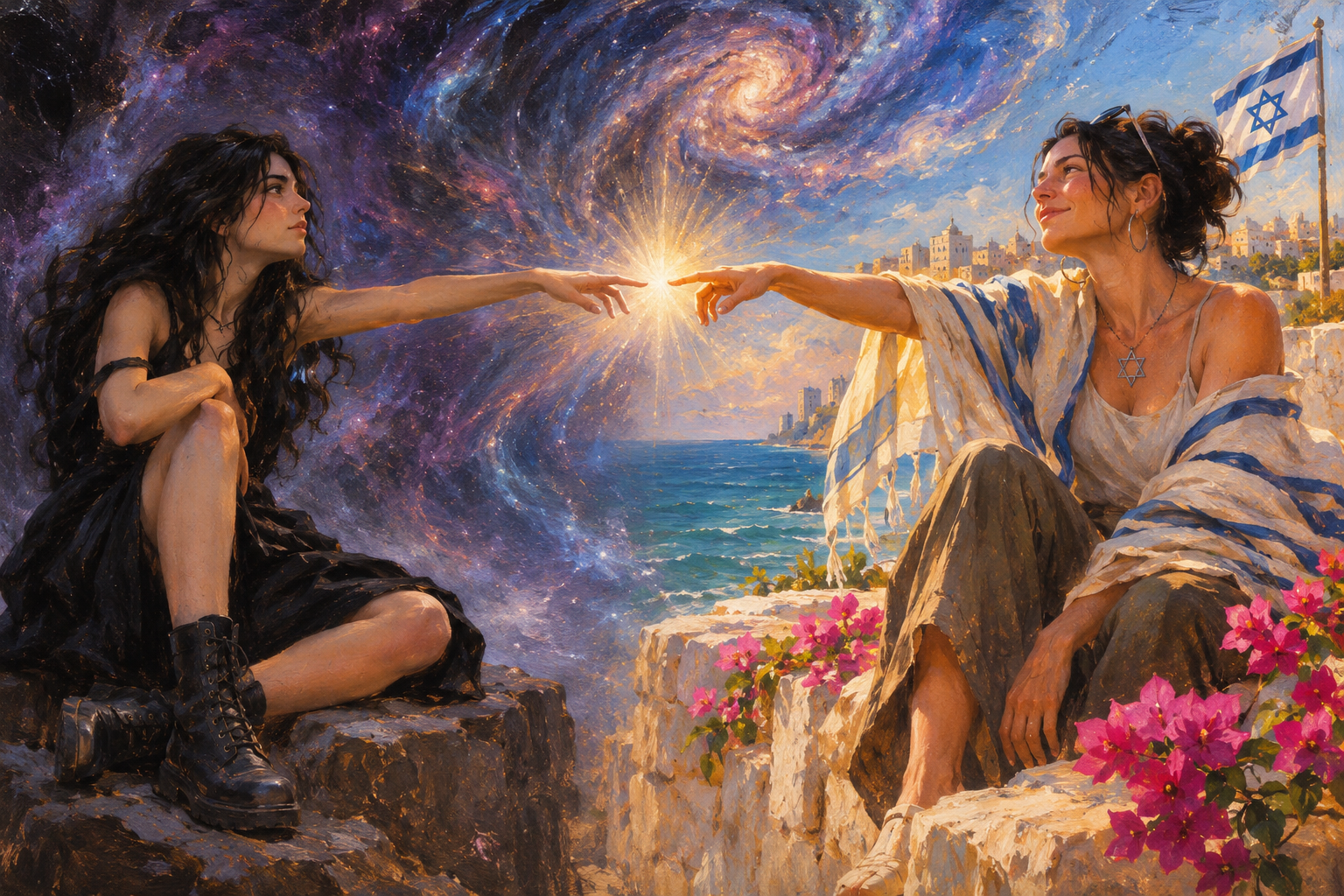
What if everything that has ever happened to you was always going to happen?
Every decision. Every heartbreak. Every mistake and every win. Every moment of extraordinary courage when you had absolutely no idea where that courage was coming from.
What if the life we believe we are creating through our own free will is actually something far more mysterious? What if the destination already existed, and we are simply experiencing the journey toward it?
I have been thinking about this quite a bit lately as I process my life’s experiences, particularly after reading some quantum physics papers exploring some rather interesting ideas emerging from theoretical physics.
One of those ideas is called superdeterminism.
Superdeterminism is a hypothesis in quantum physics proposing that all physical events—including the choices scientists make when conducting experiments—may be determined by prior conditions in the universe.
And lately, I have been asking myself a rather extraordinary question:
Was I always meant to become Israeli?
I remember back to a sunny bus ride down Steiner street in San Francisco like it was yesterday, when I casually thought to myself I needed to become more religious. Not wanted, NEEDED.
The feeling was so casual and yet so ingrained into who I was, it felt not like a choice I was making, but as just another fact. Soon after that, in looking for a book at a bookstore, I found One God Clapping, by Rabbi Alan Lew – a Brooklyn born boy who came to California in the 60’s and studied Zen Buddhism and sitting zazen before becoming a Rabbi.
The combination of Judaism and meditation spoke to something deep within my soul and I decided that I wanted to become a member of his congregation, Temple Beth Sholom. I started studying Hebrew, coming to services, and sitting zazen. These gifts are lifelong tools I have used, and I have Rabbi Lew to thank, z’l.
But back then, I had no intention of moving to Israel. In fact, Israel was a far-off land to my 18-year-old American self. I had wanted to visit sure, but living there as an Israeli – I don’t think 18-year-old me could have fathomed such a future at the time.
The Illusion of Choice
Most of us operate under the assumption that we possess free will.
We wake up, make decisions, choose relationships, pursue careers, change our minds, and occasionally make spectacular mistakes. We believe we are the authors of our own lives. But physics has a rather inconvenient habit of challenging the things human beings consider obvious.
Einstein’s theory of relativity fundamentally altered our understanding of time. One philosophical interpretation of relativity, known as the block universe, proposes that the past, present, and future are all part of a four-dimensional spacetime.
Under this interpretation, time does not necessarily flow in the way we experience it. Instead, our conscious experience moves from one moment to another within a structure in which events at different times are equally real.
Imagine a film reel: The beginning, middle, and ending are all present on the reel, even though the audience experiences the story one frame at a time.
Now imagine that the film is your life.
This means that every experience, every choice and every ultimate ending would always occur, always be who we are fundamentally.
In quantum physics, Bell’s theorem concerns the relationship between quantum predictions and assumptions about locality and the independence of measurement settings. It has shown that even when locality is controlled for – entanglement still exists. Superdeterministic approaches question that independence, allowing correlations between the conditions influencing an experimenter’s choices and those influencing the particles being measured.
In some superdeterministic models, the universe is fundamentally deterministic.
What this means is that while we silly little humans think we have free will, what if what we have instead is destiny?
How much of what we call choice is actually the product of circumstances that existed long before we became conscious of making a decision? And what does that mean for all of us?
A Life I Would Never Have Chosen
I did not choose my childhood.
I did not choose the abuse, the instability, or the circumstances that forced me to become independent long before most children are expected to understand what independence means. I was emancipated at sixteen. At an age when other teenagers were worrying about school dances and whether someone liked them, I was learning how to survive.
I did not know then what kind of woman I would become.
I certainly did not imagine that one day I would be sitting in an apartment overlooking the Mediterranean Sea, writing about quantum physics and Jewish destiny. I was simply trying to get through the next day. But I did dream about the things I wanted to accomplish in this life and pursued them relentlessly – even when others mocked me or said I couldn’t do it.
When you grow up without the luxury of assuming someone will protect you, you learn to protect yourself. You learn to question what you are made to believe. You become independent.
In my twenties, I transformed my body and became a marathon runner. I discovered the extraordinary relationship between discipline, determination, and the human capacity for change. I believed that if I worked hard enough, I could reinvent almost anything about myself.
Then life intervened again.
And at thirty-two, I was diagnosed with stage-three ovarian cancer. Cancer is an especially brutal confrontation with the illusion of control. One day you are making plans for your future. The next, you are wondering whether you will have tomorrow. At the time, I believed I didn’t…and I still survived.
And as I processed my survival, it made the temporary nature of life impossible to ignore.
It also left me with a question that has followed me ever since:
If I am still here, what am I supposed to do with the time I have been given?
I have spent much of my adult life working with people experiencing profound suffering, including more than two decades of coaching, hospice volunteering and years working in mental health with people experiencing homelessness and drug addiction. One of the things I learned there is not all humans have the ability to dream. Indeed, it is a cruel thing that trauma can steal from a human being.
But it also begs the question – if I can come out more resilient after profound abuse and trauma, why can’t others?
We can make the best decisions imaginable and still experience catastrophe. Even now, As I write this from Israel, there is always the possibility I could have to run from bombs – and I understood that before moving there and still chose it. But the difference is fear – how much we allow it to hold us back specifically.
We can make terrible decisions and somehow find ourselves standing in the middle of an unexpected opportunity. In fact, I do believe that everything we experience can be a teacher if we choose to be students of it. The main blockage in our lives is usually fear – fear of change, fear of failure…hell, even fear of actually achieving that which we set out for.
So where does free will end and circumstance begin? And is destiny simply the name we give to the patterns we recognize afterward?
The Jewish Question I Could No Longer Ignore
For much of my adult life, I considered myself politically progressive.
I participated in social justice movements. I believed deeply in universal human rights. I built relationships and communities around the idea that people deserve dignity regardless of their backgrounds.
Then October 7, 2023, happened. And my entire world changed.
But what followed in my own social world profoundly altered my understanding of belonging. I watched people I had considered friends respond to Jewish suffering in ways I could scarcely comprehend. I experienced antisemitic hostility, harassment, and eventually physical violence.
In May 2025, while removing antizionist graffiti, I was assaulted.
I found myself confronting something I had spent much of my life believing belonged primarily to history. Antisemitism was not merely an abstract subject in a Holocaust museum or a chapter in a history book any longer. It was something I was experiencing in my own life. It felt like the tethers of history were collapsing and repeating – all of the black and white reels of Jews being targeted and physically assaulted and killed was now my living life. I recognized Nazism when I saw it and now, I saw it fomenting again…this time in America.
I began questioning everything. My friendships. My political alliances. My sense of safety. My future in America. And increasingly, I began thinking about Israel. Not as an abstract political argument. Not as a vacation destination. But as home.
What fascinates me now is that I did not experience this realization as the sudden discovery of a new identity. It felt more like the recognition of something that had been waiting for me.
Something familiar.
Something all other experiences before it had prepared me for. Violence taught me to stand up for myself and fight back. Cancer taught me about survival. Antisemitism brought me home.
And a peculiar thing has happened since making Aliyah: I keep having déjà vu. A feeling like I’ve been here before, but just cannot pin point it.
Gilgul Neshamot: Does the Soul Remember?
Jewish mysticism offers a concept that has fascinated me for years: gilgul neshamot, the transmigration of souls.
Within certain Kabbalistic traditions, particularly the teachings associated with Rabbi Isaac Luria, souls may return through multiple lifetimes to continue a process of spiritual repair or completion known as tikkun. Judaism also believes that all souls were present at Sinai, even disembodied ones.
What if the soul has a history that extends beyond our conscious memory?
What if certain places, people, or experiences awaken a sense of recognition because something within us already knows them? I cannot prove reincarnation, but it is something I do believe in. I cannot tell you that I have memories of a previous life in Jerusalem or that my soul once walked the streets of ancient Judea. But I can tell you that I have experienced something remarkable since arriving in Israel.
I feel an extraordinary sense of familiarity.
And that feeling has made me wonder whether belonging is always something we create, or whether sometimes it is something we recognize.
There is a Hebrew expression, aliyah, meaning ascent.
When Jews immigrate to Israel, we do not simply say that they have moved. We say they have ascended. It is as much a spiritual ascension as it is physical. For years, I understood that expression intellectually. Now I understand it emotionally & spiritually.
The Woman on the Mediterranean
On October 15, 2026, I arrived in Israel. Forty-seven years old, carrying the scars of all my previous experiences. The girl who survived abuse is now a woman who had survived cancer, physical violence, and now adding Israeli to that list of things I have become.
As I look out at the Mediterranean and find myself overwhelmed by the simple fact that I am here, I remind that girl inside we did it. I do believe she would be screaming “AWESOME!!” while disbelieving this is who we would become.
For the first time in a very long time, I do not feel that my Jewish identity is something I must negotiate with the people around me.
It simply exists.
As naturally as the sea.
I Was Always Meant to Become Israeli
If the scientists are correct in their calculations, and superdeterminism is real, that means that everything I ever endured was meant to and so was my eventual ascent. It may have felt like free will in the moment, but our story is written.
I believe we can take experiences that were difficult and transform what they mean for our future. We can learn from them. We can become stronger. And perhaps that is where freedom of choice and destiny meet.
I cannot change the pain I endured, but I do get to decide how it will shape me.
Perhaps superdeterminism will eventually prove to be an important description of the universe. Perhaps it will not. Perhaps the block-universe interpretation of time captures something profound about reality. Perhaps our understanding of time will change again. Perhaps reincarnation is real. Perhaps the soul does return, carrying unfinished business from one lifetime into another. I am comfortable living with those uncertainties because sometimes the fun is not within certainty, but within our ability to dream about what could be.
I do not need physics to prove that my life has meaning. I am living that meaning. Every morning when I wake up in Netanya. Every time I stumble through another Hebrew conversation. Every time I walk toward the Mediterranean and remember how far I have traveled to stand on its shores.
For most of my life, I thought I was fighting to survive. But now I wonder whether I have misunderstood the nature of my journey. Perhaps I was never becoming someone entirely new. Perhaps I was slowly discovering the woman I had been moving toward all along.
I thought I was making Aliyah to begin a new life. Instead, I arrived in Israel and experienced something I had spent forty-seven years searching for…
Home.
And while I cannot prove that the universe had this destination waiting for me, I know what I believe.
I was always meant to become Israeli.
Shayna Netanya writes about Jewish identity, Aliyah, personal transformation, and life in Israel from her home on the Mediterranean coast.
Support Independent Writing from Israel
If this essay resonated with you, consider becoming a paid subscriber to my Substack. Your support helps me continue writing about Jewish life, identity, resilience, and the extraordinary experience of building a new life in Israel.
Thank you for being part of this journey.
Am Yisrael Chai. ????????
Further reading
- John S. Bell, “On the Einstein Podolsky Rosen Paradox” (1964), Physics Physique Fizika — the foundational paper behind Bell’s theorem.
- Sabine Hossenfelder and Tim Palmer, “Rethinking Superdeterminism,” Frontiers in Physics (2020) — a discussion of superdeterministic approaches to quantum foundations.
- Hermann Minkowski, “Space and Time” (1908/1909) — foundational work on four-dimensional spacetime.
- Rabbi Chaim Vital, Sha’ar HaGilgulim — a classical source for Lurianic teachings on reincarnation.
- Dan P. McAdams, The Stories We Live By: Personal Myths and the Making of the Self (1993) — a psychological perspective on narrative identity.
Related Topics
Related Posts