
No Checks. No Balances. No Guardrails.
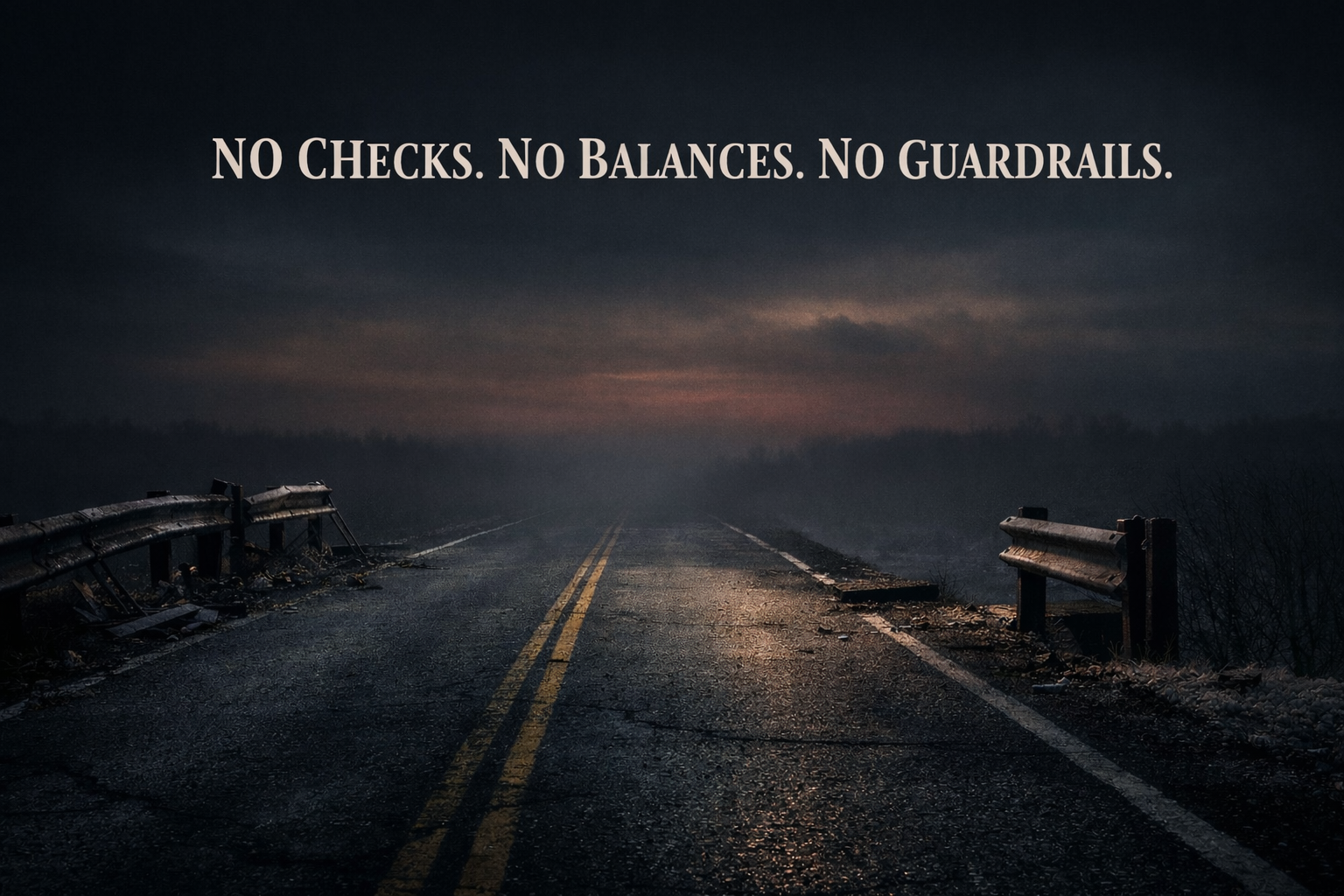
“Guardrails do not fail all at once. They fail quietly, one by one, until nothing is left to stop the car.”
Something fundamental has shifted, and pretending otherwise is part of the problem.
This is not about being surprised by Donald Trump. Most of us crossed the threshold on his fitness for office years ago. That debate is settled. What feels different now, heavier and more dangerous, is not the behavior itself. Although he seems to be really losing his shit these past few weeks, the real danger and the real difference, IMHO, is the disappearance of institutional guardrails.
A functioning democracy depends on more than laws written on paper. It depends on guardrails that constrain power in real time. Courts. Congress. Norms. The press. Elections. When those guardrails hold, violations trigger consequence and correction. When they fail, the law does not vanish. It becomes performative. Invoked. Televised. Processed. Then ignored.
That is the moment we are living through.
When the Supreme Court of the United States ruled that a president enjoys broad immunity from criminal prosecution for “official acts,” it did more than resolve a legal question. It rewired the system. For the first time, the nation’s highest court explicitly placed the presidency beyond ordinary criminal accountability while in office and, in practice, dulled accountability afterward. Once that boundary was removed, every other institution received the same signal: the guardrails at the top were now conditional.
What followed was not subtle.
Just this week, an American president seriously entertained and publicly floated the use of military force against a NATO ally to seize Greenland, then backed down only after markets recoiled. Read that again slowly. The plan to defend the Western alliance briefly involved invading a member of it. That sentence should still stop conversation. Instead, it passed through the system as content. Translated. Contextualized. Reframed as strategy. Then filed away and onto the next crazy.
The following day delivered a separate, clarifying data point. In sworn testimony before Congress, Jack Smith summarized evidence he said was sufficient to convict the President of the United States of conspiring to overturn a lawful election and knowingly inciting a violent insurrection on January 6. This was not a failure of process. The president had been impeached. The evidence had been aired. What failed was the final step. No guardrail ultimately held. The lesson absorbed by the system was not that such conduct was disqualifying, but that it was survivable.
And how does unbound power react? The absence of guardrails does not stabilize conduct. It accelerates it. Each time a line is crossed without consequence, the next transgression becomes easier, more brazen, more detached from reality. Trump is not testing limits accidentally. He is responding rationally to a system that has taught him, repeatedly, that the guardrails are gone. In a functioning democracy, or in an administration with adults in the room, many of these ideas would never be proposed, let alone pursued. Here, they are floated precisely because experience has shown they can be.
The impulse did not stop at disregarding existing institutions. It moved toward replacing them. Trump’s proposed “Board of Peace” is best understood as a crude attempt to supplant the United Nations with a body built around personal control rather than law. One need not be a defender of the UN to recognize the danger here. For all its failures, the UN is at least a rules-based institution, constrained by process, membership, and limits on individual authority. Trump’s proposal discards those constraints entirely. It offers the aesthetics of international order without any of its obligations. Authority without guardrails. Power without law. That is not reform. It is replacement by something far worse.
It would be inaccurate to say that every guardrail has failed. In recent months, courts have acted to restrain executive overreach. Judges have issued injunctions, demanded statutory compliance, and blocked actions that exceeded lawful authority. These moments matter. They demonstrate that the rule of law has not vanished.
But courts are a blunt and delayed guardrail. And let’s face it, Trump is a master class in using the courts to his advantage. They act case by case, often after harm has already occurred. They are narrow by design and slow by necessity. They cannot set the tempo of accountability, and they cannot substitute for the guardrails that prevent escalation before it metastasizes. Survivability, not consequence, has become the operating assumption.
That lesson did not remain abstract. It moved downstream.
On January 7 in Minneapolis, a federal US Immigration and Customs Enforcement agent shot and killed Renee Good during an enforcement action. Video evidence, an independent autopsy, and conflicting official accounts raised serious questions about use of force. Federal authorities quickly declared the shooting justified, declined to open a civil rights investigation, and limited cooperation with local inquiries. Protest followed. No meaningful guardrail intervened.
This was not a procedural failure. It was a guardrails failure. The system processed the event. It did not bind it to consequence. The lesson repeated itself: survivable.
Then came the moment that clarified what still enforces limits in this system. After weeks of diplomatic chaos over Greenland, it was not allies, courts, Congress, or norms that forced a retreat. It was the market. When stocks fell and risk was priced in, the rhetoric softened. In the absence of functioning democratic guardrails, capital imposed discipline where law did not.
That should terrify us. Markets are a crude substitute for democracy. They react late and care only about stability, not legality, legitimacy, or justice. A country in which the Dow is the primary guardrail has already conceded governance.
This is where the Fourth Estate was meant to matter most.
In a functioning democracy, the press is not merely an observer. It is a guardrail. Not because it prosecutes or legislates, but because it creates consequence. It establishes thresholds. It signals when conduct has crossed from politics into danger and demands response from other institutions.
That function has deeply eroded.
Part of this erosion is structural. The mainstream press no longer occupies the commanding heights of public attention it once did. Cable news audiences are shrinking. Streaming alternatives fragment viewership. Algorithm-driven short-form video now sets the emotional tempo of politics, rewarding provocation over scrutiny and speed over judgment. In this environment, even accurate reporting struggles to create consequence. Revelation without reach cannot function as a guardrail.
The American press still reports. It still publishes. What it no longer reliably does is escalate. Behavior that once would have triggered sustained scrutiny, institutional pressure, and political cost is now treated as texture. Absorbed. Contextualized. Normalized. Then replaced by the next story. They are overwhelmed by the flood and barely staying above the water line.
This is not primarily a failure of courage or intent. It is a failure of role. The press has shifted from enforcing guardrails to narrating their collapse. From drawing lines to explaining why lines are no longer clear. From demanding accountability to translating dysfunction into content.
When violations are described rather than confronted, power learns an essential lesson: it can survive exposure. Once exposure no longer carries consequence, transparency ceases to function as a check. It becomes performance.
That is how a guardrail fails. Not by disappearing, but by remaining present and ineffective.
Strip it down and the picture is bleak but clear. The courts have been blunted by a Supreme Court decision that placed the presidency partially beyond the reach of the law. Congress has gone missing, cowed by the threat of MAGA primaries and political extinction. And the mainstream media, derided as “lamestream” by those it once constrained, no longer has the reach or authority to function as a meaningful check at all. These are not isolated failures. Taken together, they explain why behavior once considered unthinkable now passes without consequence.
“Guardrails do not fail all at once. They fail quietly, one by one, until nothing is left to stop the car.”