
Founder & Principal, Line of State
No Hands on Soldiers
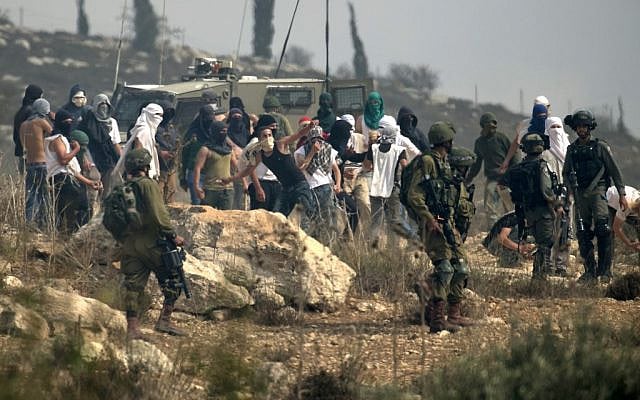
Masked Israeli civilians advance aggressively as IDF soldiers stand between them and the rest of the area, forced into the impossible position of absorbing hostility from those they are tasked to protect. The scene captures a breakdown of basic sovereignty: uniformed troops facing violence not from enemies, but from within their own population. (Jaafar Ashtiyeh/AFP)
Sovereignty fails when the defenders of the State are assaulted from within.
When an Israeli citizen raises a hand against an IDF soldier, [1] it is neither a protest nor a “rare incident”. It is an assault on the State itself: a rejection of the State’s monopoly on force and an attack on the very structure that allows Israel to defend its citizens.
Violence against IDF soldiers erases the line between order and anarchy. Ninety-nine percent of Israelis living in Judea and Samaria are law-abiding citizens who will respect any democratic and legitimate decision: yes or no, where, evacuation or construction, a Palestinian state or Israeli annexation. Violence by a marginal fringe is not part of that debate. It undermines the war effort and creates a vacuum of sovereignty.
The term “hilltop youth” is a linguistic deception – a pastoral mask for violence aimed at eroding the State. There are no hills here and no youth; there is a cell of brutality seeking to replace Israel’s sovereignty with a private law of fists. They are not “idealistic youngsters”. They are enemies of public order. They are not part of the land – they are a wound torn into it.
Sovereignty is straightforward: force is exercised by the State alone, and a law not enforced ceases to be a law. Israel cannot permit a reality in which individuals decide how high a hand may be raised or what the status of a soldier is. Whoever attacks a soldier is attacking the person protecting him – and silence in the face of that assault only lets the striking hand rise again.
The world will always tell the story that suits it – especially about Judea and Samaria. It will not decide for us. The decision will be made in Jerusalem. And the danger is not abroad but here, at home: in the soldier shoved aside, the fighter whose dignity is trampled, the unit worn down, and the law-abiding Israelis in Judea and Samaria – until a democratically elected government decides otherwise, in broad daylight – who carry a stain they did not create. Sovereignty is tested the moment a citizen stands before a soldier, where law meets force.
It always begins with a growth left in place for too long: in Mexico, assaults on police became a method for cartels to replace the State in the streets; in Iraq, militias seized borders and collected taxes until the State became a guest in its own bases; in Lebanon, surrendering the monopoly on weapons allowed Hezbollah to become an army inside a state, dictating what the government does, how and when. One blow against a police officer or soldier that was not marked as an absolute red line became a model, and the model became the State’s quiet disappearance from the terrain it once controlled. Sovereignty collapses the moment the first blow goes unanswered. Israel will not allow its own Hezbollah to rise.
Across Western democracies, the pattern has been identical: the State’s retreat began the moment political leaders – left and right – hesitated to confront violence because speaking plainly carried a political cost. In France, attacks on police in the banlieues were downplayed by successive governments to avoid inflaming electoral blocs. [2] In Sweden, ministers avoided acknowledging rising assaults on officers in “vulnerable areas” for fear of appearing discriminatory or strengthening the right. [3] In Britain, both Labour and Conservative governments allowed pockets of unrest to harden into zones where police temporarily withdrew because naming the problem risked alienating core constituencies. [4] In every case, the State stepped back once – and the forces challenging it stepped forward.
Some rise and speak the truth aloud – and opposite them stand elected officials who justify, blur or hide behind silence. The silence of an elected official is not neutrality; it is permission for violence, born of fear to speak the truth to the very public that sustains his power. Blurring is deceit, and silence is complicity. Sovereignty cannot survive when leaders are afraid to speak a simple truth in a clear voice.
A fighter who fears not only his enemy but a handful from within loses the backing the State owes him. The IDF is not a force that “serves” the State – it is the State in uniform. Every soldier is an Israeli citizen standing where we cannot; harming him is denying Israel its right to defend itself. It is an anti-Zionist, anti-Israeli act, equivalent to the terror our enemies direct against us.
There is no Right and Left here. There is a State. And the force in a State belongs solely to the State and its authorized forces. Anyone who attempts to wield force that is not the State’s, anyone who raises a hand against a soldier, and anyone who harms Palestinians in violation of the law, the mission, or the values of the IDF and the State of Israel – acts against Israel.
Sovereignty is revealed in its moments of fracture. And in those moments there is one sharp line that needs no interpretation: in Israel, no hand is raised against a soldier. Not in silence. Not with encouragement. Not with understanding. Not today. Not tomorrow. Not ever.
—
First published in Hebrew in Maariv on November 16, 2025 (“האלימות כלפי חיילי צה״ל מוחקת את הגבול בין סדר לאנרכיה”), this essay is presented here in English in an expanded edition translated and adapted by the author.
—
[1] Emanuel Fabian, “Israeli civilian attacked, lightly hurt two soldiers in Hebron yesterday, IDF says”, The Times of Israel, November 15, 2025.
[2] Angelique Chrisafis, “French Unrest Spreads Outside Paris”, The Guardian, November 4, 2005.
[3] Government of Sweden, Facts about Migration, Integration and Crime in Sweden, Ministry of Justice (official state analysis of “vulnerable areas”).
[4] Martin Wainwright, “London Riots: How Did the Metropolitan Police Lose Control?” The Guardian, August 8, 2011.
Related Topics
Related Posts