
No, Iran’s Strikes on Israel Aren’t Legal
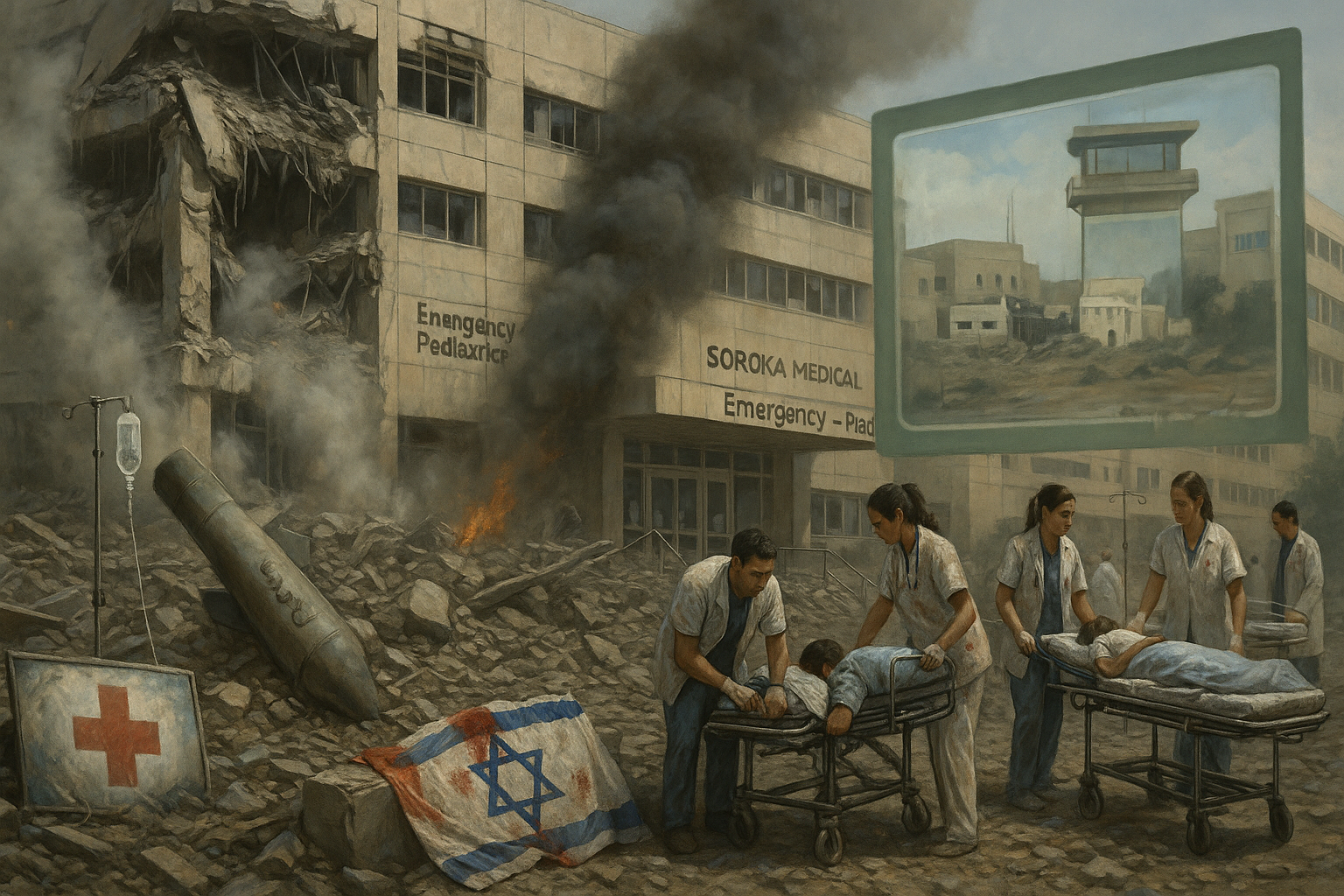
When Iranian ballistic missiles slammed into Israel’s Soroka Medical Center in June, wrecking an entire surgical wing and wounding over 200 patients and staff, Tehran offered two contradictory excuses. First, they claimed to be targeting an IDF intelligence compound in the adjacent technology park. When pressed about strikes on apartment buildings and civilian deaths, Iranian officials pivoted to a different justification: their missiles simply lack the precision to avoid collateral damage. These dual explanations expose more than diplomatic confusion. They reveal a systematic campaign of war crimes wrapped in legal pretense.
Four Pillars of International Law Iran Violated
Iran’s defense crumbles under the weight of International Humanitarian Law (IHL), which imposes four non-negotiable obligations. The principle of distinction requires parties to always differentiate between military targets and civilians. Proportionality demands that civilian harm never exceed the concrete military advantage gained. Precaution obligates attackers to employ methods that minimize civilian casualties. Finally, these duties remain absolute regardless of enemy conduct. Even if Israel had placed military facilities near civilian areas (which it hasn’t, and no, the Kirya doesn’t disprove that), Iran should not escape its legal obligations.
Claiming “Our Missiles Miss” Is an Admission of War Crimes
The most damning aspect of Iran’s position is that missile inaccuracy constitutes an admission of guilt, not a defense. Knowingly launching weapons with circular error probables (CEPs) measured in hundreds of meters into dense urban environments violates IHL by default. Firing a Shahab-3 with a 1.2-kilometer CEP into Tel Aviv constitutes an indiscriminate attack on the city itself. The mens rea is established through the deliberate choice of admittedly imprecise weapons for urban targets.
The Choice of Arsenal Proves Intent
Iran’s operational choices demolish its own justifications. The Islamic Republic possesses one of the Middle East’s most diverse missile arsenals, ranging from older Scud derivatives to modern precision systems. Recent strikes deliberately employed advanced weapons including the Emad-1 with its maneuverable reentry vehicle, the upgraded Ghadr, and the solid-fueled Kheibar Shekan. These systems achieve CEPs under 100 meters, with Iran claiming 50-meter accuracy for the Emad. Tehran demonstrated this precision capability in the January 2020 Ain Al-Asad strike, successfully targeting specific structures within the Iraqi base. The decision to mix these accurate systems with older, less precise missiles represents a calculated choice to maximize destruction, not a technological limitation.
The Pattern of Civilian Devastation
The battle damage assessment reveals a clear pattern of civilian targeting. Beyond Soroka Hospital, Iranian missiles destroyed research laboratories at the Weizmann Institute of Science, a purely civilian scientific facility with no military function. Strikes hit the Tel Aviv Stock Exchange, leveled apartment blocks in Ramat Gan and Holon, and killed families in their homes across central Israel. The geographic spread from Haifa to Beersheba indicates a campaign against Israel’s entire civilian population.
Most egregiously, Iran deployed Khorramshahr-4 missiles armed with cluster munition warheads. These weapons scatter submunitions across wide areas, making discrimination between military and civilian targets impossible. One attack dispersed bomblets across an 8-kilometer radius in central Israel, with unexploded ordnance landing in residential neighborhoods. The use of cluster munitions in populated areas constitutes a textbook war crime under IHL.
Saturation Strikes: Methodical Terror
Iran’s tactical approach centered on saturation strikes, launching massive missile volleys to overwhelm Israeli defenses. These area saturation barrages prioritize volume over accuracy, revealing the true intent: area bombardment rather than precision targeting. You cannot rationally claim to target specific military objectives while employing a doctrine designed for indiscriminate effects.
The Strategic Doctrine Behind the Strikes
Understanding Iran’s strategic doctrine exposes these attacks as policy, not accidents. Iranian military planning explicitly embraces “firepower strikes” targeting both military and civilian infrastructure. This approach treats civilian suffering as a strategic tool for psychological and economic pressure, as demonstrated in the 2019 strikes on Saudi Arabia’s Abqaiq oil facilities. IRGC statements during the conflict that “nowhere in Israel would be safe” and threats to make “occupied territories uninhabitable” confirm the terror intent.
Iran’s propaganda employs a sophisticated dual messaging strategy. For international audiences, state media produces graphics claiming surgical strikes on military targets such as the Kirya or Glilot intelligence base. Domestically, the same outlets broadcast triumphalist footage of burning Israeli cities while celebrating civilian terror. This rhetorical split reveals both consciousness of guilt and intent to deceive.
Learning from the Proxies
The parallel with Iran’s proxy forces proves instructive. Tehran has armed Hezbollah with over 150,000 rockets, primarily unguided Katyushas and Grads designed for saturation attacks on population centers. This arsenal exists to terrorize civilians through massed fire, not to achieve military precision. Iran’s own campaign mirrors this two-tier approach: saturation barrages for terror effect combined with limited precision strikes for plausible deniability.
Inaccuracy Paradox: Guilty Either Way
This creates what we might term the “Inaccuracy Paradox.” If Iran’s missiles achieve the precision Tehran claims, then strikes on hospitals and homes constitute deliberate attacks on civilians, a grave breach of the Geneva Conventions. If the missiles truly lack accuracy, their use against cities represents indiscriminate warfare. Both scenarios lead to the same conclusion: war crimes. The doctrine of dolus eventualis applies, as Iran accepts civilian casualties as an inevitable consequence of its methods.
Gaza Hospitals vs. Soroka Hospital
The contrast with Israeli operations against Hamas-controlled hospitals in Gaza illuminates the legal chasm. Hamas systematically militarized facilities like Al-Shifa Hospital, using them as command centers, weapons depots, tunnel entrances, and hostage-holding sites. Extensive evidence including captured documents, video footage of armed operatives, and prisoner testimonies demonstrated this military use. Under Article 19 of the Fourth Geneva Convention, such conduct strips hospitals of protected status. Crucially, Israel issued specific evacuation warnings before striking, demonstrating compliance with the precautionary principle.
Iran’s approach inverts this legal framework. Tehran offers no credible evidence of military use, provides no warnings, and creates fabricated justifications after killing civilians. Iranian state television even broadcast a crude animation showing imaginary tanks beneath Soroka Hospital, propaganda manufactured post facto to justify the unjustifiable.
The Soroka Strike as Legal Litmus Test
The Soroka case study crystallizes Iran’s violations. The Gav-Yam facility, which is civilian in nature and of unclear military relevance, is located roughly 2.5 km from Soroka; an unacceptably remote distance from the site of the barrage.
Even accepting Iran’s claim of targeting a ‘nearby’ facility, the direct hit on the hospital structure caused disproportionate harm. Devastating Israel’s primary southern medical center, serving over one million civilians, cannot be justified by supposedly attempting to disrupt an adjacent command post. The fabricated evidence suggests scienter, meaning knowledge of wrongdoing.
Iran’s additional claim that the hospital is said to “house a considerable number of injured soldiers” is yet a confused admission of guilt. Under the same Article 19 of the Fourth Geneva Convention mentioned above, the presence of wounded or sick combatants does not remove a hospital’s protected status. Protection may cease only if the hospital is used to commit harmful acts, after a due warning is issued, with a reasonable time limit, and after that warning is ignored.
None of those conditions were met.
International Isolation and Legal Implications
International reaction confirms the illegitimacy of Iran’s position. The UN High Commissioner for Human Rights condemned treating civilians as “collateral damage.” The WHO denounced attacks on medical facilities. Even Russia and China, Iran’s strategic partners, declined to endorse hospital strikes. This isolation underscores that Iran’s justifications find no purchase in international legal discourse.
The implications extend beyond this conflict. Accepting Iran’s logic would legitimize urban bombardment whenever military facilities exist in cities. It would make “our weapons aren’t accurate” a universal excuse for killing civilians. Under the principle of respondeat superior, both the Islamic Republic and its commanders bear criminal responsibility for these systematic IHL violations.
The Stakes for International Law
Iran’s campaign represents an assault on the foundational principles protecting civilians in all conflicts. The international community must reject these justifications categorically. Technological limitations never excuse war crimes. Proximity to military objectives doesn’t eliminate civilian protection. Contradictory explanations reveal criminal intent, not legal ambiguity. The world’s response will determine whether international humanitarian law retains meaning in modern warfare, or becomes a mere paper shield for those willing to invoke “inaccuracy” as a license to kill.
Further Reading
- Cornwell, A., Hafezi, P., & Holland, S. (2025, June 13). Iran strikes back at Israel with missiles over Jerusalem, Tel Aviv. Reuters.
https://www.reuters.com/world/middle-east/iran-strikes-israel-missiles-2025-06-13/ - Mednick, S. (2025, June 19). The Latest: Israel threatens Iran’s supreme leader as Iranian strikes wound over 200. Associated Press.
https://apnews.com/article/israel-iran-strikes-hospital-2025-06-19/ - Center for Strategic and International Studies. (2025, June 20). Iran’s Options for Retaliating Against Israel.
https://www.csis.org/analysis/irans-options-retaliating-against-israel - The Jerusalem Post. (2025, June 20). Iran knowingly targeting Israeli citizens with advance missiles.
https://www.jpost.com/israel-news/defense-news/article-858294 - Landay, J. (2025, June 19). Israel says Iran fired cluster bomb-bearing missile. Reuters. https://www.reuters.com/world/middle-east/israel-iran-cluster-bombs-2025-06-19/
- Ben Ari, L. (2025, November). ‘Tanks under the hospital’: Iran uses fake simulation to justify strike on Israeli medical center. Ynet News.
https://www.ynetnews.com/article/iran-hospital-propaganda - International Committee of the Red Cross. (n.d.). Customary IHL – Rules.
https://ihl-databases.icrc.org/en/customary-ihl/v1 - Human Rights Watch. (2009, August 6). Gaza/Israel: Hamas Rocket Attacks on Civilians Unlawful.
https://www.hrw.org/news/2009/08/06/gazaisrael-hamas-rocket-attacks-civilians-unlawful - Tehran Times. (2025, June 17). IRGC strikes hit Aman, Mossad headquarters in Israel. https://www.tehrantimes.com/news/irgc-strikes-israel-2025
- Deutsche Welle. (2025, June 19). UN rights chief decries civilians being ‘treated as collateral damage’.
https://www.dw.com/en/iranian-missile-strikes-hit-israeli-hospital/live-72967009 - Center for Strategic and International Studies. (2020, January). Uncomfortable Lessons: Reassessing Iran’s Missile Attack.
https://www.csis.org/analysis/uncomfortable-lessons-reassessing-irans-missile-attack - International Committee of the Red Cross. (1949). IHL Treaties – Geneva Convention (IV) on Civilians, 1949 – Article 19.
https://ihl-databases.icrc.org/en/ihl-treaties/gciv-1949/article-19