
יהוה הוא פועל ✡︎ Ha'Shem is a Verb.
No, Karl Marx was not ‘Jewish’
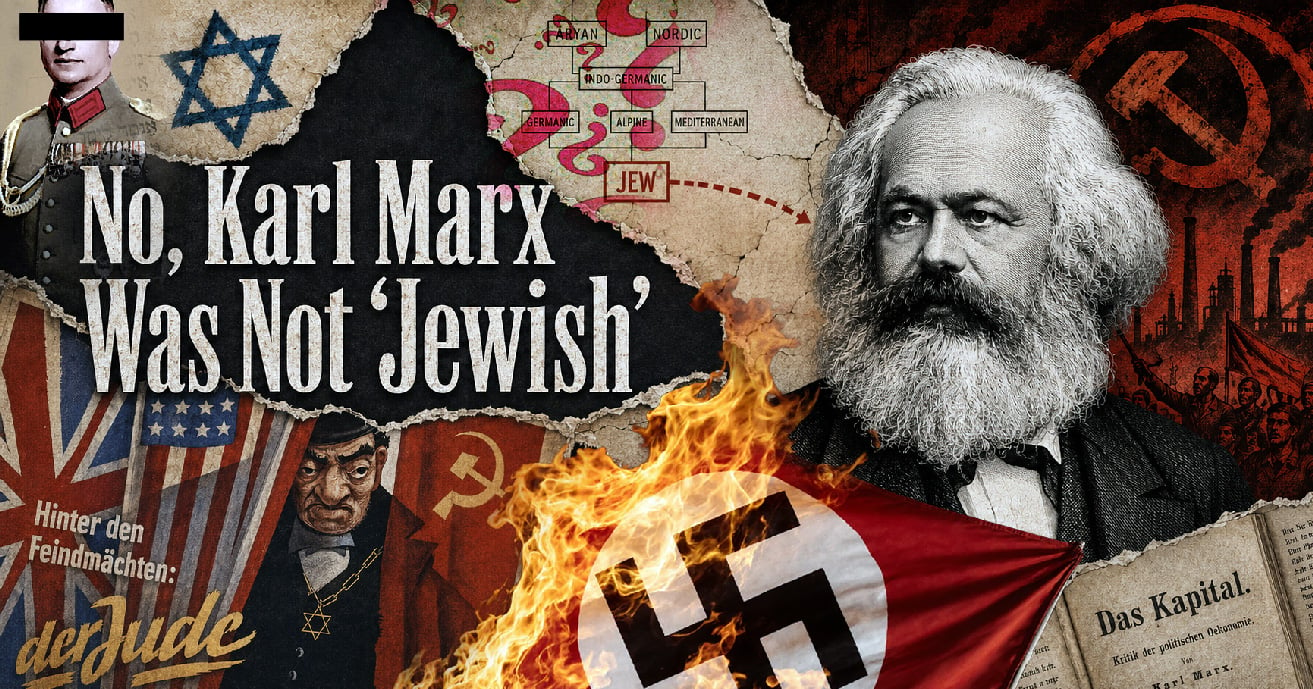
Image used with permission, from the Hashlamah Project.
In the 2001 film The Believer, starring Ryan Gosling as Daniel “Danny” Balint, a Jewish-born neo-Nazi, the protagonist asks whether antisemites hate Jews for entering spaces where they supposedly do not belong or for remaining separate; for hoarding money or displaying it; for being communists or capitalists. His conclusion is that none of these purported explanations is the real reason: Jews are hated “because they exist.” The contradictory accusations are merely interchangeable rationalizations devised after the hatred has already been established.
“Do we hate them because they push their way in where they don’t belong? Or do we hate them because they’re clannish and keep to themselves? Because they’re tight with money, or because they flash it around? Because they’re Bolsheviks, or because they’re capitalists? Because they have the highest IQs, or because they have the most active sex lives?
Do you want to know the real reason we hate them? Because we hate them. Because they exist. Because it’s an axiom of nature that just as man longs for woman, loves his children, and fears death, he hates Jews.
There’s no reason. If there were, some smartass k*** would try to come up with an argument, try to prove us wrong. And of course that would only make us hate them more. In fact we have all the reasons we need in three simple letters: J-E-W. Jew.”
The claim in part confronted within this narrative is that Karl Marx (1818 – 1883)—and therefore Communism—is commonly regarded as part of a “Jewish plot,” by anti-communist Antisemites in particular. This strange allegation, however, is easily dismantled with even a modicum of historiographical surface-scratching or even common logic and critical thinking.
More importantly, the bizarre internal contradictions of this newly-resuscitated meme-educated pseudo-intellectualism reveal the allegation for what it is: a pretext for attacking Jews regardless of any actual Jewish practice or beliefs, loyalties, economic positions, religious commitments or political orientations. As with the narrative observations of Danny Balint, Jews are simultaneously and paradoxically condemned as both capitalists and communists; wealthy financiers and impoverished revolutionaries; rootless cosmopolitans and clannish separatists.
The charges and accusations against the Jewish people change whenever circumstances require them to. This is because the accusation was never based upon coherent reasoning in the first place. Such claims were merely pretexts for anti-Jewish hatred.
In his 1946 essay Anti-Semite and Jew, Jean-Paul Sartre (1905 – 1980) argued that antisemitism is a game of Bad Faith. The antisemite manufactures absurd claims to force Jewish people into a defensive posture, not for truth, but to validate the antisemite’s own prejudices and power.
This remains painfully relevant in the age of TikTok historiography, meme-based political education and algorithmically cultivated outrage. A generation conditioned to consume historical claims in fragments encounters the allegation that Marx was Jewish and Communism was consequently a Jewish conspiracy. No serious investigation of Marx’s life, religious formation or writings follows. Jewish ancestry is simply converted into Jewish identity, Jewish identity into collective culpability, and collective culpability into a conspiracy theory implicating millions of people who had nothing to do with Marx or Marxism.
Ancestry Is Not Religious or Communal Identity
Karl Marx had Jewish ancestry. Both sides of his family included Jewish ancestors, as did a considerable number of assimilated and converted European families. That biographical fact is not in dispute. But ancestry alone does not establish a person’s religion, communal affiliation, intellectual tradition or self-understanding. Treating Jewish ancestry as an indelible racial essence ironically accepts the very definition of Jewishness which modern antisemites often disavow with their newfangled claims of Khazarian origins for Ashkenazi Jewry.
Marx’s father, Heinrich Marx (1777 – 1838), converted to Lutheran Christianity long before Karl’s baptism. Karl Marx was baptized into the Evangelical Church in 1824, when he was six years old, and was later confirmed as a Christian. Before later rejecting religion across the board, Marx professed Christianity, but never Judaism nor Jewish identity. He received no meaningful Jewish education, did not participate in Jewish communal life, did not observe Torah, Jewish holidays or Jewish religious rites, and ultimately rejected Christianity as well, embracing an explicitly atheistic worldview. The University of Chicago Library’s biographical account accordingly notes that Marx was baptized at six, had no Jewish education and became an atheist.
Marx was therefore a European intellectual of Jewish ancestry, just as innumerable secular or Christian Europeans possessed ancestors from religious communities to which they no longer belonged. He was not a rabbi, Jewish theologian, Torah scholar, synagogue member or representative of the Jewish people. He did not formulate Communism from within Judaism, ground it in Jewish scripture or present it as the political expression of Jewish communal interests.
Marx’s Own Words About Yahadut–Jewry and Judaism
Marx’s own writings make the attempt to present him as a representative Jewish thinker especially bizarre. In a letter to Arnold Ruge dated March 13, 1843, Marx acknowledged plainly: “However much I dislike the Jewish faith, Bauer’s view seems to me too abstract” (Karl Marx to Arnold Ruge, March 13, 1843).
The context must be stated accurately: Marx was rejecting Bruno Bauer’s argument that Jews should be denied political emancipation unless they first abandoned Judaism. Marx supported their civil equality. Nevertheless, his statement leaves no doubt about his personal attitude toward the Jewish religion.
That antipathy became considerably uglier in “On the Jewish Question,” written in 1843 and published in 1844. There Marx asked, “What is the secular basis of Judaism? Practical need, self-interest.” He continued: “What is the worldly religion of the Jew? Huckstering.” He then asked, “What is his worldly God?” and answered: “Money” (Karl Marx, “On the Jewish Question,” 1844, pt. 2).
Marx was attempting to use “Judaism” as a metaphor for the commercial egoism of bourgeois society. His argument was not simply that Jewish merchants participated in capitalism. He conceptually associated Jewishness itself with commerce, money, private interest and capitalist alienation. Christian society had, in his formulation, become “Jewish” insofar as money had become its ruling power.
Defenders of Marx correctly observe that the essay supported immediate Jewish civil emancipation and that Marx intended to condemn Christian capitalist society rather than construct a political program against Jews. That context matters. It does not, however, erase his reliance upon one of Christian Europe’s oldest and most destructive stereotypes: the Jew as the embodiment of money, commerce, selfishness and social corruption. Marx could defend the legal rights of individuals of Jewish background so long as they disavowed Yahadut—while simultaneously deploying profoundly anti-Jewish ideas about Judaism and Jewish character. Those positions are contradictory, but they are not—they are quite consistent with Marx’s antisemitism and ancestral self-hatred.
Marx’s Racist Abuse of Ferdinand Lassalle
Marx’s private correspondence could be even more vicious. On July 30, 1862, he wrote to Friedrich Engels about Ferdinand Lassalle, the Jewish socialist and formative leader of the German workers’ movement. Marx called him “the Jewish n****r Lassalle”—using the English racial slur in the original correspondence. He then claimed that the shape of Lassalle’s head and the growth of his hair demonstrated descent from Africans who had accompanied Moses during the Exodus.
Marx described Lassalle as a combination of “Jewishness and Germanness” with “basic negroid stock,” which, he asserted, had necessarily produced a “peculiar product.” He concluded by describing Lassalle’s behavior as “n***er-like” (Karl Marx to Friedrich Engels, July 30, 1862; Marx and Engels Collected Works, vol. 41, 388–90). The surviving letter is unambiguous: this was simultaneously anti-Jewish and anti-Black racial abuse, constructed through the pseudo-biological language of inherited physical and behavioral characteristics.
This does not prove that every element of Marx’s economic analysis was motivated by antisemitism, nor does it transform Marx into an advocate of pogroms or Jewish legal disabilities. Historical accuracy requires distinctions. But it decisively disproves the effort to present Marx as an exponent of Judaism or a meaningful representative of Jewish thought. Marx’s ancestry did not prevent him from rejecting Judaism, employing hostile stereotypes about Jews, or racially abusing a Jewish political rival.
The Slack-Brained Conspiracy Theory That Accuses Jews of Anything and Everything
The “Jewish Communism” conspiracy theory becomes still more incoherent when placed beside the equally persistent allegation that Jews are the architects and principal beneficiaries of capitalism. Antisemites blame Jews for Wall Street and Bolshevism; banking and revolution; globalism and tribal separatism; materialism and religious fanaticism. The same people are accused of controlling both capital and labor, both governments and anti-government movements, both immigration and nationalism.
These accusations cannot collectively describe reality. Their incompatibility is precisely the point. Antisemitism does not begin with evidence and arrive reluctantly at hostility. It begins with hostility and manufactures whatever evidence appears momentarily useful.
When a Jew succeeds in business, the success becomes proof of financial conspiracy and a Jewish hand controlling capitalism. When a person of Jewish ancestry becomes an enemy of capitalism, the revolution becomes proof of a Jewish conspiracy against capitalism. When Jews assimilate, we are accused of infiltration. When we maintain communal identity, we are accused of refusing integration.
The Marx allegation follows this exact pattern. Marx’s Jewish ancestry is treated as decisive whenever antisemites want to associate Jews with Communism. His Christian baptism, Christian upbringing, atheism, rejection of Judaism, absence from Jewish communal life and documented anti-Jewish rhetoric are then discarded as irrelevant. The conspiracist demands a racial definition of Jewishness because no religious, cultural or communal definition would accomplish the desired accusation.
Marx Was Not Jewish, and Communism Was Never a Jewish Plot
Communism should be evaluated on the basis of its ideas, historical movements, regimes, successes, failures and crimes. Jewish communities should be evaluated according to neither Marx nor the governments that later invoked his name. Jews were present among communist movements, just as Jews were present among liberals, conservatives, social democrats, capitalists, monarchists, religious traditionalists and opponents of Communism. Millions of Jews were also persecuted by communist governments, had their religious institutions suppressed, were accused of bourgeois nationalism, or were targeted by officially orchestrated anti-Zionist campaigns that frequently reproduced classical antisemitic imagery.
Karl Marx had Jewish ancestors, but there is no historian whatsoever who believes that he was Jewish in religion, education, observance, communal membership or mature intellectual allegiance. He was baptized and raised as a Christian, later became an atheist, and eventually rejected Judaism and Jewry with all the rabidity and hatred of the blondest and most blue-eyed of self-described German “Aryans.”
The claim that Communism was therefore a Jewish plot tells us nothing meaningful about Marxism and even less about Judaism. It tells us something about antisemitism: whatever Jews do, whatever we believe, and even when Jews abandon Judaism altogether, the antisemite will still find a way to make “the Jews” collectively guilty. This is because in the eyes of the Antisemite, Jews are guilty for merely existing, for refusing to die, and even worse–in the case of Zionism–for daring to fight back against Caliphal Colonial terrorism, the Nazi-Palestinian Mufti alliance (and the directly Nazi-funding of the Arab Revolt of the 1930s).
Sartre and the Antisemite’s Imaginary Jew
Jean-Paul Sartre identified precisely the mechanism behind the mutually contradictory allegations that Jews control both capitalism and Communism. In Réflexions sur la question juive, published in English as Anti-Semite and Jew, Sartre argued that antisemitism does not arise from any rational assessment of Jewish conduct.
The antisemite first constructs an imaginary, metaphysically evil “Jew” and then interprets every event as evidence of that invention. “Far from experience producing his idea of the Jew,” Sartre wrote, “it was the latter which explained his experience.” He consequently reached his celebrated conclusion: “If the Jew did not exist, the anti-Semite would invent him.”
Sartre addressed the supposed contradiction between “Jewish capitalism” and “Jewish Bolshevism” directly. Antisemites, he observed, speak of an alleged Jewish desire for world domination and then claim, virtually in the same breath, that behind the Jew lurk “international capitalism” and “piratical Bolshevism.” They feel no embarrassment about blaming Communism on Jewish bankers who would be horrified by it while simultaneously blaming capitalist imperialism on impoverished Jews who possess no capital whatsoever.
This is the precise architecture of the Marx conspiracy theory. Marx’s Jewish ancestry is invoked to portray Communism as Jewish, while the Jewish communities Marx rejected are elsewhere accused of controlling the capitalist institutions Marxism sought to abolish. The contradiction does not weaken antisemitism because antisemitism was never an evidentiary conclusion. It is a preexisting passion searching for interchangeable pretexts.
Sartre therefore warned against assuming that antisemites are innocently unaware of the absurdity of their assertions. “Never believe that anti-Semites are completely unaware of the absurdity of their replies,” he wrote. “They know that their remarks are frivolous, open to challenge.” Yet they amuse themselves because their opponents feel obligated to use language responsibly.
By offering ridiculous explanations, antisemites force their interlocutors to expend time disproving allegations that were never advanced in good faith. They “delight in acting in bad faith,” Sartre explained, because their purpose is “not to persuade by sound argument but to intimidate and disconcert.” When finally cornered, “they will abruptly fall silent, loftily indicating by some phrase that the time for argument is past.”
Written before the internet, Sartre’s description anticipates the online troll, the bad-faith provocateur, and the propagandist who inundates public discussion with claims that require seconds to invent and hours to refute. The contemporary digital environment has intensified the behavior Sartre diagnosed. Anonymity reduces personal accountability; algorithms reward anger and provocation; compressed video encourages historical assertions without context; and online communities permit conspiracists to surround themselves with endless repetitions of their own assumptions. The antisemite can move instantly from “Jews control capitalism” to “Jews invented Communism,” then dismiss every documented rebuttal as further evidence of Jewish manipulation. Every outcome confirms the theory because the imaginary Jew has been defined in advance as the hidden cause of every undesirable event.
For Sartre, this was not merely an intellectual error. Antisemitism was a chosen emotional and moral orientation: “The anti-Semite has chosen hate because hate is a faith.” Hatred relieves the antisemite of uncertainty, self-examination, and responsibility. Instead of confronting complicated historical forces, personal failures, or competing human interests, he attributes them to a single malevolent population. The Jew becomes the universal explanation that permits him never to examine himself.
This is also why the antisemite needs the crowd. Sartre described him as someone who “fears every kind of solitariness” and makes himself smaller lest he stand apart from the herd and confront his own consciousness. “He has made himself an anti-Semite because that is something one cannot be alone.” Online echo chambers furnish precisely this refuge: thousands of interchangeable accounts repeating the same memes, applauding the same slurs, and reassuring one another that repetition constitutes proof.
Sartre’s final diagnosis was existential. The antisemite fears his own liberty, responsibility, uncertainty, and isolation. The Jew merely supplies a target upon whom those fears can be projected. “Anti-Semitism, in short, is fear of the human condition.” The antisemite wishes to become “a pitiless stone, a furious torrent, a devastating thunderbolt—anything except a man.”
The allegation that Marx proves Communism was a Jewish plot is a textbook demonstration of Sartre’s argument. It does not matter to the conspiracist that Marx was baptized and raised as a Christian, became an atheist, received no Jewish education, rejected Judaism, remained outside Jewish communal life, and reproduced vicious anti-Jewish stereotypes. The antisemite does not investigate the historical Marx and then reach a conclusion about Jews. He begins with an imaginary Jew responsible for everything and transforms Marx into whatever that fantasy requires.
Sartre’s verdict remains decisive: the antisemite does not discover “the Jew” in history. He invents him.
Related Topics
Related Posts