
Journalist, Musician, Poet
No Kings, No Ayatollahs: Let Iranians Choose!
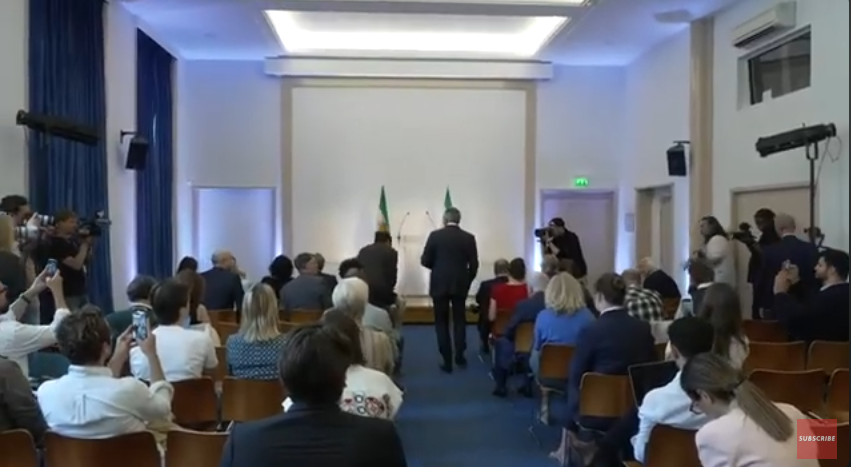
Only one person stands for the "Crown Prince," Reza Pahlavi (Khan), as it should be.
When it comes to respecting people’s “titles,” I only respect those earned through merit or democracy. If I come across a PhD in philosophy or physics, I will address them as “Doctor”—unless they insist I use their first name. Should I encounter elected officials, whether I like them or not, I will usually address them by their elected position: senator, congressman/woman, etc.
But the titles I do not respect—at all—are those of monarchs or fundamentalist clerics. I’ll never, for example, address anyone as “Your Highness,” unless it’s one of the two surviving Beatles or one of the Gallagher brothers.
Should I ever encounter the leader of Saudi Arabia, I’ll address him as “sir” or “Mr. Salman.” If I ever meet the King of England, I might extend a hand and say, “Good to meet you, Mr. Windsor.” That same principle applies to Osama Bin Laden or Hassan Nasrallah, who insisted on being addressed as “Sheikh”—and to Mr. Mohammad Reza Pahlavi Jr., who still claims to be the “Crown Prince” of Persia. He has not earned this title, and people should not acknowledge his claim to monarchy. He says he “does not seek political power,” yet recommends himself to lead Iran through a “democratic process.”
We should also remember the true legacy of his family in Iran. Reza Khan, a soldier in the British-run Persian Cossack Brigade during the 1920s, seized power in a London-backed military coup. He overthrew the Qajar Dynasty and was later “selected” by the Majlis—an Arabic Islamic council—to be the next Shah. Khan adopted the name Pahlavi in honor of a medieval Persian ruler. While many today try to rewrite history by portraying the Pahlavi era as one of secularism and pluralism, we should never forget that Reza Khan and his successors practiced Shia Islam and derived legitimacy from religious clerics.
Recently, I watched a 1976 60 Minutes interview with Reza “Shah” Pahlavi. What shocked me most was how he spoke about Israel and Jews in America. His rhetoric sounded as if it were taken directly from The Protocols of the Elders of Zion. While Pahlavi claimed to support a sovereign Israel, his actual language painted a far uglier picture. The interviewer, Mike Wallace, pressed him:
Wallace: “Surely, Your Majesty, you’re not telling me that the Jewish lobby in the United States pulls the strings of the presidency?”
Pahlavi: “Not entirely, but I think even a little too much, even for Israel’s interests.”
Wallace: “You think the Jewish lobby is too powerful for Israel?”
Pahlavi: “I think so. Sometimes they are disserving the interests of Israel. They’re pushing around too many people.”
Wallace: “How do you mean, ‘pushing around’?”
Pahlavi: “Well, pressuring. They have many means at their disposal. They are putting up pressure on many, many people, and in the end I don’t think that it will even help Israel.”
Wallace: “Why, if this is true, would the President of the United States pay attention to that lobby?”
Pahlavi: “They are strong.”
Wallace: “Strong in what sense?”
Pahlavi: “They are controlling many things.”
Wallace: “Controlling what?”
Pahlavi: “Newspapers, media.”
Wallace: “Your Majesty…”
Pahlavi: “Banks, finances. And I’m going to stop there.”
Wallace gave him every opportunity to walk it back. He didn’t. He doubled down. These words could’ve come from Candace Owens—or any number of reactionary grifters trafficking in antisemitic tropes today. Let us also not forget how Mohammad Reza Pahlavi, the founding monarch of this dynasty, was a close ally of Hitler both before and throughout the war.
Like all monarchies and dynasties, the Shah’s downfall is surrounded by mythology. One popular myth is that Ayatollah (another title I don’t respect) Ruhollah Khomeini came to power because of the 1979 Iranian Revolution. In truth, Khomeini came to power in spite of that revolution.
The 1979 uprising was diverse—led by leftists, students, workers, feminists, and religious reformers. But by 1983, Khomeini and his clerical forces had hijacked the revolution and consolidated power. If one event enabled his rule more than any other, it was Saddam Hussein’s U.S.-backed invasion of Iran in 1980. In effect, the Pahlavi Dynasty was simply replaced by the Khomeini Dynasty—which still rules, but likely not for much longer.
Another myth is that Pahlavi was “exiled” and forbidden from returning. In fact, the Iranian people demanded his return so he could face justice—a demand the U.S. ignored. He died in comfort abroad, shielded from accountability. And yet, in an almost comedic display of arrogance, his son—the so-called “Crown Prince”—recently declared that if Khomeini steps down, he’ll be shown mercy in court. Excuse me?
Let’s not forget the crimes of Reza Khan and his secret police, the SAVAK. They tortured and killed political dissidents both inside and outside Iran. Some of their victims are still alive. They’ve never seen justice—because the United States made sure of it.
The demand to extradite the Shah was one of the core terms during the U.S. embassy hostage crisis. The U.S. and U.K. had overthrown Iran’s only democratically elected government in 1953, because Mohammad Mossadegh leaned toward socialism. (Miss the Soviet Union yet, Bibi?) That coup set the stage for both the Shah and Khomeini’s rise.
Then, in the 1980s, the Reagan administration—and certain Israeli officials—secretly armed the Islamic Republic through the Iran-Contra scheme. So while both nations condemn Iran’s regime today, they helped build it. Taking military action to dismantle Iran’s nuclear program may have been their prerogative. But choosing Iran’s next ruler is not.
If the U.S., U.K. and Israeli governments truly wish to support the Iranian people, they should apologize—not just for strengthening Khomeini early on, but for destroying their democracy in the 1950s in the case of the two big powers. If an apology is too much to expect, then at the very least, to borrow a word from Donald Trump, they can stay the “f***” out of the upcoming democratic process. Israel is correct in dismantling the mullah regime, but if big regional powers are allowed to install a puppet in place of the Khomeini Dynasty over the objections of the Iranian people, then it will have all been an utter waste.
The crimes of the Khomeini Dynasty do not absolve the crimes of the Pahlavi Dynasty. Iran does not need a king. Iran needs and has a future—one that belongs to its people.
Related Topics
Related Posts