Life Member, Hadassah Westchester, Hadassah Writers' Circle
No More Martyrs: Slaughter in Pittsburgh, Poway, Israel, Boulder and Sydney
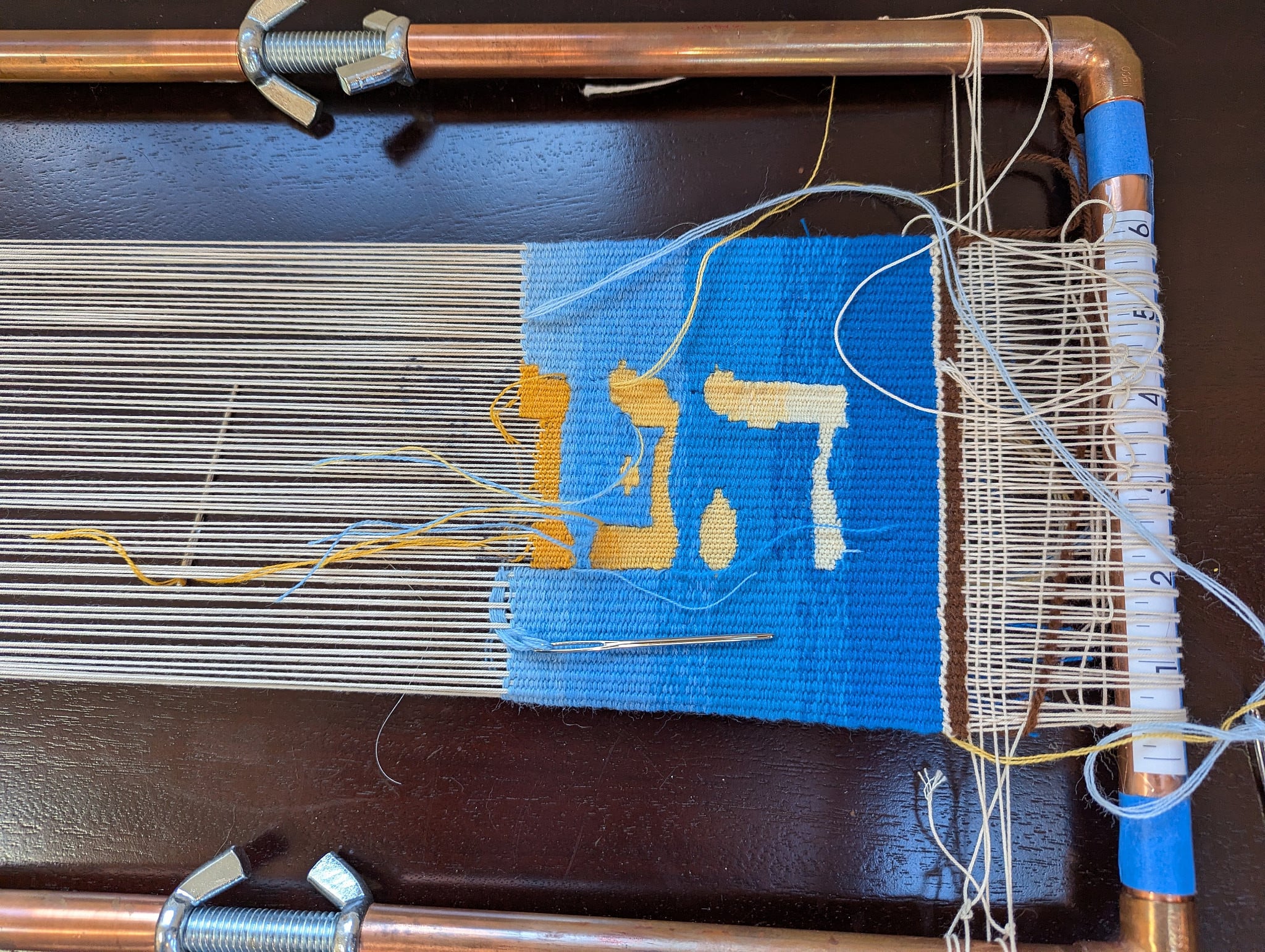
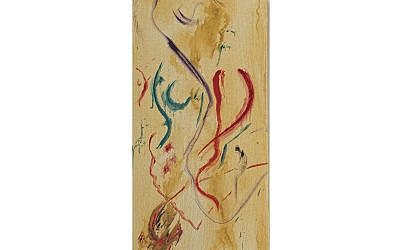
Henanni - a work in progress by the author. Wool weft on cotton warp. Image courtesy of the author.
Over seven years ago, just after the 27, 2018, massacre in a Pittsburgh synagogue, I had no idea that this was the start of a trend. I sputtered with rage, grief and confusion at the murder of 11 congregants and the wounding of two others, simply because they were Jews, as well as the wounding of four police officers who bravely responded to their call.
And then came Poway, California (2019), Israel (2023), and Boulder, Colorado (2025), among other murderous attacks on Jews in various countries. In youth group and summer camp, I’d learned Jewish joy and Jewish grief so I knew that efforts to kill Jews for simply being Jews have been with us since time immemorial.
On October 28, 2023, five years after the Pittsburgh massacre, as my current synagogue marked the yahrzeit (the anniversary) of the Pittsburgh massacre, I agonized over the escalating numbers. That day I told the congregation that “in light of the Hamas attack on Israel three weeks ago, the 11 massacred in Pittsburgh seem trivial. I struggle to remember that the horrific count of deaths is not a competition.” I then spoke about each individual’s life lest they be remembered only for the manner of their deaths.
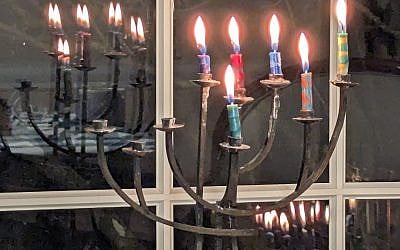
And now, in 2025, I am thrown back into the numb incomprehension of those earlier massacres, as Jews had once again been slaughtered, this time as they gathered in joyful celebration of Hanukkah at Bondi Beach, Australia.
On one Shabbat in October 2018, it was my turn to lead our Torah discussion. We were studying Genesis chapters 21 and 22, in which Isaac is born and Ishmael, son of Hagar and Abraham are cast out of Abraham’s clan and into the desert. Abraham then takes Isaac, his other son, to Mount Moriah, purportedly to offer him as a sacrifice to the God who had found Abraham just a few chapters earlier.
I’d spent weeks reading and rereading the text in three different “translations,” building on our rabbi’s admonition that “translation is always interpretation.” I’d read footnotes, commentaries, and sermons. I’d studied my two-volume Hebrew-English/English-Hebrew dictionary, trying to parse the root meanings of words and phrases.
These texts are well-known and often commented on, and so, with my fractured understanding, I followed in the shadow of ancient and medieval rabbis and in the footsteps of modern scholars, family psychologists and feminist thinkers. Though it was well-trod ground, the material for meaningful study is endless.
The stories are short, the storytelling brilliant. The biblical Hebrew is nuanced and lyrical. I started our discussion with an open call for all questions these biblical stories raise.
Questions abounded, but answers are scarce. We asked why God felt the need to test Abraham, the acolyte who had already done so much to show devotion. I questioned why God needed Abraham to show fear. Why in heaven’s name does God need to feel feared? What about honored, followed, respected, obeyed? Others in our group questioned how God could promise Abraham vast numbers of descendants while instructing him to sacrifice the sole offspring needed to make progeny possible.
What kind of God needs this sort of human sacrifice? Why does Abraham immediately take steps to meet this demand? What kind of God demands slaughter of the innocent?
Why do Hagar, whose name means “the stranger,” and her son, Ishmael, need to be sent into the wilderness?
Though I did not know it yet, on that very Shabbat morning, an evil man had begun to murder my friends and co-religionists in the Squirrel Hill neighborhood of Pittsburgh, where I had grown up. Indeed, in a synagogue my parents had helped found.
Why did he do it? Because, to him, we, Jews, are strangers and dangerous.
When I arrived back home that morning, my husband called out: “There was a shooting in Pittsburgh!” And so, I learned of the attack.
Since the public reports were scanty, I texted two people whom I was sure would know more: the cantor, whom I’ve known since third-grade Hebrew school, and the kind person who is always the first to visit the sick and run errands for the elderly. The former (thank goodness) was out of town visiting family. But she told me the latter was terribly wounded. Others, including a doctor who had visited my elderly mother and father every day when they were in the hospital, were now dead.
The coincidence of the timing, the intertwining of this assault and the latent violence of the Biblical story was chilling: Scholars point out that Abraham, who had not previously hesitated to argue with God, offered no spoken challenge when told to sacrifice Isaac. Rather, Abraham said nothing. Then, just at the last moment, God backed down, sending a messenger to stop the butcher’s knife before Isaac could be killed. In the end, in this elegantly told story, we are left without knowing if Abraham would have gone through with the sacrifice.
I choose to believe that Abraham did not, would not, promise God that he would end his son’s life. And Isaac certainly did not agree to be sacrificed to demonstrate his fear of God. Slaughter does not honor anyone.
Today, as in 2018 and 2023, I don’t know how to think about this latest massacre in Australia. But it’s also hard to think about anything else. Still, I am now less interested in “why” these massacres occur than in identifying the hard work incumbent on all of us to enable all individuals, in the words of Deuteronomy 30:19, to “choose life.”
The day that God and Abraham acted to preserve life also initiated the multigenerational Jewish story. And, although there have been and still are people who think it’s ok to kill Jews, we remain culturally committed to tikkun olam, to healing the world.
In this, I believe that even small steps matter. Accordingly, even as I continue to explore direct civil and political options, I’ll start by reviewing my charitable giving. When possible, I will redouble my efforts to route contributions to non-Jewish causes through Jewish organizations (such as the Joint Distribution Committee, the American Jewish World Service and the Jewish Council for Public Affairs), which serve hurting communities and defend their rights, regardless of ethnicity. I want no one to doubt that, despite our troubles, Jews continue that healing work.
And, of course, I continue to support my volunteer organization Hadassah, whose two hospitals in Jerusalem serve all patients, through world-renowned healing, teaching and research.
Michele is a member of the Hadassah Writers’ Circle, a dynamic and diverse writing group for leaders and members to express their thoughts about all the things Hadassah does to make the world a better place. It’s where they celebrate their personal Hadassah journeys and share their Jewish values, family traditions and interpretations of Jewish texts. Hadassah members are proud of their Zionist mission and their role as keepers of the flame of Jewish values, traditions and beliefs as well as advocating for women’s empowerment and health equity for all. Since 2019, the Hadassah Writers’ Circle has published nearly 800 columns in The Times of Israel Blogs and other Jewish media outlets. Interested? Please contact hwc@hadassah.org.
Related Topics
Related Posts