
Middle East Forum Fellow/North Africa Risk Consultant
No More Red Line: Why Israel Must and Will Deter Hezbollah’s Rematch
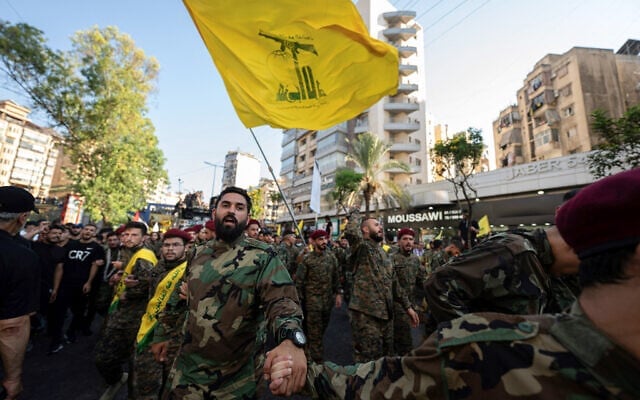
Credit: via AFP
Nearly a year into the fragile ceasefire between Israel and Hezbollah, the illusion of calm along the northern border is quickly fading. Beneath the surface of supposed stability, Hezbollah has been quietly rebuilding its war machine. Intelligence sources confirm that the Iran-backed militia is smuggling in rockets, rearming its southern Lebanon strongholds, and recruiting new fighters under the cover of reconstruction. Israeli jets, aware of the threat, have continued targeted strikes on Hezbollah’s military infrastructure, determined not to allow a repeat of the October war scenario. The next confrontation, if it comes, will not be another round of mutual deterrence but a decisive reckoning.
Israel, for its part, has learned that deterrence through restraint is no longer sustainable. The old “red line” that once tolerated Hezbollah’s presence in southern Lebanon has evaporated. Since the October war, Israeli defense doctrine has shifted from reactive to preemptive. Jerusalem now treats every Iranian proxy as an active threat, not a potential one. The Israel Defense Forces have adapted accordingly, combining precision airpower with real-time intelligence and deep-strike capabilities that make Hezbollah’s underground networks increasingly vulnerable. The message is simple: Israel will not wait for missiles to fall on Haifa or Tiberias before responding. It will strike first, hard, and decisively.
Lebanon’s political class, meanwhile, remains paralyzed. The government’s inability or unwillingness to disarm Hezbollah has turned the country into a hostage of its own militia. While Hezbollah diverts state resources to fund its parallel army, the Lebanese people are living through one of the worst economic collapses in modern history. Banks are bankrupt, infrastructure is decaying, and half the population lives below the poverty line. In this vacuum, Hezbollah presents itself as both protector and provider, even as it endangers Lebanon’s very survival by provoking a war it cannot win. Israel knows this reality all too well, and it will no longer allow its northern border to be dictated by a failed state.
The next Israeli-Hezbollah confrontation, if it erupts, will not be a repeat of 2006. Israel’s technological superiority, coupled with the lessons of urban warfare learned in Gaza, gives it a decisive edge. Hezbollah’s arsenal may be larger than ever, but its strategic depth is shrinking. Its command posts, tunnels, and weapons depots are mapped and monitored. Every rocket launch site is a target waiting for authorization. Israeli defense planners are preparing not for another limited skirmish but for a campaign aimed at dismantling Hezbollah’s military infrastructure once and for all. The goal will not be deterrence through damage but deterrence through destruction.
Critics in Europe and the UN will predictably call for restraint. They will warn of escalation and humanitarian crises. But Israel cannot be expected to tolerate a heavily armed Iranian proxy sitting meters from its border, stockpiling rockets capable of reaching every major Israeli city. International diplomacy failed to disarm Hezbollah after 2006, and UN Resolution 1701 has become little more than ink on paper. The responsibility to ensure security now rests with those who have the will and capability to enforce it. For Israel, that means acting before Hezbollah turns southern Lebanon into another Gaza.
Hezbollah’s calculations are built on the belief that Israel fears a wider war. That assumption may have been valid once, but no longer. The Israeli public understands that allowing Hezbollah to rearm freely only guarantees a deadlier conflict later. The Israeli government, backed by strong US support, is prepared to enforce deterrence on its own terms. The choice now rests with Hezbollah and its Iranian masters. They can either back down quietly or face a response that will rewrite the rules of engagement in the north.
Related Topics
Related Posts