No Pride in a Color-Blind Rainbow
Pride parade participants showing support for Palestine have become one of the more reliable plot twists of recent Western street politics. In city after city, Pride events have seen pro-Palestinian, anti-Zionist, and increasingly anti-Israel activism move from the edge of the route to the middle of the road, quite literally.
This is not subtle stuff. In Philadelphia, pro-Palestinian protesters interrupted the Pride March with “No Pride in Genocide” messaging and pro-Palestinian chants. In Boston, protesters temporarily blocked the Pride route, with local reports describing clashes with police and several detentions. In Toronto, anti-Israel and pro-Palestinian protesters blocked the parade route and forced organizers to cut the event short. In Ottawa, the Capital Pride parade was cancelled after Queers for Palestine blocked the route near Parliament Hill. In New York, activists blocked part of the Pride March near Stonewall, broke through barricades, and threw red paint or fake blood at the Human Rights Campaign float, because apparently nothing says liberation like making someone from event operations Google “how to remove theatrical blood from vinyl signage” on a Sunday afternoon.
The slogans have settled into a kind of liturgy. “No Pride in Genocide.” “No Pride in Apartheid.” “Queers for Palestine.” “Zionists out.” “No queer liberation without Palestinian liberation.” They are short, portable, camera-friendly, and best delivered in a crowd where nobody is expected to explain what would happen to the average Pride marcher if they attempted to hold the same parade in Gaza, Tehran, or much of the West Bank.
That’s the awkward little detail, isn’t it? The one everyone sees, then politely steps around like a suspicious brown, squishy object on the sidewalk.
A Pride parade in Tehran would almost certainly not be allowed to proceed in any ordinary public sense. It would likely be stopped before it began or broken up quickly by security forces. Participants would face detention, interrogation, execution, family retaliation, loss of employment, surveillance, and worse. In Gaza, a Pride parade would likely be impossible to hold safely at all, with organizers and marchers facing the risk of immediate death, armed-group violence and community retaliation. The same is true in the West Bank.
So naturally, the political energy of some Western Pride movements has concentrated on the real villain here: Jewish LGBTQ groups trying to march with a Star of David somewhere near a rainbow.
You have to admire the rhetoric A Pride event in a liberal city, protected by police barriers, municipal permits, sanitation crews, corporate insurance, and several layers of civil rights law, becomes the perfect venue to denounce the one country in the Middle East where large public Pride events actually happen. The moral courage is almost too much to bear.
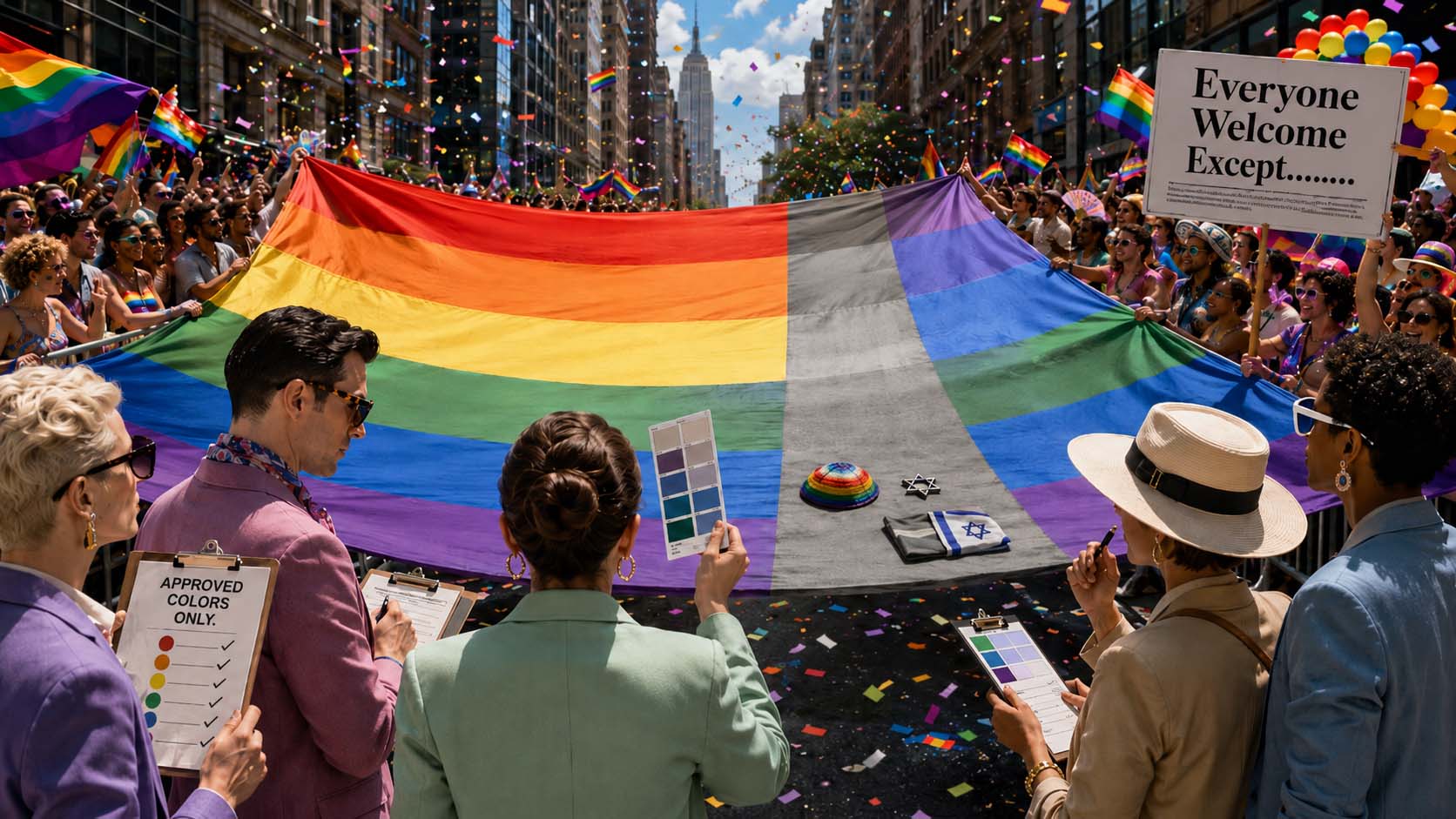
Rome Pride reportedly barred Keshet Italia, Italy’s only Jewish LGBTQ group, from participating with a float because it would not sign a political platform condemning Israel’s actions in Gaza as genocide. Montreal Pride initially excluded Jewish groups, including Ga’ava and CIJA, then reversed the decision and apologized after backlash. Sydney Mardi Gras barred Pride in Protest after posts accused Dayenu, a Jewish LGBTQ group, of being “pro-genocide.” In Bologna, Israeli and anti-Iranian-regime participants reportedly said they were pushed, verbally accosted, and forced out after displaying a rainbow Israeli flag and a Star of David symbol, while chants of “Zionists out” were heard.
Of course, we are assured this is not about Jews. It is never about Jews. It is only about Zionists, which apparently includes Jewish LGBTQ groups, Jewish community organizations, Israelis with rainbow flags, people insufficiently eager to sign the exact genocide language drafted by activists, and anyone who fails the increasingly delicate purity test administered beside the glitter booth.
Corporate sponsors have become convenient villains, too. Cisco, Boeing, the Human Rights Campaign, Pride committees, city officials, and whoever else can be accused of “pinkwashing” or complicity. The accusation does a lot of work. It allows activists to turn a Pride parade into a foreign-policy tribunal without the boredom of evidence standards, legal definitions, or acknowledging that many LGBTQ Palestinians face danger from their own authorities, armed groups, families, and communities. Never let facts and details get in the way of a good persecution. They ruin the poster.
And that is where the irony stops being funny and starts becoming something uglier.
Pride began, at least in its modern public mythology, as a demand to be seen. Bodies in the street. Names spoken out loud. Police no longer deciding who gets to exist in public. The whole point was that visibility should not depend on permission from the powerful, approval from the fashionable, or silence from the inconvenient.
Now some Pride spaces seem increasingly willing to tell certain Jews, Israelis, and Zionists that their visibility is conditional.
Everything has every right to be debated, protested, defended, criticized, and mourned over. Civilian suffering everywhere is real. Anger over war is real. The impulse to bring politics into Pride is not new either. Pride has always had politics in its bloodstream.
But there is something grimly absurd about watching Western activists use Pride, of all places, to single out Israel while showing such tender curiosity toward movements and societies that would not only refuse them a parade permit, but would criminalize the dream of asking for one.
That is not solidarity. It is theatre with a megaphone, a keffiyeh, and a strange habit of finding the nearest Jewish float.
And maybe that is the question Pride now has to answer. Not whether it can fit one more slogan onto a placard. Not whether it can find one more sponsor to denounce. Not whether it can shout “liberation” loudly enough to drown out the contradictions.
The question is simpler, and much more uncomfortable:
If the rainbow only protects people who pass the politics test, then what exactly is it protecting?
Because a movement that began by insisting nobody should be forced back into the closet should think very carefully before it starts building new closets of its own.