
Where Objectivity Meets Reality
No right to speak: London lit this fire
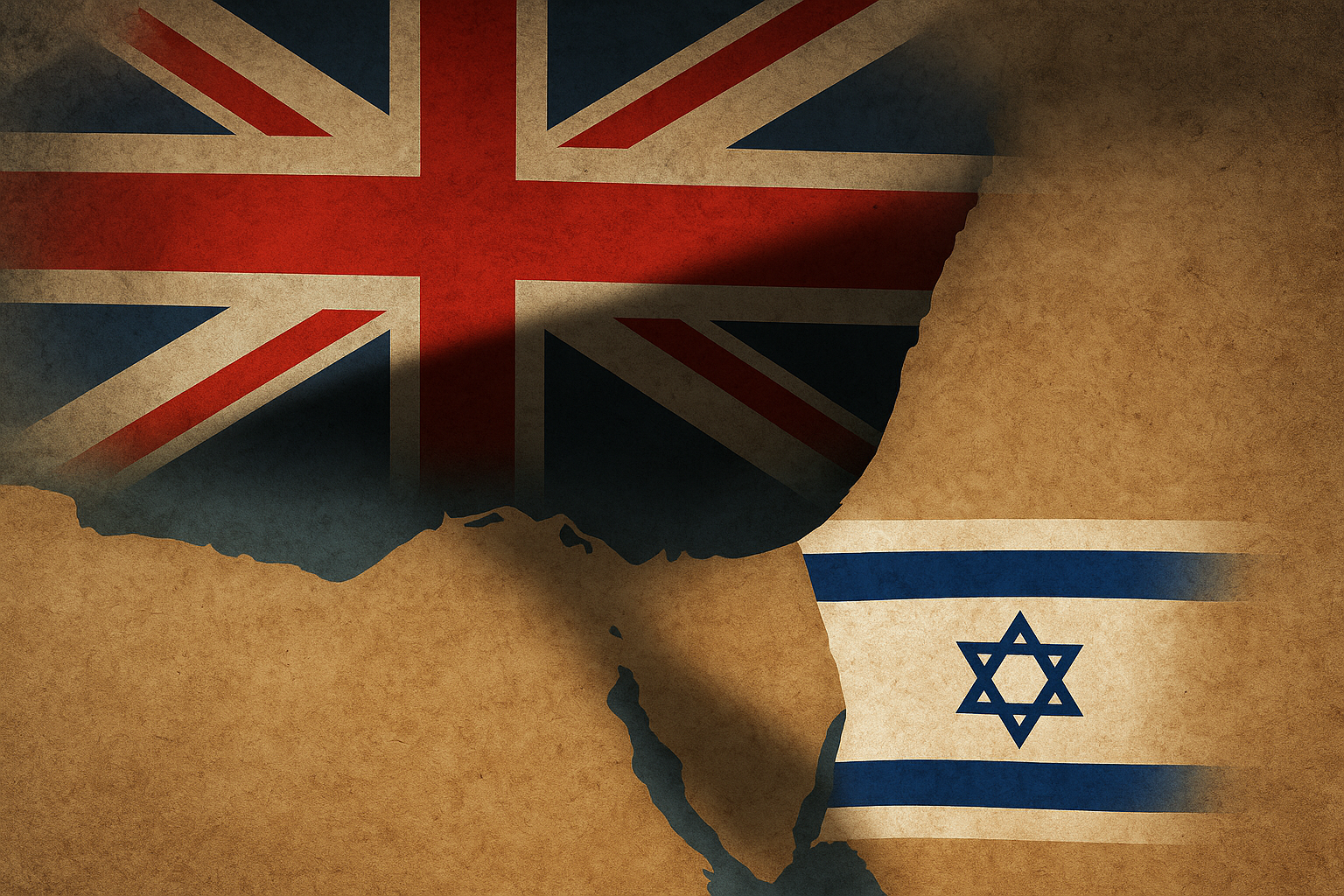
(Generated image, 21/09/2025)
The United Kingdom is set to recognize Palestine as a state today. For some, it may sound like a historic gesture; for others, a political necessity in light of the tragedy unfolding in Gaza. But anyone with a sense of history can only see this as hollow, ironic, and even shameless. For if there is one country with no moral right whatsoever to weigh in on this conflict, it is Britain itself.
From Balfour to the Mandate
In 1917, Arthur Balfour promised the Jews a “national home” in Palestine. Not out of idealism, but from cold imperial calculation: winning support in wartime, outmaneuvering France, currying favor with the Jewish diaspora. At the very same time, Britain pledged Arab independence in the Hussein–McMahon correspondence. Duplicity was not an error. It was deliberate strategy.
When the League of Nations granted Britain the Mandate for Palestine in 1922, that duplicity became law. The Mandate explicitly called for the establishment of a Jewish national home “in Palestine,” meaning the territory between the river and the sea. For the Arabs, another territory was carved out to the east of the Jordan—the land that would become modern Jordan. There was no mention yet of a distinct “Palestinian” people. In fact, Emir Faisal himself signed an agreement with Chaim Weizmann confirming his acceptance of a Jewish homeland in Palestine.
In other words: both international law and the political understandings of the time clearly established that the Jews were entitled to their national home in the land between the river and the sea. Britain’s role was to facilitate that.
British sabotage
Instead, London sabotaged that mandate from day one. British officials, many openly antisemitic, worked relentlessly to block Jewish immigration. As Hitler rose to power in Germany and Jews desperately sought refuge, Britain slammed the gates shut with the infamous 1939 White Paper. Millions of Jews who might have escaped Europe were denied entry to the one land that had been internationally designated as their home.
After the war, those who tried to reach Palestine were often intercepted by the Royal Navy and sent to detention camps in Cyprus. Not Nazis, but Britons put Holocaust survivors behind barbed wire to keep them from reaching their promised homeland.
At the same time, Britain did everything possible to undermine Jewish defense organizations. Weapons depots were seized and handed over to Arab militias. Jewish groups who sought to organize were hunted down. Even during the catastrophic civil war of 1947–48, Britain actively worked against the Jewish community: the transfer of strategic Fort Esther to Arab fighters is just one telling example.
The great betrayal of 1948
When Britain finally withdrew, it did so not as a responsible administrator but as a thief in the night. After a quarter-century of mismanagement, after systematically frustrating both Jews and Arabs, London simply dumped the keys on the ground and walked away.
In the UN vote on the 1947 Partition Plan, Britain abstained. Not for, not against—just cowardly silence. This was abdication of the highest order. The consequences were obvious: war, refugees, destruction. Britain looked away, pretending it no longer bore responsibility.
An empire of scars
Palestine was not an exception. Everywhere the British left, they left blood and borders behind: the disastrous partition of India and Pakistan, the conflict in Cyprus, the Troubles in Northern Ireland, instability across Africa. The pattern was always the same: arrogance while ruling, chaos when leaving, and moral lecturing ever after.
Today, Britain postures as the moral conscience of the world by recognizing Palestine. But it was Britain that blocked Jewish refugees from escaping Europe. Britain that betrayed promises to Jews and Arabs alike. Britain that abandoned Palestine to chaos in 1948. The fingerprints of London are all over this conflict.
Recognition or shame?
Make no mistake: this recognition is not an act of justice. It is a cheap gesture, a political symbol devoid of substance. Nothing will change on the ground. There will be no peace, no security for Israel, no viable future for Gaza. The only change will be in London, where politicians can pat themselves on the back for having “done something.”
But what Britain should do is the opposite: remain silent. Reflect. Confront its history. Admit that it failed—not by accident but by active sabotage. Admit that it betrayed. Admit that it should be ashamed.
Better silence than hypocrisy
The deaths in Gaza are real. The grief in Israel is real. No one denies this. But precisely because of that, it is obscene for Britain to pose today as a defender of justice.
There is one contribution London could finally make: to say openly that it lit this fire. That it abandoned its duty. That it created the very contradictions that burn to this day.
Until such honesty is spoken, every recognition is nothing more than hypocrisy. Britain has no right to speak.
—
Bibliografie
-
Balfour Declaration. (1917, November 2). The National Archives (UK). Retrieved from https://www.nationalarchives.gov.uk/education/balfour-declaration
-
League of Nations. (1922, July 24). Mandate for Palestine. Geneva: League of Nations. Retrieved from https://avalon.law.yale.edu/20th_century/palmanda.asp
-
Faisal–Weizmann Agreement. (1919, January 3). Avalon Project, Yale Law School. Retrieved from https://avalon.law.yale.edu/20th_century/faisal.asp
-
British Government. (1939, May 17). Palestine White Paper. Cmd. 6019. London: His Majesty’s Stationery Office.
-
United Nations General Assembly. (1947, November 29). Resolution 181 (II): Future Government of Palestine. Retrieved from https://www.un.org/en/ga/search/view_doc.asp?symbol=A/RES/181(II)
-
Segev, T. (2000). One Palestine, Complete: Jews and Arabs under the British Mandate. New York: Metropolitan Books.
-
Wasserstein, B. (2008). Britain and the Jews of Europe, 1939–1945. London: Leicester University Press.
-
Morris, B. (2008). 1948: A History of the First Arab–Israeli War. New Haven: Yale University Press.
Related Topics
Related Posts