
Recovered Antisemite
No Sympathy
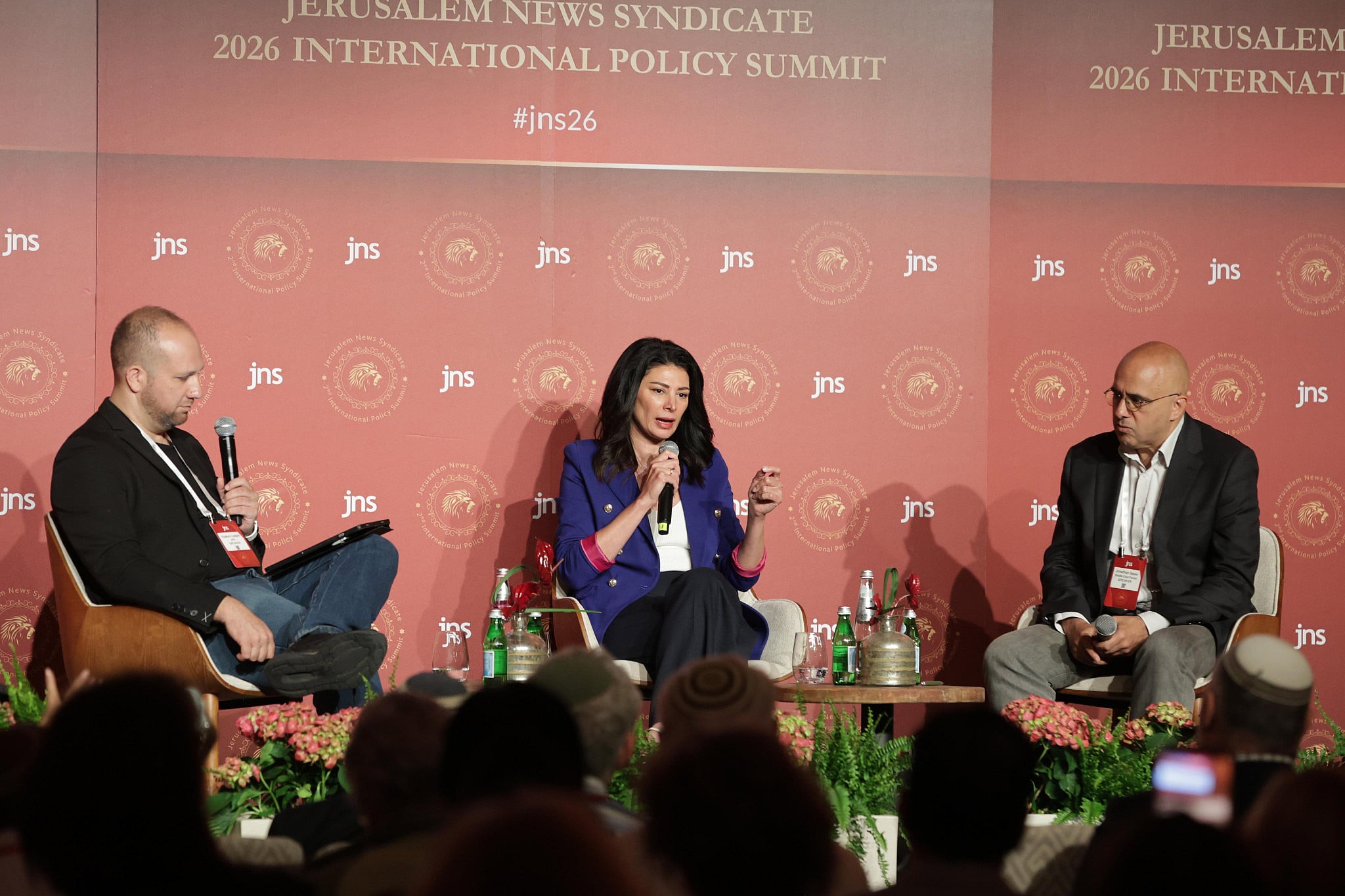
Yaakov Lappin, Rawan Osman, Jonathan Spyer --- Photo credit: JNS
Yesterday, at the JNS policy summit in Jerusalem, my panel was titled Syrian Security Challenges. Together with Jonathan Spyer, we reminded the audience that nothing has changed for the Syrians: minorities continue to be persecuted, jihadists and criminals have been integrated into the new government and the new Syrian army, the population remains poor, and the suffering that defined decades under the Assad dictatorship has not lifted. Jonathan spoke about the Hol Camp — once holding tens of thousands of ISIS members, their families, and their victims, now gradually emptied through releases, escapes, and quiet resettlements that the world has barely registered — people who had been abducted, enslaved, forcibly married, converted, and impregnated. I sat there wondering how much the world actually knows about this, the security challenges it poses, and the tragedies its inaction and indifference have brought upon millions.
From an Israeli strategic perspective, one genuine shift has occurred: the fall of Assad severed the land corridor connecting Hezbollah to the mullahs’ regime in Iran, a development with real consequences for the balance of threat. But that is an Israeli gain, not a Syrian one. For the Syrians, the faces in power have changed but he tragedy has not.
Meanwhile, Iranian dissidents sit in dark prison cells awaiting execution. Afghan women are dying slowly in cold, dark confinement while the world ignores their enslavement at the hands of one of the most backward Islamist movements on earth. How are Ukrainians living today? What about the Russians who never chose this war and are paying its price anyway? What about the people of North Korea? Of Somalia? Of Nigeria?
And yet, somehow, the world has reserved its most passionate solidarity for the Palestinians alone.
This asymmetry is neither accidental nor driven by sympathy. Genuine sympathy would be indiscriminate. It would not skip over Yazidi women sold in open markets, or Uyghur Muslims sterilized by state decree, or Christian communities burned out of their homes in sub-Saharan Africa. Sympathy does not choose its beneficiaries based on who the perpetrator is. What we are witnessing is something else entirely.
We sometimes say that Jew-hatred is the true motive driving the pro-Palestine camp. Those operating from conspiratorial antisemitism are difficult to reach. But there is another constituency: people who genuinely believe they are seeking justice, who see themselves as moral observers, continuously exposed to the Palestinian cause and feeling compelled to take a side. For this group, the question of motive is more complicated, and more important to answer. Their engagement is not accidental. It is the product of three deliberate mechanisms: framing, visibility, and emotional manipulation.
Framing. Academics, religious leaders, political figures, and self-described witnesses have spent decades constructing a one-sided, anti-Zionist narrative that is, in many of its expressions, straightforwardly antisemitic. They demonize Israelis so thoroughly and so relentlessly that the Israeli voice is treated as inherently suspect before it is even heard. In much of the Arab and Muslim world, this is not even a matter of persuasion. Contact with Israelis is legally forbidden and socially penalized, which means an entire civilization has been sealed off from the other side of the argument.
Visibility. Al Jazeera, founded in 1996, is a media empire that has been waging a systematic war against Israel since its inception. But it is far from alone. Alongside the established anti-Zionist broadcast channels, there are thousands of social media pages, Telegram groups, and online communities dedicated to delegitimizing the Jewish state, spreading conspiracy theories, and inciting hatred against Jews and their country. The coverage of this conflict is a coordinated propaganda infrastructure.
Emotional manipulation. By exaggerating Palestinian suffering while erasing Palestinian agency and responsibility as a party to this conflict, and by depicting Jews as cunning, manipulative, and cruel, the architects of these campaigns have successfully recruited emotional masses into justifying Palestinian violence. The goal is to enrage, not to inform. And once enraged, these masses set off two chain reactions that extend far beyond campus protests. The first is political: they pressure elected officials who are not moved by sympathy or justice but by the calculus of votes and the fear of losing office, producing a class of politicians who take positions they do not believe in order to survive. The second is social: they radicalize frustrated segments of the Right, who watch the left’s embrace of Islamist causes with fury and respond in kind, fracturing and weakening the democratic liberal camp from within and accelerating the very polarization that makes Western societies easier to destabilize.
What these three mechanisms produce is rage, hatred, and moral disgust. Negative emotions, not humanitarian ones. The proof is in the silence. University students willing to go on hunger strikes, to risk their academic futures, to devote months of their lives to the Palestinian cause have had nothing to say about Yazidi slaves, Afghan girls, Christians in Nigeria, or the dissidents rotting in Iranian prisons. If this were about human suffering, the cause would be legible across borders, instead of having one address.
Who is most susceptible to this kind of manipulation? Those who are ideologically primed to romanticize armed struggle, to loathe hierarchy, to reject state authority, and to frame every conflict as a confrontation between the oppressor and the oppressed, regardless of the facts on the ground. The radical left. And who has worked hardest to press exactly those buttons? Islamist movements that are globally organized, strategically patient, and fully aware that the radical left is simultaneously easy to mobilize and easy to discard. The left can be inflamed against states, institutions, and order, and then, once it has done its work, swept aside without ceremony.
This is not a new playbook. It is precisely what happened in Iran in 1979, when the left marched alongside Khomeini, helped dismantle the Shah’s regime, celebrated the revolution as a victory for the oppressed, and was then methodically crushed the moment Khomeini consolidated power. The mullahs needed the left to tear down the existing order. They had no need for it afterward. The same logic applies today: a structured, institutionally rooted Western establishment capable of defending liberal democratic values is far harder to defeat than a mass of enraged students and activists who believe they are fighting for justice. These movements are not funding campus activism out of solidarity. They are funding it because the left is useful, and because it costs very little to set the West against itself.
Misdiagnosing the problem is therefore not merely an intellectual error but a strategic vulnerability. What we are facing is not a humanitarian movement that has gone too far. It is a civilizational war waged against the West, in which the Palestinian cause serves as the spearhead and Israel as the primary target.
Those who believe that offering the Palestinians a state would end the conflict are operating with the wrong map entirely. The conflict was never, at its core, about statehood. It is about the land that was Islamized for centuries and then reclaimed by the people who were there before Islam arrived: the Jews. That reclamation is experienced not merely as a political defeat but as a theological catastrophe, a rupture in the narrative of Islamic expansion and permanence that cannot be absorbed or negotiated away. Restoring Islamic sovereignty over that land is not one goal among many. It is a precondition for restoring the prestige and spiritual authority that Islamist movements need to justify their global ambitions and inspire the spread of Islam elsewhere. A Palestinian state under those conditions would not be a conclusion but rather a staging ground.
Israel is therefore on the front line not by accident but by design. Defeat Israel, and the logic of the entire Western order begins to crack: its right to defend itself, its Judeo-Christian foundations, its insistence that liberal democracy is worth protecting. The rage directed at Jews and Zionists is not the endpoint. It is the opening move.
Related Topics
Related Posts