Noach: What the Tower of Babel taught me about multinational teams
Torah interpretations through the Bridge6 leadership model
Parashat Noach · Genesis 11:1-9
This Shabbat we read Parashat Noach. From a leadership perspective, the story of Babel jumps out at me more than the other lessons this week. This part of the parasha speaks most to the work of intercultural leadership.
After the flood, the instruction was to fill the earth (Genesis 9:1). At that time everyone on earth had the same language and the same words, safah echat u’devarim achadim (Genesis 11:1). After settling, the people decided to build a city and a tower. The way I read it, at least part of the intention in building the tower was to avoid being scattered (Genesis 11:4). This seems to contradict the instruction to fill the earth. I also interpret the builders’ use of bricks instead of stone (Genesis 11:3) as a sign that uniformity was prioritized over diversity or difference.
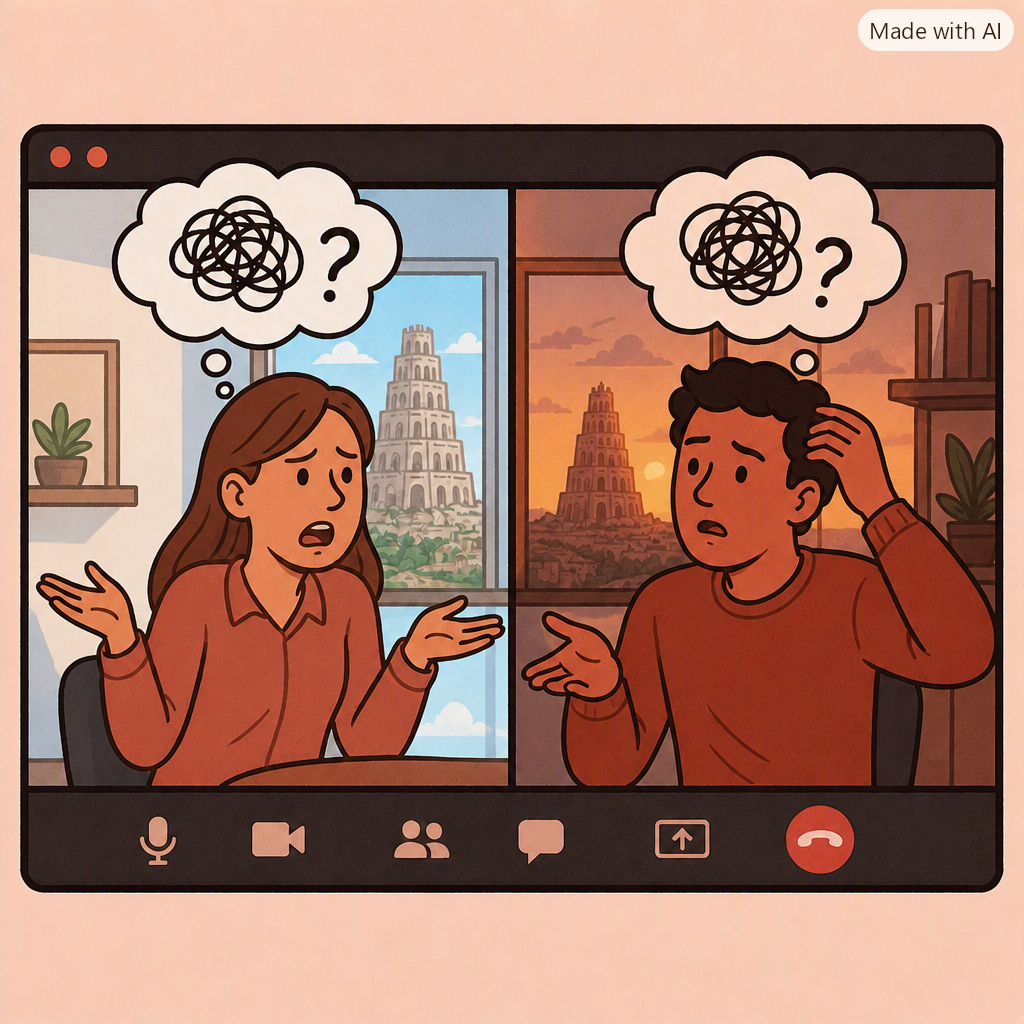
When God comes down to see the city and the tower (Genesis 11:5), the response is to confuse their language “so that they shall not understand one another’s speech,” lo yishme’u (Genesis 11:7). The Hebrew verb comes from the root that means to hear, the same root as Shema. The people could still speak. What they lost was the ability to grasp what the other person meant. This is exactly the difficulty with multinational and multicultural teams: they can talk to each other and still struggle to convey or understand meaning.
This story reminds me particularly of a moment in 2021 when I was facilitating a partnership process between two organizations from different countries who shared a common language but still failed to hear each other. I played my part in this failure, as did the flat, two-dimensional collaboration over Zoom. One of the groups came from a country in which it was insensitive to explicitly object to a request or even a demand. The other favored open and direct communication on everything, even denials.
In weekly meetings the direct communicators asked for updates on the local process in the other country, expecting things were moving forward as originally planned. Their direct questions about the plan routinely got no response or a non-committal answer. After several weeks it emerged that things were totally off the original plan. The direct communicators were furious: how come they hadn’t been informed? They had been faithfully working under the assumption that the plan was still functioning, had put in a tremendous amount of work that was now pointless, and felt deeply insulted. The other side found it highly uncomfortable to be harangued and pressured constantly after they felt they had made very clear signals that the plan wasn’t working. My guess is that the pressure made it even harder for them to say the plan was off, though I can’t be certain.
As the facilitator, I was also to blame for the bad communication across the cultures. The lack of response to direct questions was the most telling sign that the plan wasn’t on track. In the high context culture, where subtle cues speak loudly to the people who share them, that would have been enough; for the low context culture, where details are explicit and often repeated, the lack of direct communication was the problem. Being online made it worse. I could have tried to speak bilaterally with one of the high context people to get the full picture, but didn’t have the chance. This case illustrates challenges in the pillar of the Bridge6 model I call Fluency, the ability to read and work across different cultural codes.
In the end, the work continued to completion but with little enjoyment or satisfaction. The process eroded trust and left little will to keep working together afterwards.
Returning to Babel, the story ends with people scattered over the earth and speaking different languages. That’s what the instruction to fill the earth called for in the first place, so the way I read it, difference was intended from the start. In work it’s the normal condition for collaboration. No two people are identical and the more different they are, the harder it is to understand each other. The leadership work is learning to read and work across those gaps, at the individual, team, and organizational level.
How could leaders improve their work if they had more ways to question assumptions?
Leadership lessons from Noach
- Sharing a working language doesn’t mean a team shares the same meaning. A multinational team can speak the same language but team members can still fail to understand each other.
- Sometimes no response is itself a message. When direct questions get no answer or a non-committal one, that may be the answer, depending on the culture of the person giving it.
- People are often unaware of how their own way of communicating comes across to others. Signals that are clear in one culture can be missed completely in another.
- Working online makes communication across cultures harder. Much of what high context communication relies on, like tone and informal conversation, gets lost on a screen.
- Leaders and facilitators need to make space for private conversations. A bilateral talk is often where someone can say what they can’t say in the group.
- Completing the work doesn’t repair lost trust. In our case the project reached completion but the trust wasn’t restored.
- Difference is a normal, and potentially productive, part of collaboration. At Babel it was intended from the start, and leaders need to build the skills to work with it.