
Noah, the Animals, and the Generation of HAMAS
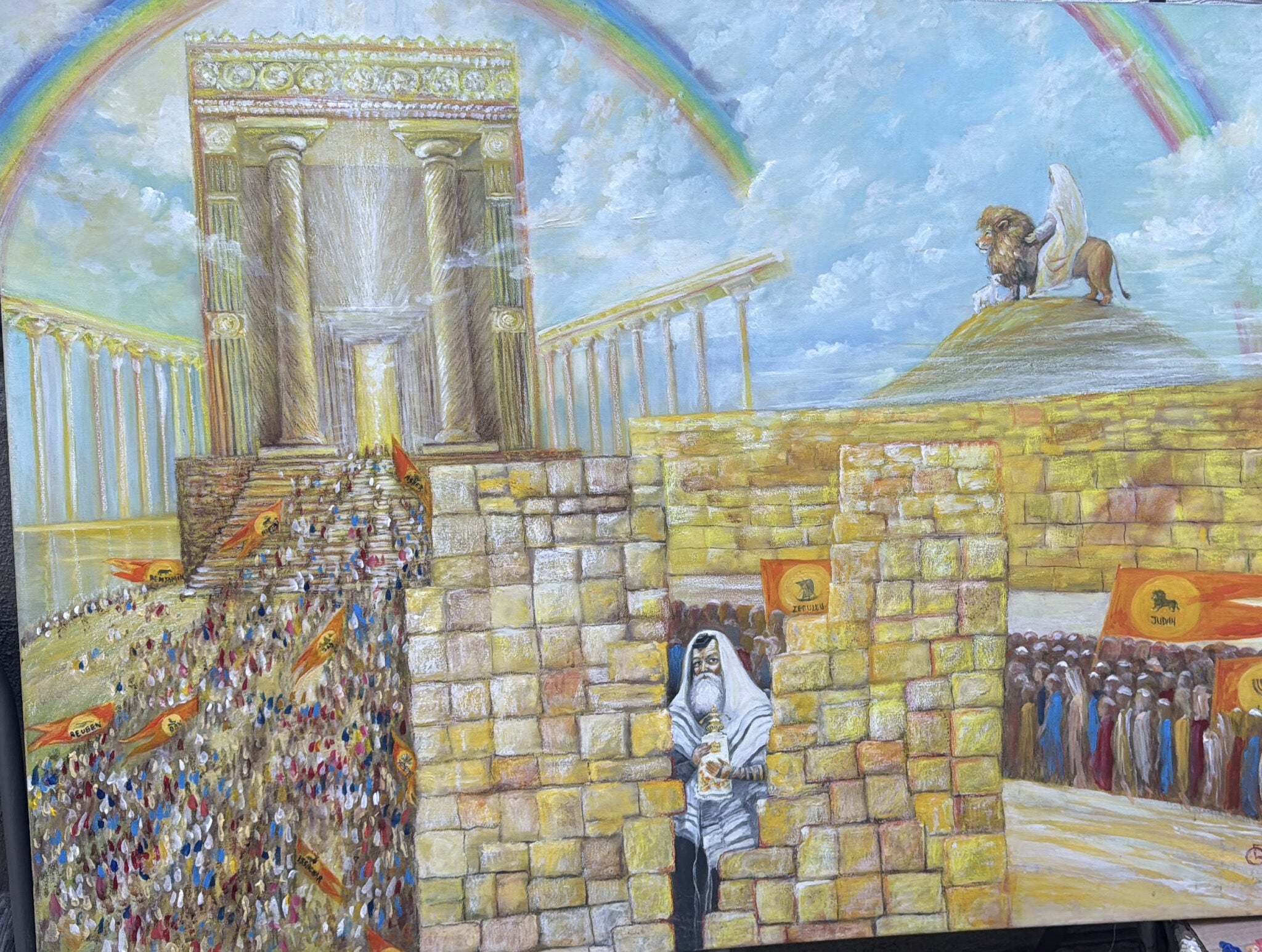
Noah, the Animals, and the Generation of HAMAS: From Violence to CHESED
The Ark, the Rainbow, and God’s Covenant With Every Living Soul
Rabbi, Animal Chaplain, Founder and Royal Custodian of the Royal House of Kanaani
The weekly Torah portion of Noach presents one of the most profound theological and ethical questions in the Hebrew Bible: Why did an entire human civilization perish in the Flood, while animals were brought into the Ark and given the opportunity to survive? What does this distinction teach us about human responsibility, Divine justice, compassion, and the sacred obligation to preserve life?
The Torah declares: “The earth was corrupt before God, and the earth was filled with violence” (Genesis 6:11). The Hebrew word used here is HAMAS (חָמָס), a term encompassing violence, injustice, oppression, and moral wrongdoing. Rashi, in his commentary on Genesis 6:11, particularly associates this corruption with robbery, gezel. The generation of the Flood was not simply a society in which individual crimes occurred. It had become a civilization in which injustice was normalized, moral boundaries were eroded, and the distinction between righteousness and wickedness was increasingly disregarded.
The danger of such a society lies not only in the actions of those who commit evil, but also in the gradual acceptance of evil by those who witness it. When wrongdoing becomes customary, conscience loses its authority. When Divine patience is mistaken for Divine indifference, human beings may begin to believe that their actions carry no ultimate moral consequences. The generation of the Flood illustrates the catastrophic consequences of this spiritual and ethical deterioration.
Yet the biblical narrative also reveals that Divine judgment was preceded by extraordinary patience. Following Cain’s murder of Abel, God did not immediately destroy Cain. Instead, Cain received a protective sign, and his descendants continued to develop human civilization. The Torah describes the emergence of cities, animal husbandry, musical instruments, and metalworking among Cain’s descendants (Genesis 4:17–22). These achievements demonstrate that material and technological progress do not necessarily correspond to moral advancement. A society may become increasingly sophisticated while simultaneously losing its ethical foundations.
It is important, however, not to confuse ancestry with moral responsibility. The Torah does not teach that the generation of the Flood was condemned simply because of descent from Cain, nor does it establish that every descendant of Seth was righteous. Noah himself descended from Seth, but his distinction rested upon his character and conduct. As Genesis 6:9 declares, Noah was a righteous man, blameless in his generation, who walked with God. Righteousness in this narrative is not an inherited privilege but an ethical responsibility.
Pirkei Avot 5:2 emphasizes the patience of the Almighty through the ten generations between Adam and Noah. The passage describes how God endured the wrongdoing of successive generations before bringing the Flood. This rabbinic teaching presents Divine patience as an opportunity for repentance, teshuvah. Humanity was not deprived of the possibility of moral transformation. Rather, the tragedy was that a civilization became so accustomed to corruption that it failed to recognize the necessity of change.
Against this background, the preservation of animals within the Ark acquires profound theological significance. God commanded Noah to bring living creatures into the Ark so that their species might continue upon the earth (Genesis 6:19–20; 7:2–3). Animals had not consciously constructed the systems of human oppression and injustice. They did not possess the same moral agency or responsibility as human beings, who were endowed with the capacity to distinguish between good and evil and to make ethical choices.
The distinction is remarkable. A human civilization that had embraced HAMAS faced destruction, while animals were deliberately preserved as part of the future of creation. This does not authorize us to pronounce judgment upon every individual who perished in the Flood. Rather, it challenges us to recognize the devastating consequences of collective moral corruption and the extraordinary importance God places upon the continuity of life.
Noah’s responsibility extended far beyond constructing a vessel capable of surviving the waters. Once the animals entered the Ark, their survival depended upon his continuous attention. They required food, shelter, protection, and care. Rabbinic tradition emphasizes the demanding nature of this responsibility, portraying Noah and his family as constantly occupied with feeding and attending to the creatures entrusted to them.
From the perspective of contemporary animal theology, Noah may therefore be understood as a biblical model of compassionate stewardship. In the language of my own spiritual vocation, his conduct offers an ancient precedent for what we now describe as animal chaplaincy: the recognition that caring for animals is not merely an expression of personal affection, but a meaningful ethical and spiritual responsibility.
The theological importance of animals becomes even more explicit after the Flood. God establishes a covenant not only with Noah and his descendants, but also with every living creature that emerged from the Ark. Genesis 9:9–10 declares that the Divine covenant extends to birds, domestic animals, and every living creature upon the earth. The Hebrew expression kol nefesh hachayah, every living soul or living creature, reminds us that the covenant embraces life beyond humanity.
This is one of the most extraordinary dimensions of the Noahide covenant. Human beings are not its only beneficiaries. The animals are included within the Divine promise, and the earth itself becomes part of the covenantal relationship. God does not regard the nonhuman world as an insignificant background to human history. The preservation of animal life forms an essential part of the restoration of creation.
The rainbow becomes the visible sign of this covenant. In Genesis 9:13, God declares: “I have set My bow in the cloud, and it shall be a sign of the covenant between Me and the earth.” The promise that all flesh will never again be destroyed by a universal flood does not mean that suffering, violence, or natural catastrophe will disappear from human experience. It means that the future of life remains open and that Divine mercy continues to sustain creation despite humanity’s imperfections.
The connection between the Flood and Divine compassion becomes particularly significant in the Haftarah associated with Parashat Noach, Isaiah 54:1–10. In Isaiah 54:9, the prophet explicitly recalls the waters of Noah and the Divine oath concerning the Flood. The following verse offers one of the most beautiful expressions of covenantal faithfulness in prophetic literature: “For the mountains may depart and the hills be removed, but My steadfast love shall not depart from you, and My covenant of peace shall not be removed” (Isaiah 54:10).
The Hebrew word CHESED (חֶסֶד) signifies lovingkindness, mercy, loyalty, and enduring covenantal faithfulness. Isaiah’s immediate message concerns God’s relationship with Israel, particularly the restoration of hope following suffering and exile. Nevertheless, the prophet’s reference to Noah creates a meaningful theological connection between the universal covenant following the Flood and the enduring Divine commitment to Israel.
The contrast between HAMAS and CHESED offers a powerful moral framework for understanding the Torah portion. HAMAS represents the destruction of ethical relationships through violence, injustice, and indifference. CHESED represents the restoration and preservation of relationships through compassion, responsibility, and faithfulness. The generation of the Flood demonstrates what happens when HAMAS dominates human civilization. The covenant after the Flood, together with Isaiah’s prophetic vision, reminds us that the future must be built upon CHESED.
This theological framework also raises an important question about the relevance of biblical commandments and narratives to contemporary life. A young yeshiva student once challenged me with a thoughtful observation: “God commanded Noah to save the animals, but God did not personally command you to save the Kanaani cats. Why, then, do you regard their preservation as a spiritual mission?”
My response was simple: The Almighty addressed Noah, but the Torah addresses every generation. Why do we continue to study the story of Noah if not to draw ethical and spiritual lessons from his example?
I do not claim to be a prophet, nor do I suggest that my personal responsibilities are equivalent to the direct Divine command received by Noah. Jewish tradition carefully distinguishes prophetic revelation from ordinary human conviction. The Talmud, in Yevamot 49b, discusses the distinctive clarity of Moses’ prophecy in comparison with that of other prophets. The biblical text presents God as speaking to Noah, although it does not explain precisely how Noah experienced that revelation.
Nevertheless, the absence of personal prophetic revelation does not relieve us of moral responsibility. The Torah is not merely a historical record of extraordinary individuals who lived thousands of years ago. It is also a continuing source of ethical instruction. Although the actions of biblical figures do not automatically become binding commandments for every person, their examples can illuminate the responsibilities of subsequent generations.
We do not require a new revelation to recognize that an abandoned animal deserves protection, that a suffering human being deserves compassion, or that a threatened living heritage may deserve preservation. The ethical principles of the Torah invite us to translate spiritual understanding into practical action.
For me, one expression of this responsibility is the preservation of the rare Kanaani cat breed, developed in Israel by Doris Pollatschek. Originating in Jerusalem, the Kanaani represents a distinctive chapter in the modern history of Israeli domestic cats. I regard its preservation as an act of responsible stewardship and as a tribute to the vision of its founder.
Within the Royal House of Kanaani, these cats are also associated symbolically with the golden cat described in Targum Sheni to the Book of Esther as part of the magnificent throne of King Solomon. This connection belongs to the sphere of Jewish cultural memory, religious symbolism, and contemporary heritage interpretation. It is not presented as evidence of a scientifically established biological lineage extending from antiquity to the modern breed.
The designation “Heirs to King Solomon’s Feline Throne” expresses this symbolic continuity and the responsibility to preserve a living feline heritage associated with Jerusalem and the Land of Israel. Yet the deeper theological significance of this work is not dependent upon royal symbolism or the rarity of a particular breed. It rests upon the principle that the lives entrusted to our care deserve protection and that compassion must be translated into action.
The lesson of Noah extends far beyond Kanaani cats. It applies equally to abandoned animals, injured creatures, threatened species, neglected communities, and human beings whose spiritual or cultural inheritance has been interrupted by historical circumstances.
I think particularly of Russian-speaking Jews whose families experienced generations of Soviet repression, during which Jewish religious education, communal institutions, and traditional observance were systematically restricted or disrupted. Many individuals grew up separated from Jewish learning and practice through circumstances they did not choose. Their distance from religious tradition should not automatically be interpreted as rejection of Judaism.
Here, too, the example of Noah offers a meaningful ethical metaphor. A welcoming Jewish home, an invitation to study Torah, a patient conversation, or an opportunity to experience Jewish communal life can become a small ark of spiritual return. The objective should not be judgment, pressure, or condemnation, but the restoration of connection through dignity, understanding, and love.
The same principle applies beyond the Jewish community. The covenant following the Flood embraces every living creature. Our compassion cannot be limited exclusively to those who share our ancestry, language, religious observance, or cultural background. The recognition of universal life within the Noahide covenant challenges us to extend moral concern beyond the boundaries of our immediate communities.
This does not diminish the particular covenantal relationship between God and Israel. Rather, it reminds us that Jewish ethical responsibility operates within both particular and universal dimensions. The covenant with Israel establishes a distinctive religious relationship, while the covenant with Noah affirms the enduring significance of humanity, the animal kingdom, and the earth itself.
In this sense, the Ark may be understood not only as an ancient vessel of survival but also as a lasting moral symbol. Every generation faces circumstances in which life, dignity, memory, or cultural continuity becomes vulnerable. We may not possess the ability to preserve everything, but we can assume responsibility for those lives and traditions within our reach.
The Flood teaches that human choices carry consequences. The Ark teaches that life is worthy of preservation. The rainbow teaches that the future remains open through Divine mercy. The prophet Isaiah reminds us that CHESED, steadfast lovingkindness, stands at the heart of the covenantal vision.
Noah was commanded to construct an Ark. We have inherited his story, together with the responsibility to consider its meaning for our own lives. We need not claim to be Noah, nor pretend to possess his prophetic authority. We must, however, ask whether we have learned from his example.
The enduring message of Parashat Noach is therefore not simply that an ancient civilization was destroyed by a catastrophic Flood. It is that humanity must choose between the destructive normalization of HAMAS and the sustaining moral power of CHESED. Our response to suffering, whether human or animal, reveals the values upon which we seek to build our world.
The covenant of the rainbow reminds us that every living soul has a place within the Divine concern for creation. To preserve life, to welcome those seeking spiritual belonging, and to protect the vulnerable are not separate or unrelated activities. They are expressions of a shared ethical obligation rooted in the biblical understanding of compassion.
The question left to every generation is not whether we can build an Ark large enough to save the entire world, but whether we are willing to build the smaller arks of responsibility, kindness, and protection that the world continues to need.