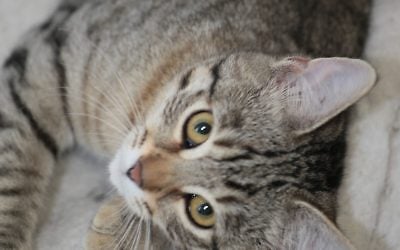
The Royal Kanaani: A Living Bridge of Friendship Between Greece and Israel
On November 28, 2026, a beautiful chapter in the history of the Kanaani began in Athens. For the first time in Greek history, two representatives of the rarest cat breed from the Holy Land participated in a World Cat Federation (WCF) exhibition. At nine months old, Princess Haya and Princess Neshama, two young sisters, had entered the Junior class. Haya arrived in Greece with two championship certificates earned in Finland in August, while for Neshama, Athens marked her exhibition debut. Interestingly, the sisters found themselves competing against each other. This time, Neshama won her first championship certificate in the Junior class, while Haya maintained her leading position in the worldwide Kanaani breed rankings.
Later, during the Junior Shorthair Ring, both sisters were eliminated at an early stage. Surrounded by unfamiliar people, sounds, and the excitement of the exhibition, they felt shy and uncomfortable. For Neshama, this was her first exhibition, and for Haya, only her second. As I kissed, embraced, stroked, and comforted my young princesses, I was reminded of a beautiful teaching from the Babylonian Talmud. In Tractate Eruvin (100b), we learn that had the Torah not been given, humanity could have learned modesty from the cat. What some may see as shyness, Jewish wisdom invites us to recognize as modesty. In the Kanaani, I see a particularly beautiful expression of this quality.
As an ordained Animal Chaplain, I received my ordination through the Compassion Consortium, which I regard as one of the world’s finest interfaith institutions in animal chaplaincy, under the guidance of Reverend Sarah Bowen, a respected leader in this field. At the heart of my spiritual understanding of animal chaplaincy is the recognition that animals have souls, that their lives have spiritual value, and that we have a moral responsibility to provide them with the best possible conditions in which to live. Our mission also includes providing spiritual and emotional support to people experiencing crises involving their beloved animal companions, whether through illness, suffering, separation, or death. Although my spiritual roots are in Judaism, compassion toward animals transcends religious, cultural, and national boundaries.
For me, the Kanaani is, above all, about the human-animal bond. As I held my young princesses in my arms, I wondered whether this was precisely what deserved recognition in the exhibition ring. A beautifully groomed Maine Coon or an elegant Bengal confidently following a feather toy may impress an audience with a performance reminiscent of a circus. But should not a genuine expression of love between a human being and an animal touch our hearts even more? Through our relationship with animals, we reveal who we truly are. I would love to see international cat exhibitions celebrate this sacred relationship and introduce a special recognition — a Crown of Compassion.
These reflections bring to mind Steven Spielberg’s remarkable film Disclosure Day. Although the film explores humanity’s encounter with extraterrestrial intelligence, I believe that one of its most important spiritual messages concerns our own humanity and our capacity for empathy. Perhaps much of humanity’s suffering is connected to the suffering we continue to inflict upon the animal world. We dream of establishing contact with a higher intelligence somewhere in the universe, yet we have still not learned to treat the living beings already entrusted to our care with sufficient compassion. How can humanity expect to be welcomed by a more advanced civilization if we have not learned to respect the lives, feelings, and intelligence of the creatures with whom we already share our planet?
I traveled from New York to Athens with two young Kanaani cats, without sponsors or outside financial support for this journey. The veterinary travel certificate alone cost me $940. I mention this not because I seek sympathy for myself, but because I want people to understand the difficulties involved in preserving a breed that the world has largely forgotten. Yesterday, I hoped to witness compassion not toward me, but toward the Kanaani. Unfortunately, I did not see the expression of compassion I had hoped for. In my view, this was a missed opportunity and a moral failure, not necessarily a failure to follow exhibition rules, but a failure to recognize the greater significance of the occasion.
The world is home to countless Maine Coons, British Shorthairs, Scottish cats, Bengals, and Savannahs. They are beautiful animals, deeply loved and widely recognized. Another trophy is unlikely to change the future of these well-established breeds. For the Kanaani, however, international recognition could make a meaningful difference in its struggle for survival. Even in Israel, the birthplace of the Kanaani, internationally popular breeds often receive far more attention than the country’s own unique breed. There is nothing wrong with loving popular breeds, but when commercial success and popularity become the main measures of value, we risk losing something that can never be replaced. I believe that this way of thinking has contributed to the situation in which the Kanaani finds itself today, standing on the brink of extinction.
The story of Noah reminds us that the majority is not always right. Sometimes, true moral leadership requires us to stand apart from the majority and protect what others fail to value. A decision may be perfectly correct according to established rules, yet its moral consequences deserve reflection. What will another trophy for an internationally popular breed contribute to humanity? And what might a moment of recognition contribute to the survival of a breed that is in danger of disappearing forever?
In this context, I am reminded of the words of Asaph in the Book of Psalms: “How long will ye judge unjustly, and accept the persons of the wicked?” The Psalmist continues with a powerful appeal: “Defend the poor and fatherless: do justice to the afflicted and needy. Deliver the poor and needy.” And further: “I have said, Ye are gods; and all of you are children of the most High. But ye shall die like men, and fall like one of the princes.” (Tehillim — Psalm 82:2–7). Although these words originally address human justice, I believe their moral wisdom can inspire our relationship with the animal world as well. Earthly authority is temporary, but our responsibility toward those who depend upon our decisions remains. True wisdom lies not only in our ability to judge what stands before us, but also in our ability to understand what it represents.
There is another remarkable aspect of the Kanaani that deserves international attention. All domestic cats trace their ancestry to the African wildcat (Felis lybica). Thousands of years of domestication, evolution, and selective breeding have given us the wonderful variety of domestic cats we know today. The Bengal was developed by crossing domestic cats with the Asian leopard cat, while the Savannah was developed by crossing domestic cats with the African serval. Both are remarkable breeds, but neither the Asian leopard cat nor the serval is the common ancestor of domestic cats. What makes the Kanaani particularly special is that the wild species involved in its creation is the very same species from which all domestic cats originally descended — the African wildcat. While the history of feline domestication goes back thousands of years, the Kanaani’s direct connection to this ancient ancestor was established only about three decades ago in Jerusalem.
In the language of biblical symbolism, the African wildcat represents the Adam and Eve of the domestic feline world. If cats had their own Bible, the African wildcat would stand at the beginning of their Book of Genesis. The Kanaani brings us symbolically closer to that beginning, reminding us of the ancient relationship between humanity and the cat, a relationship that has grown over thousands of years into the beautiful human-animal bond we cherish today. According to Targum Sheni, a golden cat decorated the fifth step of King Solomon’s magnificent throne. In the Kanaani, I see a spiritual heir to that ancient symbol of wisdom and royalty.
Yet the presence of the Kanaani in Athens carries a meaning far greater than any exhibition result. Greece and Israel represent two great civilizations that have enriched humanity with their philosophy, spirituality, wisdom, and culture. Athens and Jerusalem are more than cities; they are timeless symbols of humanity’s search for knowledge and divine truth. More than two thousand years ago, the Torah was translated into ancient Greek, laying the foundation for the Septuagint and opening the treasures of Jewish sacred wisdom to the Greek-speaking world. Greece is also home to the Romaniote Jews, one of the oldest Jewish communities in Europe, whose roots reach back to the Second Temple period. Despite the tragedies of history, their beautiful traditions and Greek-speaking Jewish heritage continue to enrich the cultural and spiritual life of modern Greece.
During my stay in Athens, I have grown to love Greece even more. I have discovered not only the beauty of its ancient history but also the warmth of its people, the richness of its culture, and the spiritual atmosphere of a land that has given so much to humanity. It is precisely because of my growing love for Greece and my profound respect for the Greek people that I write these words. I believe that great civilizations have the moral strength to reflect upon their experiences and transform missed opportunities into meaningful achievements.
How beautiful and meaningful it is that two young ambassadors from the Holy Land have arrived in Athens, offering an opportunity to strengthen the friendship between Greece and Israel through cultural diplomacy and to continue a conversation that began more than two thousand years ago. Cultural diplomacy does not always begin in government buildings or at official receptions. Sometimes, it arrives quietly, on four little paws.
As human beings, we bear a collective moral responsibility toward the animal world. I do not wish to carry the moral burden of having remained silent while a unique breed struggles for its survival. That is why I am writing this article. I am doing everything within my power to preserve the Kanaani. Have others done everything within theirs? That is a question each person must answer before their own conscience. Nevertheless, I believe that disappointment should never be stronger than hope, and criticism should never be stronger than love.
Haya and Neshama left the exhibition ring as they had entered it, with the quiet grace of two young princesses. Their dignity remains unchanged. Crowns may be awarded, ribbons may fade, and applause may fall silent, but true royal dignity does not depend on human recognition. When the quiet beauty of this rare Jewish cat breed from the Holy Land goes unnoticed, I believe that Heaven stands up for it. For what human eyes may overlook, the eyes of the Almighty never do.
My greatest hope is that Greece, a great nation with an extraordinary cultural heritage and deep philosophical traditions, will become a partner in preserving this rare living treasure of the Holy Land. Together, Greece and Israel can set an example of compassion, moral leadership, and respect for God’s creation. The true victory of our journey to Athens will not be measured in championship certificates, trophies, or exhibition points, but in the friendships it inspires, the hearts it touches, and the bridges it builds.
I came to Greece with two little princesses and a dream of preserving a living treasure of Israel. I hope to return home with something even more precious — the beginning of a beautiful friendship dedicated to that dream.
May God bless Greece and its wonderful people. May God bless Israel. May the friendship between our peoples continue to flourish, and may the Royal Kanaani become one of its most beautiful living symbols.
Animal Chaplain and Rabbi Mikhail Salita
Athens, Greece — November 29, 2026.