Middle East Analyst
Normalization from the Saudi Perspective: Part II
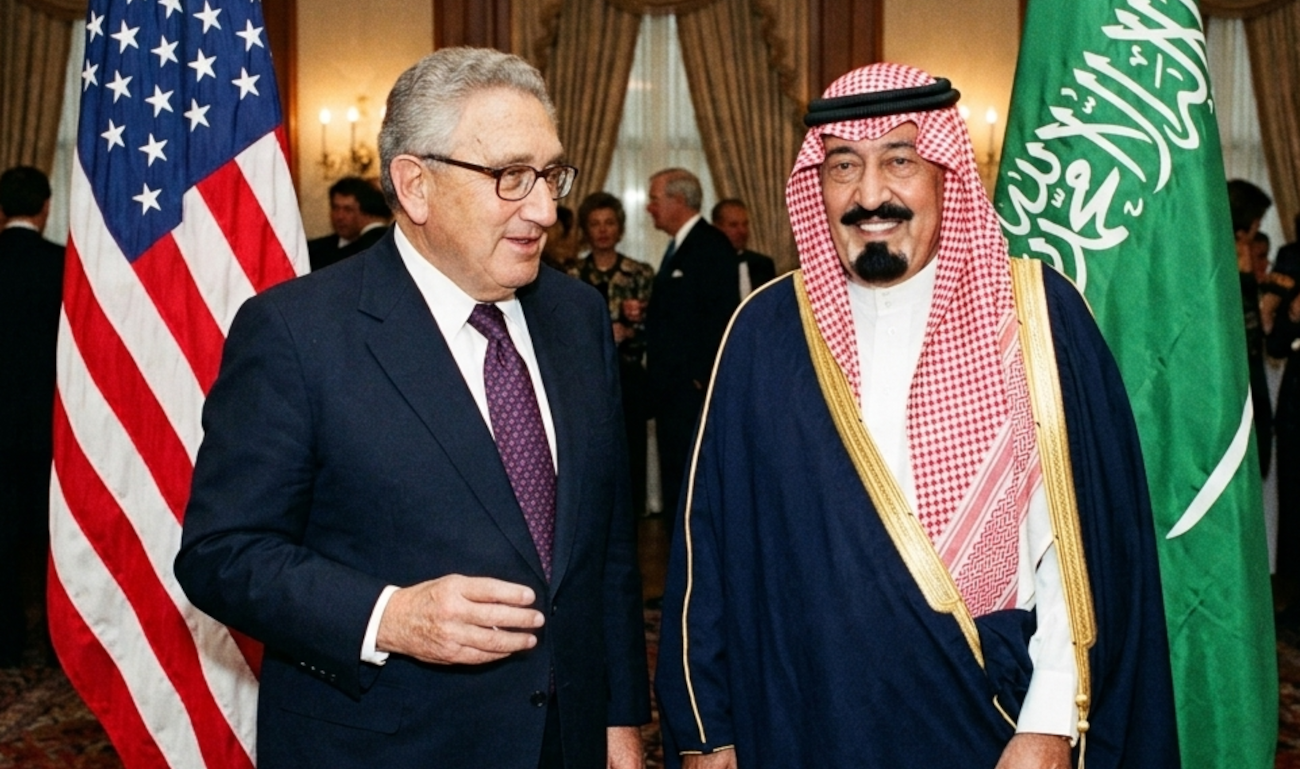
Henry Kissinger and then Saudi Crown Prince Abdullah - 1996 (AI)
Crown Prince Abdullah and Kissinger’s realpolitik miscalculation
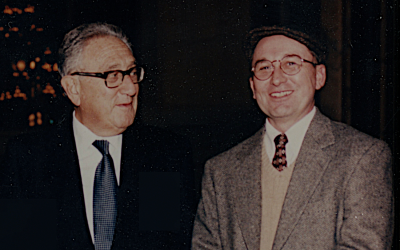
During my tenure as an American defense contractor working in support of the Saudi Air Force, I found myself in a detailed conversation with Dr. Henry Kissinger. The region was transitioning through a highly volatile phase, and King Fahd’s health was failing rapidly leaving his brother, Crown Prince Abdullah, as the de facto ruler of the Kingdom.
Dr. Kissinger leaned in and asked a question that was weighing heavily on the minds of Washington’s foreign policy elite: “I am very interested in hearing what you defense contractors think about Crown Prince Abdullah?”
“Well, for the most part, we are worried,” I replied candidly. “He seems to be firmly in control, and the consensus is that he is fairly anti-American. This could make for a lot of problems down the road for U.S. relations and Saudi defense contracts.”
Kissinger smiled, deploying the classic, detached confidence of a man who viewed global politics as a permanent chess match. “Well, it is certainly true that Abdullah has always been more of a nationalist, but I suspect you’ll see that he won’t be that different than Fahd if he actually becomes king,” he observed. “As Crown Prince he has to play the bad cop, but if he actually takes the throne, he will probably be more moderate. It is the same as with American presidents. They are always very tough when they are campaigning but when in power, they are guided more by national security interests, just like all of the presidents that came before them.”
“I suspect you are right,” I conceded at the time. “It still comes down to oil and security. That much hasn’t changed.”
“Exactly,” Kissinger concluded. “You know the Saudis have been very good friends to the United States. You should always pay more attention to what they do than what they say. If you look at their behavior over the last twenty years, you’d have to say they are better allies than many of the Europeans.”
It was a masterclass in Western political analysis—and it was fundamentally, catastrophically wrong. Kissinger was guilty of the ultimate sin of modern intelligence: mirror imaging. By comparing a Saudi Crown Prince to an American presidential candidate pivoting from a primary campaign to general governance, Kissinger was trying to force a tribal, monarchical, honor-based system into a Western, electoral, bureaucratic framework. He genuinely believed that Abdullah’s fierce Arab nationalism was merely a piece of political theater performed for the Arab street, and that once in power, the cold calculations of “national security interests” would force him back into the transactional box.
House of Saud’s lessons learned from Nixon’s betrayal
What Kissinger failed to realize was that for the House of Saud, the lesson of the 1973 Nixon betrayal had been deeply institutionalized. The royal family had learned a brutal lesson: the personal promises of American presidents are entirely temporary assets that reset every four to eight years depending on domestic political winds. They realized that Washington’s version of realpolitik meant using Saudi Arabia as a convenient geopolitical instrument while offering absolutely zero reciprocal loyalty when Saudi honor or regional stability was on the line.
The historic breaking point arrived exactly where Kissinger predicted it wouldn’t: circa 2000 and 2001, driven by the catastrophic collapse of the Clinton-brokered Camp David negotiations and the subsequent explosion of the Second Intifada.
President Bill Clinton, desperate to secure a historic foreign policy legacy before his term expired, rushed the Camp David Summit in July 2000. He explicitly promised Palestinian leader Yasser Arafat that if the talks failed, the United States would not play a public blame game. Yet, the moment the summit collapsed over the intractable status of East Jerusalem, Clinton broke his personal covenant, publicly laying 100 percent of the blame on Arafat while praising Israeli Prime Minister Ehud Barak.
Crown Prince Abdullah was watching from Riyadh, and he was deeply insulted. To the Saudis, East Jerusalem and the Al-Aqsa Mosque were not negotiable real estate chips to be sacrificed for an American president’s exit legacy; they were a sacred Islamic trust. By completely abandoning the role of an objective mediator, Clinton confirmed Abdullah’s deepest structural fear: the United States could never be trusted to keep its word when domestic political pressure mounted.
The situation deteriorated into outright fury in the summer of 2001. As Israeli tanks deployed into Palestinian civilian centers during the Second Intifada, President George W. Bush held a press conference where he openly defended Israeli Prime Minister Ariel Sharon while placing the entire moral burden of the violence on the Palestinians. Declassified records show that Abdullah, watching the broadcast live in Riyadh, completely lost his patience.
He immediately summoned his ambassador to Washington, Prince Bandar bin Sultan, and ordered him to deliver a brutal, unprecedented ultimatum directly to National Security Advisor Condoleezza Rice:
“We believe there has been a strategic decision by the United States that its national interest in the Middle East is 100-percent based on Sharon… Starting from today, you’re from Uruguay, as they say. You [Americans] go your way, I [Saudi Arabia] go my way. From now on, we will protect our national interests, regardless of where America’s interests lie in the region.”
This was not a politician playing a “bad cop” routine. This was the de facto ruler of the world’s leading oil power formally severing the transactional trust grammar that had anchored the alliance since World War II. Abdullah proved that when American actions fundamentally violated Saudi honor and Arab identity, the Saudis would absolutely alter what they did, not just what they said. He refused to allow U.S. forces to use Saudi bases to launch the 2003 invasion of Iraq, and he forced Washington to confront the 2002 Arab Peace Initiative—an ultimatum demanding full Israeli withdrawal to 1967 borders as the non-negotiable price for normalization.
Trump repeats Kissinger’s mistake
Today, Western policymakers are repeating Kissinger’s exact analytical error with Crown Prince Mohammed bin Salman. They look at MbS’s ambitious Vision 2030, his opening of movie theaters, and his cracking down on the old religious establishment, and they assume he has transformed into a purely secular, transaction-driven corporate manager. They believe that if they offer him enough advanced weapon sales, semiconductor access, and civil nuclear technology, he will eagerly sign a normalization deal with Israel, leaving the Palestinian issue behind as a relic of the past.
But the ‘Abdullah Revolt’ proved that the House of Saud has permanently evolved beyond naive reliance on American verbal commitments. This historical evolution explains the exact structural roadblocks paralyzing normalization talks today. Riyadh is no longer interested in “handshake agreements” or personal assurances from a sitting U.S. president. the Saudis are demanding an ironclad, Senate-ratified Mutual Defense Treaty, legally modeled after NATO’s Article 5, because they know an incoming administration can arbitrarily reverse the outgoing administration’s policy —or in Trump’s case—a signed agreement for nuclear cooperation can be reversed with a new condition posted on Truth Social overnight.
Fool me once—shame on you. Fool me twice—shame on me.
Riyadh has institutionalized its historic memories of betrayal. They are playing a high-stakes game of legal and strategic containment against Washington’s fluid political system. When Israel and the United States treat normalization as a simple transaction, they fail to see that for Saudi Arabia, a treaty is not just a mechanism to acquire weapons—it is a binding covenant designed to ensure that the United States can never again walk away from its word without severe, systemic consequences. The transactional accord is dead; the era of demanding structural accountability has arrived.
Related Topics
Related Posts