


A Moroccan Journalist
Normalization Without the People Isn’t Normalization
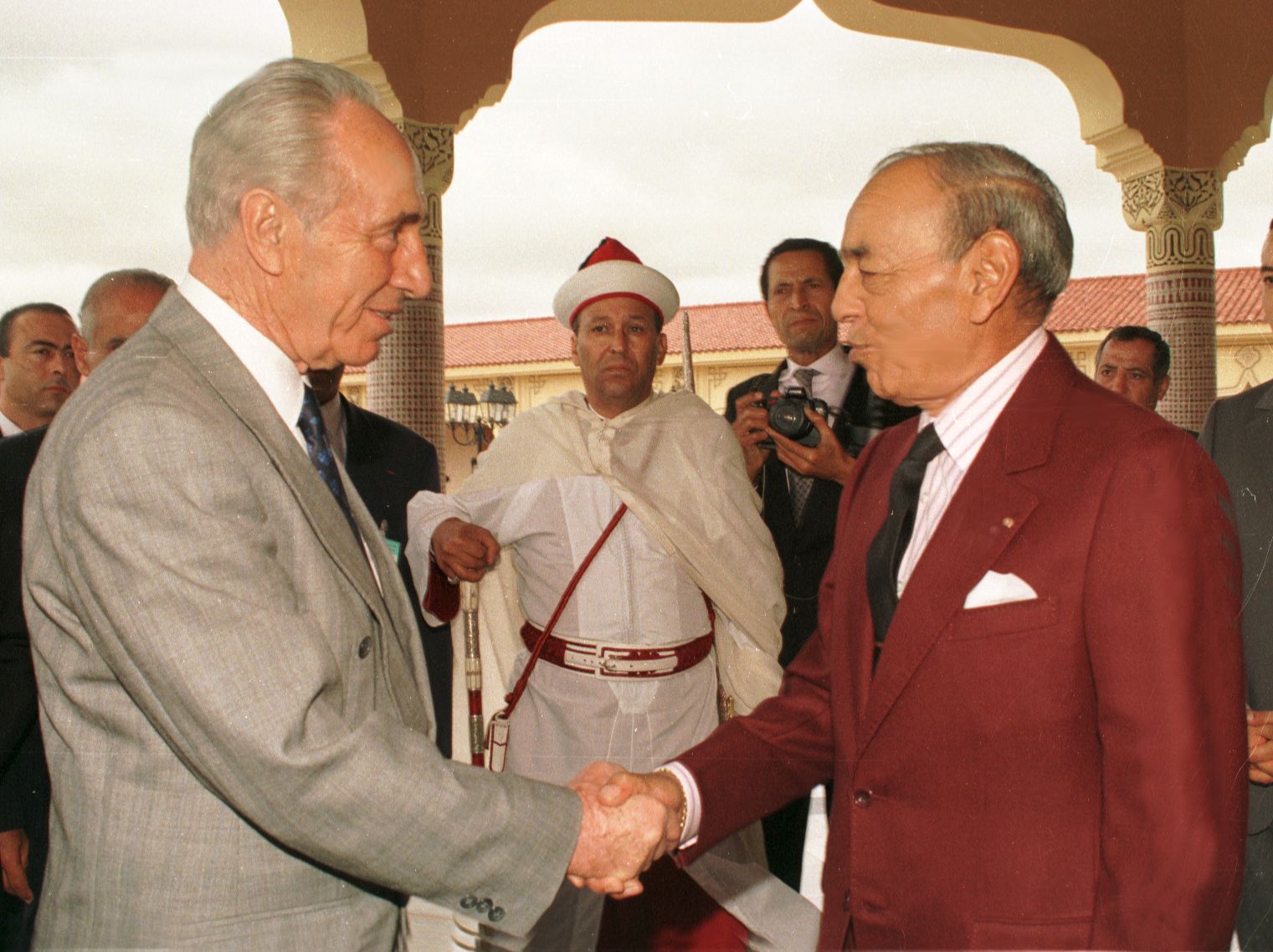
Israeli Foreign Minister Shimon Peres meets with King Hassan II of Morocco at the King’s Bouznika Palace during the Casablanca Conference in 1994. (Wikipedia)
I have said this before at TOI before October 7, and now I say it again that Israel should normalize with people and not the governments! Normalization without the people isn’t normalization. It’s a gamble against public opinion.
As a Moroccan, I’ve watched four decades of the region’s “cold peaces” and the more recent burst of government-to-government normalization. The pattern is painfully consistent: elites sign, embassies open, trade MOUs are waved for cameras – and the street rejects it. After October 7 and the devastation in Gaza, that gap has become a canyon. Across Arab societies, support for recognizing or “normalizing” with Israel has collapsed to single digits or the low teens, with Morocco falling from 31% support pre-war to just 13% in 2023-24.
In a 16-country survey, 89% of Arabs opposed recognition of Israel altogether; in Saudi Arabia, fully 96% favored that Arab countries cut official ties – including breaking any remaining contacts with Israel in protest against its military action in Gaza. These are not outliers or online moods; they’re robust measurements of consent – the only consent that matters if you expect durable peace rather than a brittle deal.
Another truth we must face is that every so-called “normalization” deal came with incentives – clear transactional benefits that had nothing to do with genuine reconciliation. The UAE and Bahrain were promised advanced US weapon systems and security guarantees. Sudan was lifted from Washington’s list of state sponsors of terrorism. Morocco received the long-sought US recognition of its sovereignty over the Sahara. Each case followed the same pattern: normalization with Israel was not the end goal, but a side effect – an uncomfortable clause that governments accepted to unlock the real prize.
This means even the official normalizations were never born of an honest acknowledgment of Israel’s legitimacy; they were bargains. That is why they remain brittle. If the benefits fade, the “peace” collapses. If the street erupts, the governments hide their ties. Normalization in this form is little more than transactional diplomacy, not a transformation of hearts, narratives, or societies. And until Israel chooses to normalize with peoples instead of relying on elites trading concessions, every such arrangement will remain hostage to circumstances rather than grounded in conviction.
And what shows that people-to-people ties are truly what matters is the Moroccan case itself. The palace attempted to give the deal a humanitarian and cultural dimension, emphasizing that it would reconnect with the nearly one million Moroccan Jews in Israel – an inseparable extension of our own identity and history. The argument went further: that such ties could even serve the Palestinian cause by creating new channels of coordination with Israel. This rationale reveals everything. It acknowledges that legitimacy cannot come from abstract treaties or transactional rewards; it must be grounded in living, human connections. Without those, normalization is nothing more than paper agreements that collapse at the first gust of political wind.
This legitimacy deficit isn’t theoretical. It explodes into the open whenever policy collides with conscience. In Morocco, where normalization came packaged with Washington’s recognition of our sovereignty over the Sahara, the public reaction to Gaza has been unmistakable: repeated mass marches, organized labor actions, and civil society campaigns urging the government to freeze ties. When normalization survives only by being kept low-profile – when the government must constantly downplay, deny, or fence off the relationship – what exactly is “normal” about it? Even French and international reporting has noted how public support here plunged, while protests have targeted ports and pushed authorities to calibrate repression carefully. That’s not social peace; that’s managed volatility. And even Hebrew media, in their own analysis, have gone so far as to label the Moroccan public as among the “most hostile” toward normalization.
Nor is this just a Moroccan story. In Egypt and Jordan – the region’s longest-running peace cases – the relationship with Israel has been described for years as a cold peace: strategic coordination paired with enduring social hostility. Governments can police squares, but they cannot decree affection. The result is familiar: diplomatic ties without social legitimacy, cooperation constrained by recurring waves of anger, and a constant risk that any spark – Gaza, settler violence in the West Bank, Al-Aqsa provocations – reignites mass mobilization and forces elites into damage control. That’s not a platform for long-term integration; it’s a truce with public opinion.
By definition, a government or a state is, first and foremost, a group of people – which means that the people must be at the heart of any normalization process. The top-down nature of the Abraham Accords, however, has been criticized precisely because they remain agreements between elites, struck in diplomatic chambers, without meaningful public buy-in. This absence of grassroots support weakens their long-term durability.
The plight of Palestinians continues to resonate deeply with Arab publics, where it remains an emotional and political touchstone. As long as no just settlement is reached, Israel will struggle to achieve broad legitimacy in Arab eyes. Normalization that bypasses this reality risks being fragile and short-lived.
True transformation cannot stop at state-to-state relations. It must extend to genuine exchanges between civic institutions, universities, youth groups, tech companies, and other non-governmental actors. The more ordinary Israelis and Arabs meet, collaborate, and learn from one another, the more they will see that coexistence is possible.
The path to lasting peace does not run solely through presidential palaces or foreign ministries – it runs through the hearts and minds of people. Only by engaging Arab populations directly can Israel begin to bridge the worldview gap and lay the foundation for meaningful, sustainable normalization.
Why does government-only normalization keep failing?
- No democratic mandate. Most Arab systems are non-democratic or semi-authoritarian. Deals struck by insulated elites don’t confer social license. When publics overwhelmingly oppose a policy, that policy is vulnerable – politically, economically, and symbolically. Every business partnership or cultural exchange becomes a lightning rod instead of a bridge.
- Moral injury and law. The Gaza war didn’t just sour moods; it created a legitimacy crisis. The International Court of Justice (ICJ) issued provisional measures finding a real and imminent risk to Palestinians’ rights under the Genocide Convention and ordering Israel to prevent genocidal acts and enable humanitarian aid. You cannot market “normalization” while nightly images from Gaza and court orders dominate the moral horizon. Any attempt to do so is read, rightly or wrongly, as indifference to law and life – and public opinion hardens.
- Security illusions. Elites often argue normalization buys security. Maybe tactically, but strategically it can backfire when publics feel betrayed. A relationship that lacks social legitimacy turns every crisis into a referendum on the relationship itself, inviting domestic instability and forcing governments to choose between repression and retreat. We have watched that movie play in neighboring states for decades.
- Economics without dignity doesn’t sell. MOUs and investment headlines don’t shift attitudes when people see dispossession and blockade on their screens. Without a credible political horizon for Palestinians, “economic peace” reads as moral laundering. Polls show even limited business-only links perform better than full political normalization, but the ceiling is low if the core injustice remains unaddressed.
- The “cold peace” trap. Egypt and Jordan prove the point: you can sign, coordinate, even trade – but absent people-to-people legitimacy, the relationship stays shallow and vulnerable. October 7 made that trap obvious to everyone.
From Rabat’s vantage point, the lesson is clear. The 2020 deal aligned with a central Moroccan interest – the Sahara – and many of us argued it could be leveraged for Palestinian rights and people-to-people bridges grounded in our shared Moroccan Jewish heritage. But the Gaza war, the mass casualties, and ongoing settler impunity in the West Bank shattered any illusion that societies would compartmentalize. In Morocco, as in the wider Arab world, the people have spoken – and their verdict is overwhelmingly anti-normalization under current conditions. Governments can insulate policy for a time; they cannot normalize against their own societies.
So what would real normalization – with peoples first – actually require from Israel?
1) A credible political horizon, now. Freeze settlement expansion, stop legalizing outposts, and enforce accountability for settler violence. Nothing poisons public sentiment more predictably than daily facts on the ground that scream annexation.
2) Compliance with international law. Implement the ICJ’s provisional measures in full: enable sustained humanitarian access, prevent incitement, and report transparently. Even those who don’t love international courts understand that legitimacy in Arab societies runs through visible law and restraint.
3) A rights-first security logic. Publics distinguish between legitimate security and punitive collective punishment. Durable security requires a rights architecture for Palestinians – movement, economic life, due process – not just deconfliction channels. (Egypt and Jordan, again, are warnings here: cooperation did not create affection.)
4) Human contact that isn’t propaganda. End the era of slick PR and influence ops. Instead: mutual visa regimes; scholarships for Arab students and joint academic labs; co-produced films and archives; Arabic-language curricula in Israeli schools; serious, independent Arabic media engagement that answers hard questions rather than dodging them.
5) Lean into shared histories, honestly. Morocco’s Jewish story is a living bridge: millions of Israelis trace roots to the Maghreb. Honor that connection with humility – acknowledging Palestinian suffering alongside Mizrahi memory – so exchanges feel like reconciliation, not erasure.
6) Dignified economics. Build projects that ordinary people can touch: medical partnerships, municipal water and energy solutions, tech apprenticeships open to Palestinians and Arabs – not just elite defense or venture deals behind closed doors.
7) Language discipline from the top. Words from ministers matter. When senior officials flirt with maximalist maps or transfer talk, every handshake in the region dies a little. If you want societal buy-in, stop lighting cultural fires that others then have to extinguish.
None of this is easy. But it is much easier than pretending that more MOUs with insulated regimes will somehow manufacture social legitimacy. And let’s be honest: this wall exists on both sides. On the Israeli side, overt rhetoric from the far right often portrays Arabs as threats, breeding contempt rather than connection, embedding an “us versus them” dynamic that precludes any real normalization. It frames Arabs as inherently suspect – terrorists by default, people of lesser value compared to Jews. In such a worldview, genuine people-to-people normalization is dismissed before it even begins, because “the other” is never treated as an equal.
This dynamic was laid bare when Israeli diplomat Hassan Kaabia, who served for a period as deputy head of Israel’s Liaison Office in Rabat, infamously declared during Morocco’s national solidarity march in 2023 that “anyone who sympathizes with Hamas… is not human and has no connection to humanity.” That statement didn’t just offend; it dehumanized an entire public and obliterated any pretense of normalization. Normalization cannot flourish amid contempt and dehumanization; it must be rooted in equality, recognition, and human dignity.
Normalization, by definition, should feel normal. Today, it doesn’t. It feels forced, secretive, and permanently one crisis away from collapse. If Israel wants something durable with our region, it should stop trying to normalize with governments only and start normalizing with peoples – beginning with a visible commitment to Palestinian rights and a politics of restraint, not exception. Anything less is not normalization. It’s a memorandum of misunderstanding waiting for the next spark.
Related Topics
