
An odd collection of thoughts
Not All Agents Are Agents: A Halakhic Lens on AI
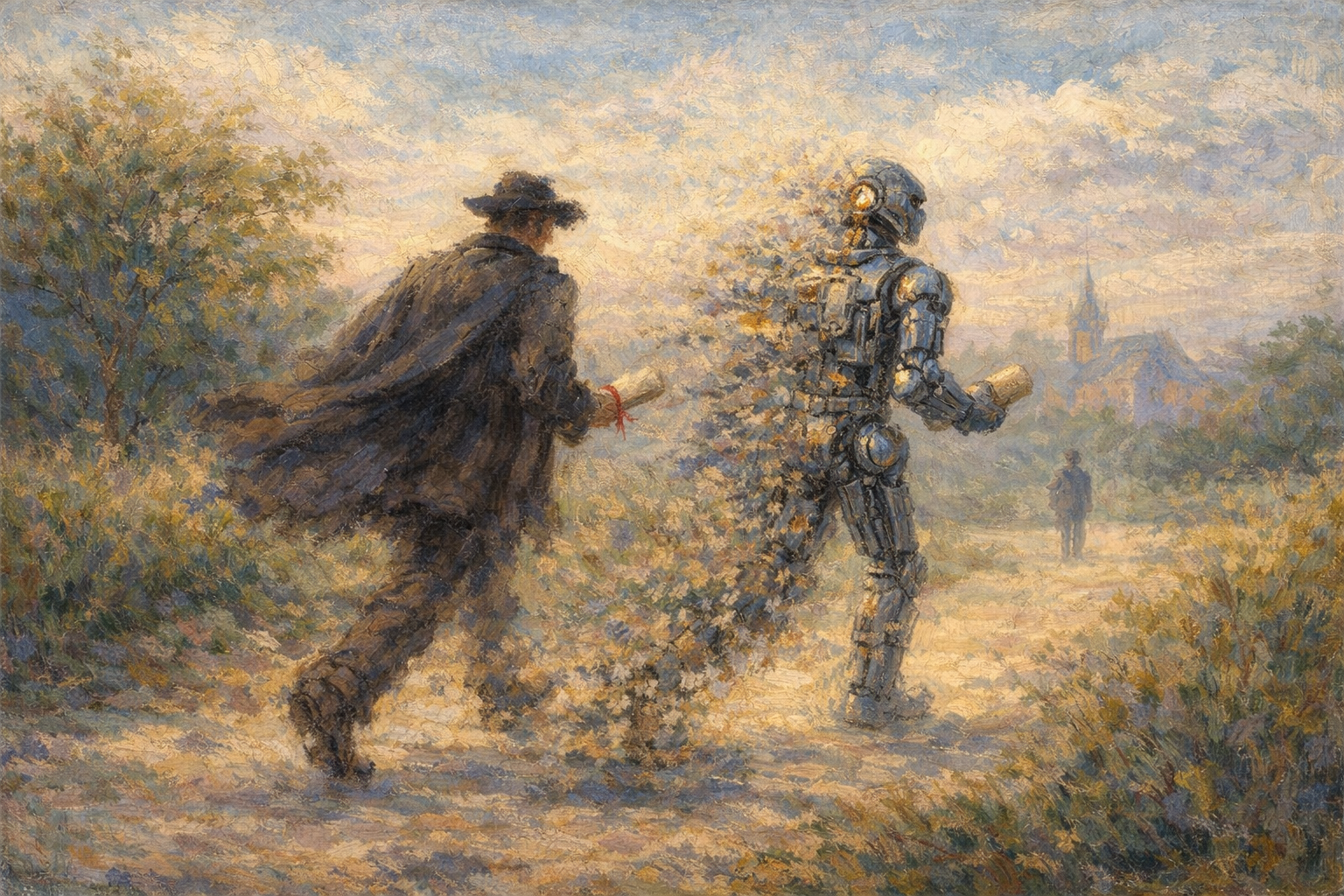
Delegation can carry the task forward. Responsibility still walks behind it
A Tradition of Defining Terms
Some words should slow us down.
That is why the Talmud lingers over terms others might pass by. Tractate Kiddushin opens with a jarring phrase, at least to the modern ear: האשה נקנית — a woman is acquired. The Gemara does not hurry past it. It pauses to press on the verb itself. What does it mean? What does it allow? What does it not allow? An entire moral and legal architecture begins with the refusal to let a single word remain vague.
This is the brilliance of our tradition and its reverence for language. It refuses to let a word go unexplored, unchecked, or, in a strange way, unloved. It insists on knowing what is meant and what is being communicated before we can proceed.
Our technological culture has little patience for that kind of scrutiny. It moves quickly. It names things confidently and moves on. Noah Feldman, writing recently from his reflections on Silicon Valley, noticed this dynamic crystallized in a very particular word: Agent.
And he puts the question exactly where it belongs: is the AI agent acting for you, or is it so autonomous that it is acting on its own?
That is precisely the problem. The term carries more weight than many of those using it seem to realize. In one sense, an agent is a delegate, someone empowered to act on your behalf. In another sense, an agent is something closer to a self: a being with judgment, intention, accountability. The systems being built today book flights, screen documents, manage calendars, and negotiate prices. They do not merely answer questions. They act. And the word we have chosen for them quietly implies that they are acting as selves.
New words — or more precisely familiar words applied to new terrain — deserve exactly the kind of pressure the Talmud would bring to bear.
The Halakhic Category: Shaliach
Jewish law has a more disciplined vocabulary for this.
The halakhic term is shaliach — an emissary, one who is sent. The Talmud states the governing principle plainly:
שלוחו של אדם כמותו – A person’s emissary is like the person himself. (Kiddushin 41b)
Under the right conditions, what the emissary does is treated as though the sender did it. Marriage can be contracted through an emissary. A bill of divorce can be delivered through one.
The Rambam codifies the logic with characteristic clarity:
יֵשׁ לָאָדָם לַעֲשׂוֹת שָׁלִיחַ כָּל מַה שֶׁיִּרְצֶה לַעֲשׂוֹתוֹ בְּעַצְמוֹ, חוּץ מִדְּבָרִים שֶׁאֵין אָדָם רַשַּׁאי לַעֲשׂוֹתָן עַל יְדֵי שָׁלִיחַ
A person may appoint an agent to perform any act that he himself may perform, except for matters that cannot be done through an agent. (Mishneh Torah, Hilkhot Shluchin v’Shutafin 1:1)
Delegation, in other words, is real. Action can pass through another.
But the tradition never leaves it there. The same sugya tempers the legitimacy of delegation with a counter-principle:
מצוה בו יותר מבשלוחו – It is a greater mitzvah to perform it oneself than through one’s agent. (Kiddushin 41a)
Even where delegation is permitted, something morally significant may still be lost when the act is performed through a degree of separation. Presence matters. Ownership matters. The fact that I can send another does not necessarily mean I should.
Not everyone may serve as a shaliach. The Talmud debates, for example, who may deliver a get (bill of divorce) and under what conditions. Agency is not casual. It is structured, bounded, and dependent on the nature of both the act and the actor. And more importantly, not every act may be delegated at all.
אין שליח לדבר עבירה – There is no emissary for a transgression. (Kiddushin 42b)
Wrongdoing cannot be outsourced. Delegation does not dissolve responsibility. If anything, it clarifies where responsibility lies.
The Rambam deepens this point when discussing the obligations that arise once someone acts on another’s behalf. If a person sends an agent to conduct business with his property, Rambam writes:
הוֹאִיל וְנָשָׂא וְנָתַן בְּמָמוֹן חֲבֵרוֹ — הֲרֵי זֶה כְּבֶן בַּיִת
Since he has handled another person’s property, he is treated like a steward of the household… (Hilkhot Shluchin v’Shutafin 9:5)
From Agency to Delegation
Whatever their sophistication, these systems do not possess will. They do not deliberate toward the good. They do not stand under obligation. They are not agents in the way a moral agent is an agent. What they are is something more like a shaliach — a delegated executor, acting within a bounded domain, in service of goals it did not originate, under authority granted elsewhere.
And once you see them that way, the question changes.
The question is not whether machines have achieved genuine agency. The question is which human acts may properly be delegated.
Halakha treats that question with seriousness because delegation is never merely technical. It is moral. Some acts can be delegated because what matters is execution — getting the letter delivered, the payment processed, the reservation confirmed. Others cannot be delegated because the act requires judgment, presence, or accountability that cannot be externalized without remainder. Sometimes the point is not merely that something be done. The point is that I do it.
The Principal-Agent Problem
Political science offers a parallel way of seeing the problem.
The classic principal-agent problem begins with a simple concern: once one actor delegates authority to another, how can the principal be sure the agent will act faithfully, competently, and in alignment with the principal’s aims? But the problem is often more complicated than that. Agents do not always serve a single principal at all. In the realm of congressional committees, agents are answerable not only to the chamber but also to party caucuses and outside constituencies. The question, then, is not just control. It is divided loyalty. Whose interests is the agent really serving?
That insight lands with force in the AI context.
An AI “agent” may appear to be acting for the user. But is it acting for the user alone? Or is it also acting for the company that built it, the institution that deployed it, the compliance regime that shaped it, the risk model that constrained it, the revenue incentives embedded within it? An insurance algorithm may present itself as a neutral evaluator of claims. But in reality it may be serving several principals at once: the patient, the insurer, the actuarial model, the legal department, the bottom line.
Once we put the matter that way, the term agent becomes even more slippery. The problem is not only that the system is mistaken for a self. It is also that its delegations are rarely clean. The line of accountability grows harder to trace precisely when power becomes easier to exercise.
This is what the shaliach framework exposes, and what the standard AI ethics conversation often misses. The usual debate is about bias, accuracy, and guardrails. It assumes that delegation is acceptable so long as the execution is right. But halakha insists on a prior question: are there acts whose moral substance depends on a person performing them? Acts where handing them to another, however competent, however reliable, alters the act itself?
Should an AI system decide which job candidates advance? Which patients are flagged as high risk? Which loan applications are rejected? These questions are usually framed in terms of reliability. But they are also questions about whether the act of judgment can survive the act of delegation.
The Burden That Remains Ours
And there is something else. The more discretion the emissary is given, the greater the burden on the one who sends him to specify, supervise, and own the act.
That is true in halakha. It is true in political science. And it is true here.
This is precisely where the language of “AI agents” misleads. As the systems grow more capable, it becomes tempting to speak as though responsibility has migrated into the machine.
The system decided. The model flagged it. The agent handled it.
But someone authorized the delegation. Someone defined the task. Someone set the parameters. Someone sent the emissary. The danger is not that machines will become moral selves. The danger is that human beings will begin to speak as machines stripped of morality, compassion, empathy – the danger is we may forget how to see each other with radical amazement.
Not Through an Emissary
At Passover, reflecting on the verse “And the Lord brought us out of Egypt,” the Haggadah says:
לֹא עַל יְדֵי מַלְאָךְ, וְלֹא עַל יְדֵי שָׂרָף, וְלֹא עַל יְדֵי שָׁלִיחַ, אֶלָּא הַקָּדוֹשׁ בָּרוּךְ הוּא בִּכְבוֹדוֹ וּבְעַצְמוֹ
Not through an angel, not through a seraph, not through an emissary, but the Holy One, blessed be He, in His glory and by Himself.
The tradition is not denying that emissaries exist. Much of religious and legal life depends on them. But the Haggadah insists that some acts are too weighty to be mediated, too consequential to be assigned outward. Some moments demand presence. Some judgments demand ownership. Some responsibilities cannot be transferred without changing the act itself.
The challenge of the AI age may lie precisely here: learning again which human acts belong to that category.
Because however sophisticated our emissaries become, the burden of judgment is not theirs.
It is ours.
Related Topics
Related Posts