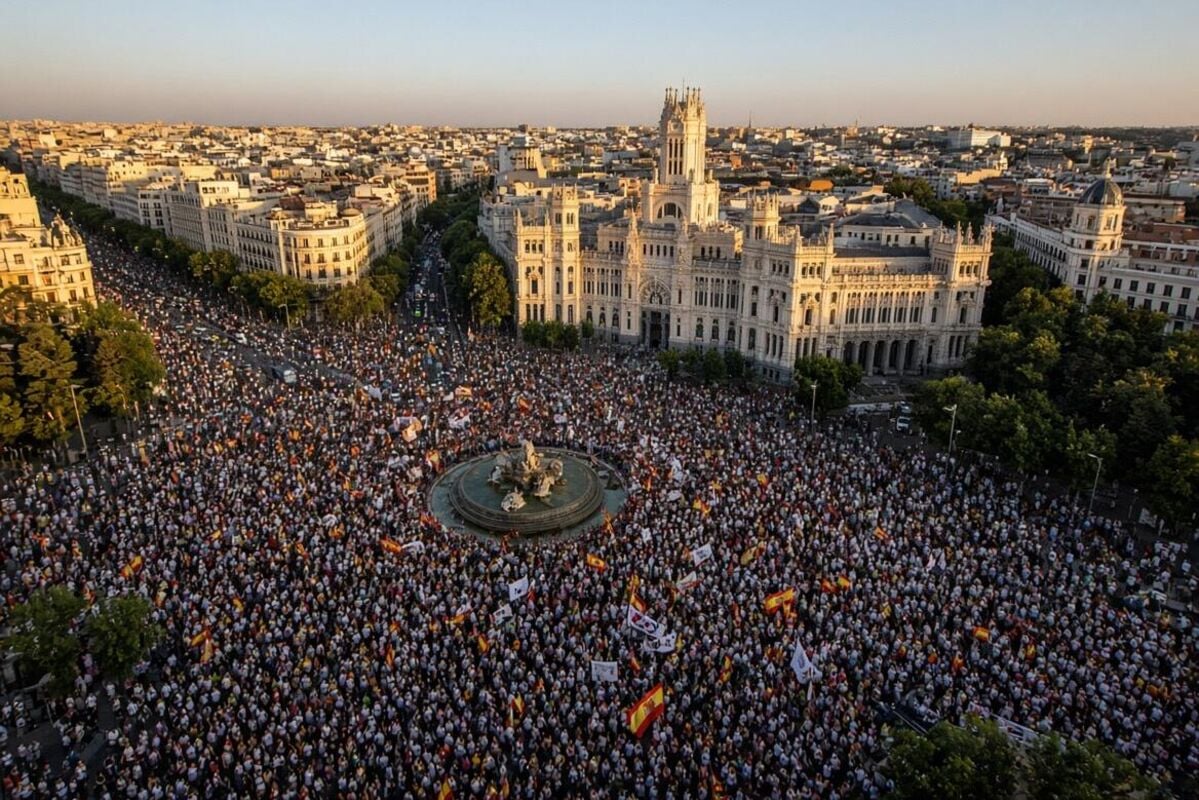
Yesterday Spain took to the streets, and Pedro Sánchez’s government once again did the numbers the way one manages a budget — downwards. While the government delegation in Madrid insisted on 50,000 people in Plaza de Cibeles, the capital’s city hall — and the images — pointed to 150,000. In Ceuta, a Spanish city of some 80,000 inhabitants on the North African coast, between 20,000 and 25,000 filled the streets on the city’s official day, in what was described as the largest demonstration in its recent history. In Andalusia there were more than 160,000; in Castile and León, tens of thousands in the provincial capitals alone; in the Canary Islands, 10,000. In total, hundreds of thousands of Spaniards in nearly two thousand localities — 1,996, according to the Popular Party and the Spanish Federation of Municipalities and Provinces — a quarter of the country’s municipalities.
The rarest thing, however, was not the numbers. It was seeing left and right — including municipal socialists, despite a veto from party headquarters at Ferraz — standing side by side, with only Spanish and Ceuta flags, no podium speeches stealing the purpose, just the unison chorus of “Ceuta is not for sale, Ceuta defends itself” and “Sánchez, resign.” This was not a Vox rally. It was a wave that carried socialist mayors, PSOE deputies from Ceuta, and people who would never vote for Santiago Abascal. Reducing everything to “the far right” is the Pavlovian reflex of those who prefer the narrative to what was seen in the streets: Spaniards fed up with a government that treats a Spanish city as someone else’s problem.
A month after more than 72,000 people entered Ceuta in 24 hours — the breach Madrid still prefers to call a “massive influx” — the city still has five to ten thousand migrants in the streets, on the beaches and in makeshift camps. A National Police report now in the hands of the National Court points to “active guidance” by Moroccan security forces, uniformed and in civilian clothes, and to prior planning rather than a spontaneous rush. Sánchez continues to deny that Rabat was behind it. He prefers another culprit.That culprit, in the prime minister’s telling, is Israel.
In a radio interview on 31 August, Sánchez claimed that after 30 and 31 July “rumours and disinformation” had spread from social networks “linked both to Russia and to Israel,” and to an “international far right” that uses migration to attack Spain and divide Europe. He said research by the EU’s diplomatic service showed those networks at work, and that Jerusalem and Moscow had exploited the crisis because they dislike Madrid’s positions on Gaza and Ukraine. He offered no public evidence that Israeli networks had organised, financed or triggered the crossing itself.
A Spanish police analysis of the phones that amplified the call to cross found that more than 90 percent carried Moroccan prefixes. None of this has stopped Sánchez from pointing east. When a Spanish border city is overwhelmed, Jerusalem is a useful alibi. Rabat, the neighbour with the fence, is treated as an indispensable partner.
To soothe public opinion, the Council of Ministers approved on Tuesday a “shock plan” of €309 million — 16 percent of the city’s annual GDP — for security, reception and support for businesses. Money that arrives late, and that many in Ceuta see as a widow’s pension for a problem the government proved unable to manage.
If Sánchez insists on staying, he stays isolated. The polls are already stripping him of millions of votes and giving the PP and Vox the numbers to govern alone. Today’s session in Congress is the reality check he could not postpone: the opposition and even some partners are demanding explanations the prime minister does not have — least of all an explanation of how Israel became responsible for a breach at Tarajal. If he falls — by no-confidence motion, by internal erosion, or by early elections — the most likely outcome is a turn to the right that will make Ceuta the first test of a Spain that has grown tired of being governed as if borders were an ideological detail, and foreign policy a search for someone else to blame.
In any case, the government that yesterday tried to count the people downwards discovered that the country no longer accepts being counted the same way.
Sofia Afonso Ferreira is the Executive Director of StandWithUs Portugal.
She currently divides her time between Lisbon and Tel Aviv while working on a book about the war in the Middle East.