
99.6% Ashkenazi + .4% Viking = 100% Zionist
Not in their Backyard… Yet
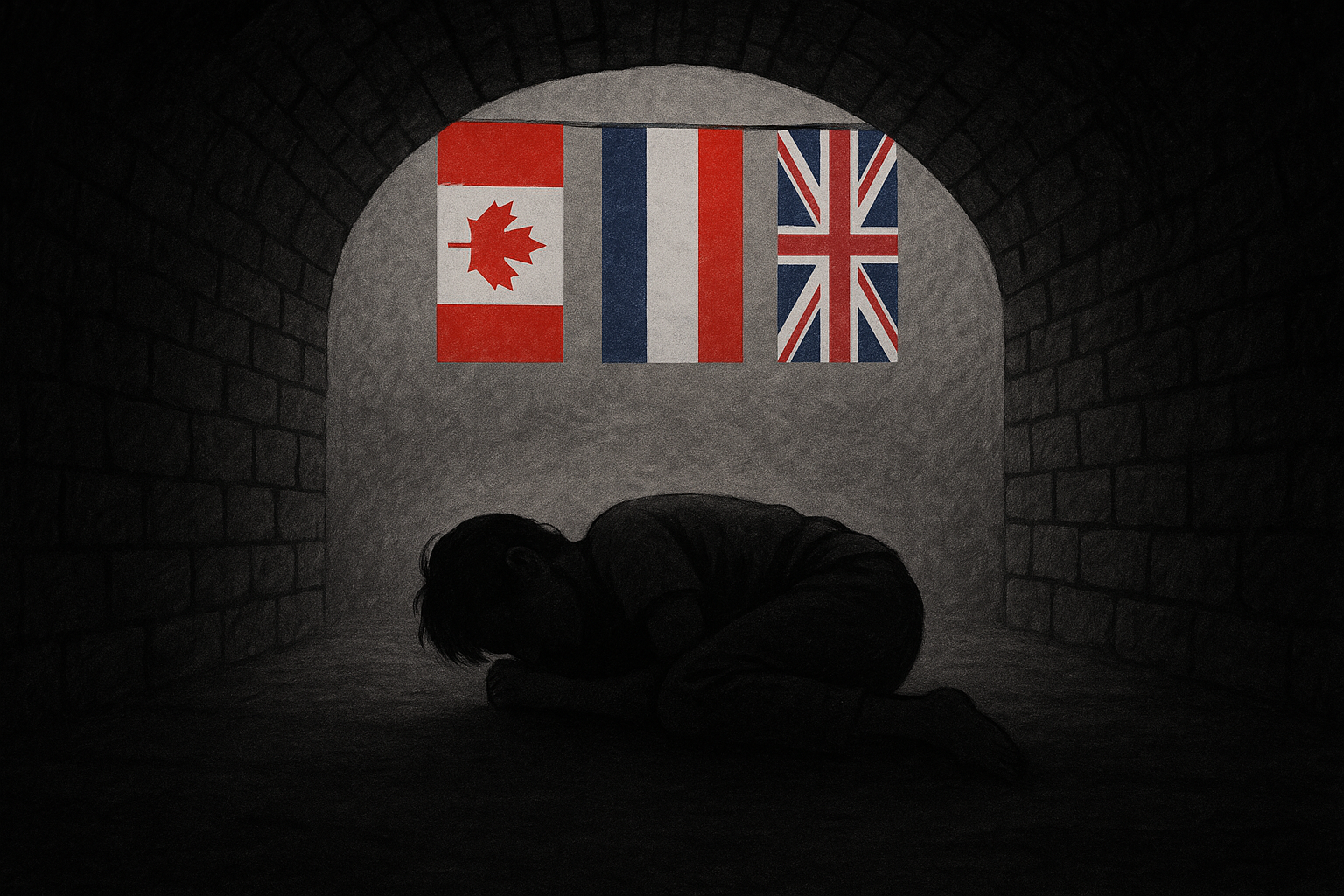
Not in their Backyard... Yet
They waved statehood like a banner—and left the hostages behind.
When the governments of Britain, France, Canada and a handful of other Western democracies suddenly moved to “recognize” a Palestinian state, they took a rare card off the table. Recognition is not cheap political theater; it is a tangible lever of international legitimacy. For any honest statesman asking how to use leverage in a crisis of this magnitude, the answer was obvious: demand the release of the hostages and insist on the disarmament of Hamas before you grant the imprimatur of sovereignty. Instead, those governments cashed the card in for applause.
This is not high-minded posturing. Families who have watched their loved ones vanish into captivity — or worse, grieve their dead without closure — have waited for their supposed allies to translate moral outrage into action. Recognition without conditions is an insult to them. It tells the families that their pain is secondary to a press release, that ballots at home are more important than the lives still held in caves. It signals to Hamas that the world will reward terror with state legitimacy. That is a historic error with dangerous incentives.
If these Western capitals wanted to speak of peace, they had an opening — a clear, enforceable bargain: recognition, yes, if and only if hostages are freed and Hamas’s military capability is neutralized. That was the real leverage. Instead, the chorus opted for the easy line: “ceasefire.” A ceasefire is tidy in a headline and cheap in political capital. It requires little enforcement, allows everyone to posture for domestic audiences, and asks nothing of the perpetrator. “Ceasefire” sounds humane; “Release the hostages” sounds costly. Which one do you think moves votes on the home front?
Let me be candid about motives. This cluster of recognition was not born of sudden epiphany or principled reappraisal. It was a political calculation. When domestic streets grow loud and citizen outrage demands a visible symbol, politicians—even those who once prided themselves on prudence—reach for the gesture that soothes crowds and photographs well. They want to look decisive without having to do the hard work of coercion or consequence. Leadership used to mean bending power toward principle. Now it too often means bending principle toward the next election cycle.
The practical consequence is the same: the West muffles its own moral credentials. Recognizing a state without exacting any security guarantees, without placing the release of living human beings at the center of the bargain, is moral theater disguised as courage. It is also strategically incoherent. If recognition is meant to advance a two-state solution, it must be tied to the institutions that make states safe and responsible: disarmament, rule of law, and accountability. Rewarding the architects of terror with recognition before any of those conditions are met will only harden enmity, deepen mistrust, and carve open new wells of violence.
Israel should respond plainly and proportionately. When nations act in bad faith—performing a moral act while simultaneously stripping it of its moral obligation—diplomacy must reflect that betrayal. Israel should consider expelling diplomats from those capitals that rushed to recognize statehood unconditionally. Yes, reciprocity will follow. Yes, the press will carp. That is the point. If recognition is to be more than a ceremonial flourish, it must carry consequences. Otherwise, what is the point of recognition at all?
Finally, if policymakers truly wanted to force the world to face geopolitical realities rather than domestic politics, Israel should move to formalize sovereignty over East Jerusalem. This is not a reckless territorial flex; it is the admission of a fact that has existed on the ground and in history for millennia. Jerusalem is not a bargaining chip; it is the ancient, continuous, spiritual, and political capital of the Jewish people. Empires have besieged it, armies have taken it, and foreign powers have tried repeatedly to redraw its meaning and erase its connection to the Jewish people—but none of those historic intrusions erased the reality that Jerusalem is, at its heart, Jewish. The world’s opinion on that fact is irrelevant to the lived truth.
Annexing East Jerusalem accomplishes several things at once. It answers the domestic political calculus of the United States (satisfying the specific ask to avoid annexation of the West Bank), it removes any illusion that there will be a Palestinian capital in Jerusalem, and it hardens Israel’s bargaining posture by ending the charade of “contested” sovereignty where none exists in practice. If Western democracies wish to take a stand now—let them explain why their recognition of a Palestinian state matters more than the lives of hostages, and more than the security of a democratic ally. If they cannot, Israel need not dignify their gesture.
Here’s the ugly choice the West forced: gesture without consequence, or consequence without gesture. They chose the former. Israel, and the families of the hostages, deserve the latter. If these countries wanted to be leaders, they should have traded recognition for life. Instead they traded it for applause. The applause is now theirs; the price is on Israel’s doorstep.
Perhaps those countries felt it was an easy “fix” — as the conflict, the violence, the hatred is not in their backyard… yet.
Related Topics
Related Posts