
Nouriel Roubini and AI
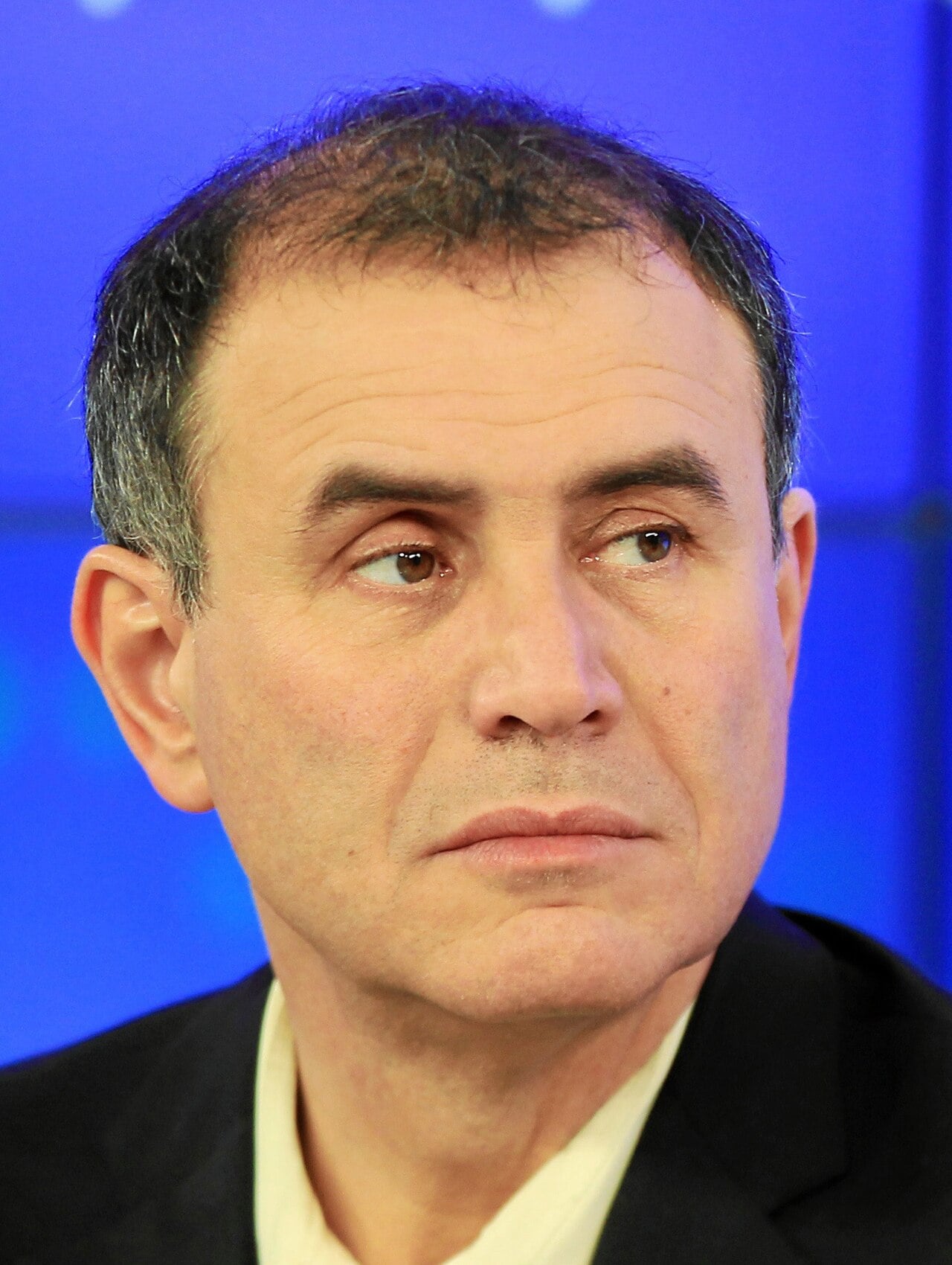
Over the years of economic analysis, I learned to admire Nouriel Roubini, or Dr. Doom, as he was called in the early crypto years. He tends to get major economic calls right, not because he predicts short-term market movements, but because, much like Stiglitz, of the way he thinks about the global system. He focuses on the big structural risks rather than surface-level data, tracking long-term imbalances in debt, finance, geopolitics, demographics, and technology that slowly build pressure until they break.
As an investor, Roubini himself brings more than an academic approach but real-world experience. He was a frequent critic of bitcoin and other cryptocurrencies, stating in 2018 at a cryptocurrencies panel of the Milken Institute Global Conference: “All this talk of decentralization is just bullsh*t.” He was spot on.
As a crisis economist, Roubini studies nonlinear outcomes, moments when stable systems suddenly collapse, while most mainstream models assume smooth and predictable growth. He also integrates politics and power into his analysis, understanding that wars, populism, sanctions, and institutional decay drive markets as much as interest rates and earnings. Unlike consensus economists, he is deeply skeptical of bubbles and groupthink, warning when leverage, speculation, and moral hazard dominate decision-making. And most importantly, Roubini accepts being early as a hazard of the trade: his warnings often look wrong for years, until reality catches up. In short, he usually gets it right because he studies fragility, not just growth, and history shows that fragility is what ultimately moves the world.
I usually do the same because predicting the future is virtually impossible, and everyone gets it wrong sooner rather than later. Assuming one knows something about the future that his fellow humans do not know, especially in a human-driven area like economics, is a cancer that all historians and economists, from Harari to Marx, suffer from. Somehow, most people think that predicting the future is the only raison d’être of a historian or an economist. That kind of narrow thinking misses the silver lining, which is: the analysis economists make to get to their conclusion is way more important than their prediction.
This serves to talk about Nouriel Roubini’s latest paper that debunks most current gloomy economic predictions and gives the AI economy 1.0 a medium life cycle that will maintain the US economy strong. The paper argues that the pessimism surrounding the U.S. economy after the April 2025 tariff shock is overstated. While tariffs and protectionist policies carry stagflationary risks, they are constrained by market discipline, Federal Reserve independence, institutional guardrails, and political checks. More importantly, a massive wave of AI-driven investment in semiconductors, automation, robotics, and data centers represents a powerful positive supply shock that can lift productivity, boost potential growth, and ease inflation pressures. In this view, “tech trumps tariffs,” and U.S. exceptionalism remains intact.
Roubini contends that AI and related technologies could raise U.S. potential growth from roughly 2% today toward 4% by the end of the decade, with compounding gains thereafter. Capital spending on data centers and advanced computing is already accelerating, productivity has picked up since 2019, and corporate earnings have remained resilient despite policy headwinds. If this technology-driven productivity boom continues, equity valuations need not imply a bubble, debt sustainability improves as GDP grows faster, and the U.S. retains its leadership position in frontier technologies such as AI, semiconductors, biotech, quantum computing, robotics, and defense tech.
Finally, the paper maintains that the U.S. dollar’s reserve-currency dominance is unlikely to erode meaningfully. Although tariffs, sanctions, and fiscal deficits create short-term volatility and some downward pressure, long-term capital inflows driven by superior U.S. growth and investment opportunities should support the dollar. While geopolitical risks and U.S.–China rivalry may generate instability along the way, the central conclusion is that technological tailwinds will dominate over protectionist headwinds, allowing the U.S. economy to survive and thrive over the medium to long term.
The study is a great read, but like all predictions, take it with a grain of salt, and remember that Roubini reaches his conclusion by combining classical growth accounting with large-scale technology investment data and independent institutional research. He starts from the standard macro framework used by the Federal Reserve and Congressional Budget Office, where potential growth equals labor-force expansion plus productivity growth. He then incorporates forecasts from the OECD, McKinsey, Goldman Sachs, Wharton, the Federal Reserve Bank of Dallas, and AI Impacts, which estimate AI could add 0.5–1.5 percentage points to annual productivity this decade. He validates these projections using hyperscaler and semiconductor capital-expenditure trends, showing how massive data-center and automation investment converts AI innovation into real economic output and sustained growth.
The question for the long term that the study does not answer is: what kind of economy will the US and the World have when AI replaces most of the workforce, and there is no more consumption expenditure?