
Russian-American-Israeli Palestinian. Palestine is Israel.
November 30 — Nakba Day: The Jewish Expulsion and Flight from Arab Lands
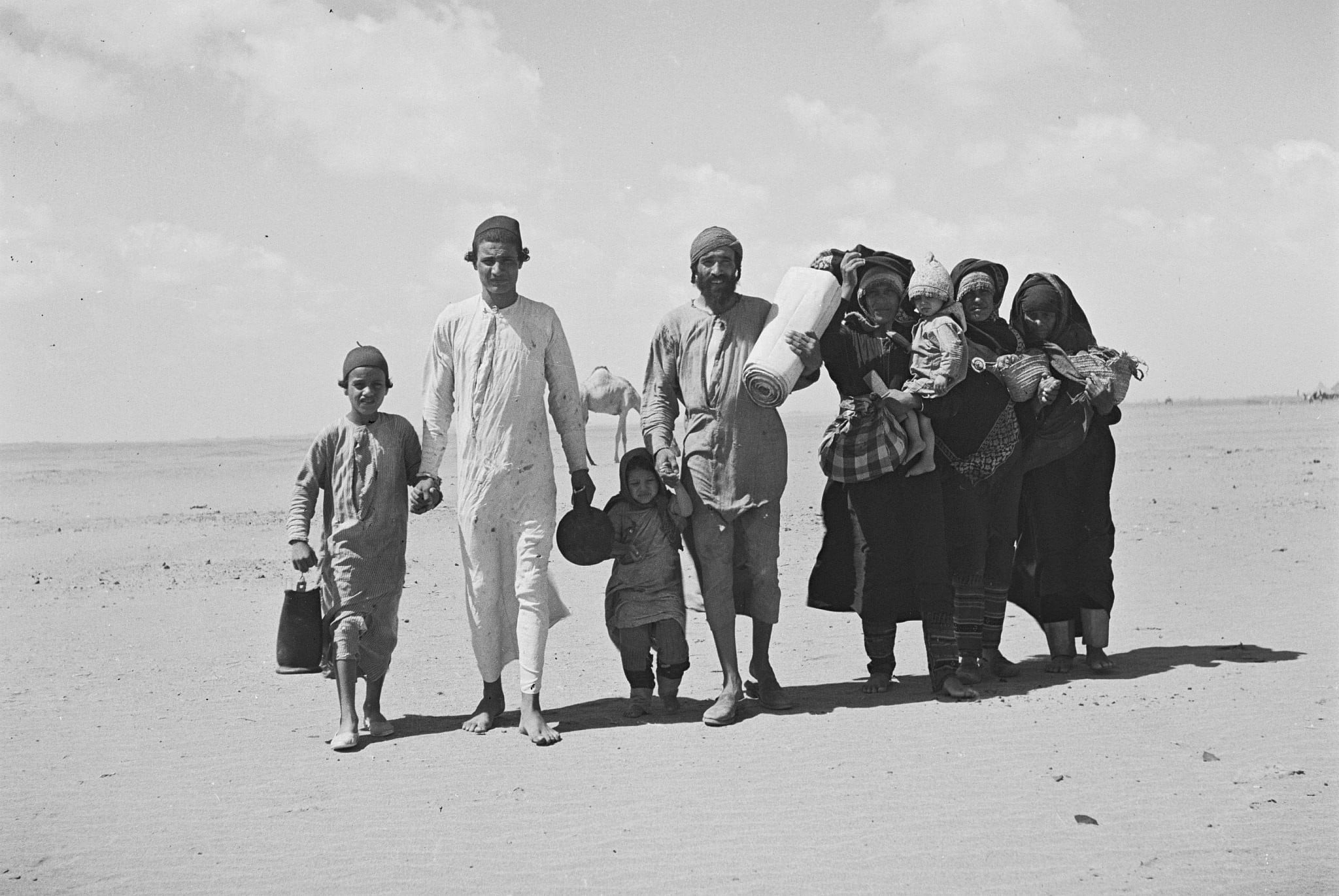
A Yemenite family expelled during the Nakba treks through the desert to a reception camp set up by the “Joint” near Aden, November 1, 1949. Public domain. Source: Wikimedia Commons.
Remembering the Nakba: From the Jewish Exodus to the Ongoing Assault on Jews and Israel
Israel formalized November 30 as the national Jewish Refugee Day — Yom HaPlitim in Hebrew — in 2014. Every year, Jewish communities in Israel and throughout the world mark the expulsion and flight of nearly a million Jews from Arab countries and Iran. The memory is well-preserved; the events are well-known; the commemorations are established. What has been missing is not remembrance, but terminology — the willingness to call this day by the name that fully captures the scale and meaning of what happened. If the Middle East has known a true Nakba, a genuine catastrophe characterized by the destruction of entire communities and the erasure of ancient civilizations, then it is the Jewish expulsion from the Arab world. November 30 should be officially designated, or at least widely nicknamed, the Nakba Day.
The reasoning is clear. The word Nakba describes the collapse of a people’s established life in its native lands. That is precisely what befell Jews in Baghdad, Cairo, Damascus, Tripoli, and Sana’a. Their communities did not merely decline; they vanished. Civilizations that had existed for millennia — predating both Islam and Arab national identity — came to an abrupt end. No Jewish Aleppo remains. No Jewish Yemen, no Jewish Iraq, no Jewish Libya. The erasure was comprehensive.
Succumbing to UNRWA propaganda, some speak of “two Nakbas,” a Jewish one and an Arab one, as if the term can be stretched to fit symmetrical narratives. But the symmetry is illusory. Arab society in the Middle East remained intact; its cultural and political presence was never extinguished. By contrast, the Jewish presence in the Arab world was eliminated. To frame these events as parallel is to distort both history and language. The concept of a dual Nakba weakens the meaning of the word itself. In historical terms, there is only one phenomenon in the region that qualifies as a Nakba — and November 30 marks its beginning.
This understanding is no longer confined to Israel’s internal discourse. Recognition is expanding internationally, including in the United States. A bipartisan resolution, H.Res. 904, introduced by Representatives Debbie Wasserman Schultz of Florida and Craig Goldman of Texas, formally acknowledges the forced displacement of Jews from Arab lands and Iran. It designates the commemoration in both English and Hebrew — Yom HaPlitim — and encourages public education about the expulsion. For the first time, the U.S. Congress affirms that this exodus was not a peripheral migration but a major historical rupture.
Such recognition reinforces a broader moral and historical point: understanding catastrophe in the Middle East requires acknowledging the destruction that actually occurred, rather than inventing symmetrical narratives. The widespread habit of invoking a fabricated “Arab Nakba” narrative while overlooking the elimination of Jewish life across the region distorts the historical record. This distortion becomes even more consequential amid ongoing waves of antisemitic hostility and efforts to delegitimize Jewish identity and sovereignty. Precision in language is not a matter of rhetoric; it is a matter of historical integrity.
November 30 stands as the date that anchors this integrity. It marks the beginning of the process that violently severed Jewish history in the Middle East and North Africa—not through natural decline, but through deliberate political acts of exclusion, confiscation, intimidation, and expulsion. This process reshaped the demography and culture of the region more profoundly than any other twentieth-century development. Naming it properly is essential to recognizing its scale.
The term Nakba belongs to this story. It captures the loss, the uprooting, and the civilizational collapse that occurred across the Arab world’s Jewish communities. Assigning this name to November 30 does not compete with any other narrative; it corrects a long-standing imbalance in historical language. It ensures that the destruction of Jewish life in the Middle East is neither minimized nor linguistically erased.
For these reasons, November 30 should be known — formally or informally — as the Nakba Day: the name that recognizes the magnitude of the Jewish exodus from Arab lands and restores the word Nakba to the only event in the region’s modern history that truly embodies its meaning.
Nakba that began in 1948 and today are not separate events. There has been an ongoing Nakba since 1948: a catastrophe inflicted upon Jews and Israelis through terrorism, delegitimization, and war. Every intifada. Every hijacking. Every stabbing, bombing, shooting, and lynching. Every missile from Hezbollah. Every drone from the Houthis. Every Iranian threat and attempt to wipe Israel off the map. Every death chant in the streets of London, Paris, and New York. Every international resolution that singles out Jewish self-determination as the one impermissible national aspiration.
A central mechanism sustaining this catastrophe is the machinery built around the Arab settlers in Gaza, Judea, and Samaria — populations maintained not as refugees but as permanent dependents. Unlike the nearly one million Jews expelled from Arab lands, who rebuilt their lives without demanding hereditary refugee status, these groups were transformed into something else entirely: UNRWA Clientele — a bureaucracy-dependent base whose political utility relies on their perpetual statelessness. Also known colloquially as UN-Ruh Clientele, or simply Clientele, they form a deliberately preserved demographic bloc, engineered through policy rather than circumstance.
The ultimate manifestation of this ongoing Nakba is October 7, 2023 — when Hamas terrorists invaded Israel, raped and mutilated civilians, burned families alive, and live-streamed their own genocidal assault. All while cheering crowds around the world revived the same slogans — including “Free Palestine” — that were stolen from the true Palestinian patriots: the Zionists.
See Also
Related Topics