
The Butchers of Tehran and the Nation They Fear
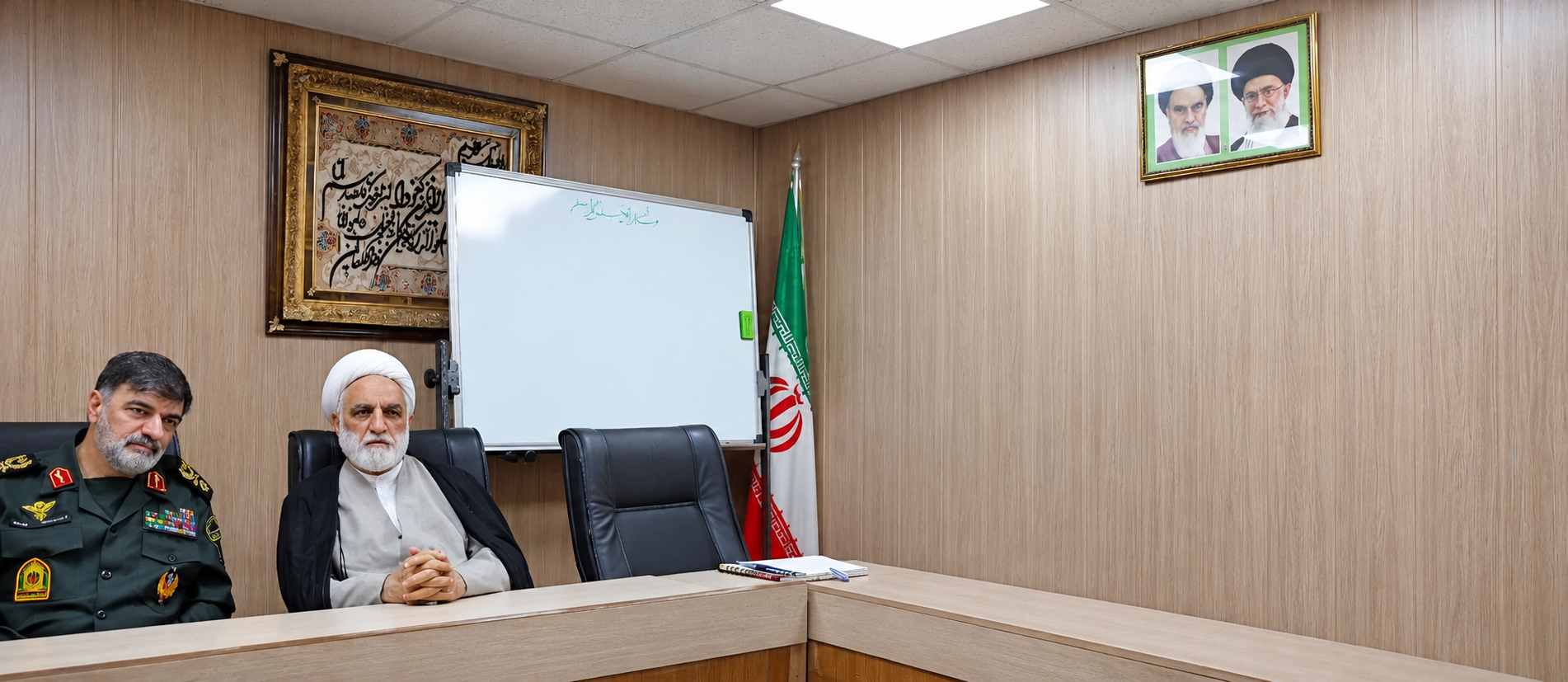
Ahmad-Reza Radan -the chief commander of Iran's police (Law Enforcement Command / FARAJA)- and Gholam-Hossein Mohseni-Eje'i, an Islamic jurist and the Chief Justice of Iranian regime / Picture : radio california - Free for all platforms.
In Tehran, murder wears a uniform, cruelty wears a notorious clerical robe, and both have the audacity to call themselves guardians of the law.
The knife-wielding thugs of the Islamist dictatorship are still in business, still issuing their threats from behind the walls of a decaying tyranny, still intoxicated by the power to humiliate, imprison, and kill, and still laboring under the fatal delusion that a nation whose voice they have strangled has somehow forgotten how to speak.
On Monday, November 23, Ahmad-Reza Radan, the police chief of the Islamic Republic, proclaimed that his forces would identify and suppress every disturbance before it could even come into existence, dismissing allegations concerning dirty bombs and reaffirming his slavish obedience to the commands of the Supreme Leader. Yet beneath the swagger of this uniformed thug, beneath the rehearsed menace and the vulgar exhibition of authority, there lurks something neither his uniform nor his weapons can conceal: the naked, consuming fear of a reckoning.
For the greatest terror of men like Radan and Gholam-Hossein Mohseni-Ejei is neither Washington nor Jerusalem, neither American aircraft nor Israeli missiles, but the Iranian nation itself, the prospect of a national resurrection, the awakening of a people whose civilization had already witnessed the rise and ruin of empires centuries before these men discovered that religion could be made into a weapon, justice into an execution chamber, and an entire country into the private estate of a clerical oligarchy. And sooner or later, with or without Trump, with or without Netanyahu, the Iranian people will rise upon their own feet and reclaim the destiny that others have presumed to negotiate on their behalf.
They have heard it all before, that tiresome litany of promises and postponements: before the World Cup, after the World Cup; before the midterm elections, after the midterms; before the arrival of 2027, after its arrival. The promises have grown stale, the threats hollow, and the spectacle increasingly contemptible.
Somewhere amid this interminable carnival of geopolitical bargaining, Iranians came to understand that they were neither the proxies of foreign powers nor the expendable flesh upon which other nations might purchase their strategic advantages. They had cried out for their king and the overthrow of the Islamic dictatorship, only to find Trump interposing himself in their struggle, transforming the anguish of a nation into another occasion for negotiation in pursuit of his own interests. His words no longer command the faith they once did, for a people acquainted with betrayal eventually learns to distinguish the rhetoric of salvation from the arithmetic of self-interest.
Meanwhile, Iran remains in the hands of men like Radan and Ejei. The former is no ordinary police chief but a street thug dressed in the uniform of state authority, a hardened practitioner of intimidation whose professional existence has been devoted to the humiliation of women, the suppression of dissent, and the preservation of tyranny through violence. The sanctions imposed upon him by the United States, the European Union, and Canada constitute an international indictment of a career that has borne little resemblance to the enforcement of law. The latter, Ejei, is his counterpart in clerical robes, a man whose record stretches from the sinister legacy of the chain murders of the 1990s to the machinery of contemporary mass executions, and whose understanding of justice appears indistinguishable from the political necessities of his masters. One commands the instruments of repression; the other furnishes its atrocities with the counterfeit dignity of judicial authority. Together, they embody the moral obscenity of a system in which cruelty has become a profession, bloodshed a doctrine of government, and impunity the sacred privilege of those who rule.
Since the massacres of January 2026, millions of Iranians have awaited the downfall of these architects of repression, the day when their uniforms and robes will cease to confer immunity, when the machinery of terror will fall silent, and when those who have spent their lives passing judgment upon others will themselves stand before the judgment of a liberated nation. For all their calculated brutality, all their prisons, gallows, and instruments of coercion, these men have failed to comprehend the one truth upon which their ultimate ruin rests: a nation may be wounded without being conquered, silenced without surrendering, and condemned to decades of darkness without ever forgetting the meaning of dawn.
Iran belongs neither to the butchers who have drenched its history in blood nor to the foreign statesmen who presume to bargain over its future. It belongs to the Iranian people. And when the long, hideous night of this dictatorship finally ends, history will remember Radan and Ejei not as men who governed a nation, but as men who, possessing neither the dignity to govern it nor the courage to face it, devoted their miserable careers to keeping it on its knees.
The world closed its eyes to an appalling reality: according to estimates placing the death toll between 55,000 and 75,000, the Islamist caliphate slaughtered its own citizens in the desperate pursuit of its survival, plunging a nation into darkness, severing its connection to the outside world, and reportedly extending its violence even into hospitals, where physicians, nurses, and the wounded were not spared.
Yet perhaps the most enduring obscenity of this tragedy was that, while Iranian families were burying their dead, self-interested statesmen were still contemplating the diplomatic dividends of shaking hands with their oppressors. History may yet record that Islamist totalitarianism posed a greater menace to the twenty-first century than communism did to the twentieth, and that its survival owed as much to the moral bankruptcy of its foreign appeasers as to the savagery of its own architects.
Iran is a nation in mourning, imprisoned within its own ancestral homeland, crying out to a world that appears to have eyes without sight, ears without hearing, and a conscience without a pulse.
The butchers of Tehran mistook the silence of the graves for the surrender of a nation; history will teach them the difference.
Related Topics
Related Posts