CFO | Empower Society for Good I Author
October 7 and the Collapse of Moral Language
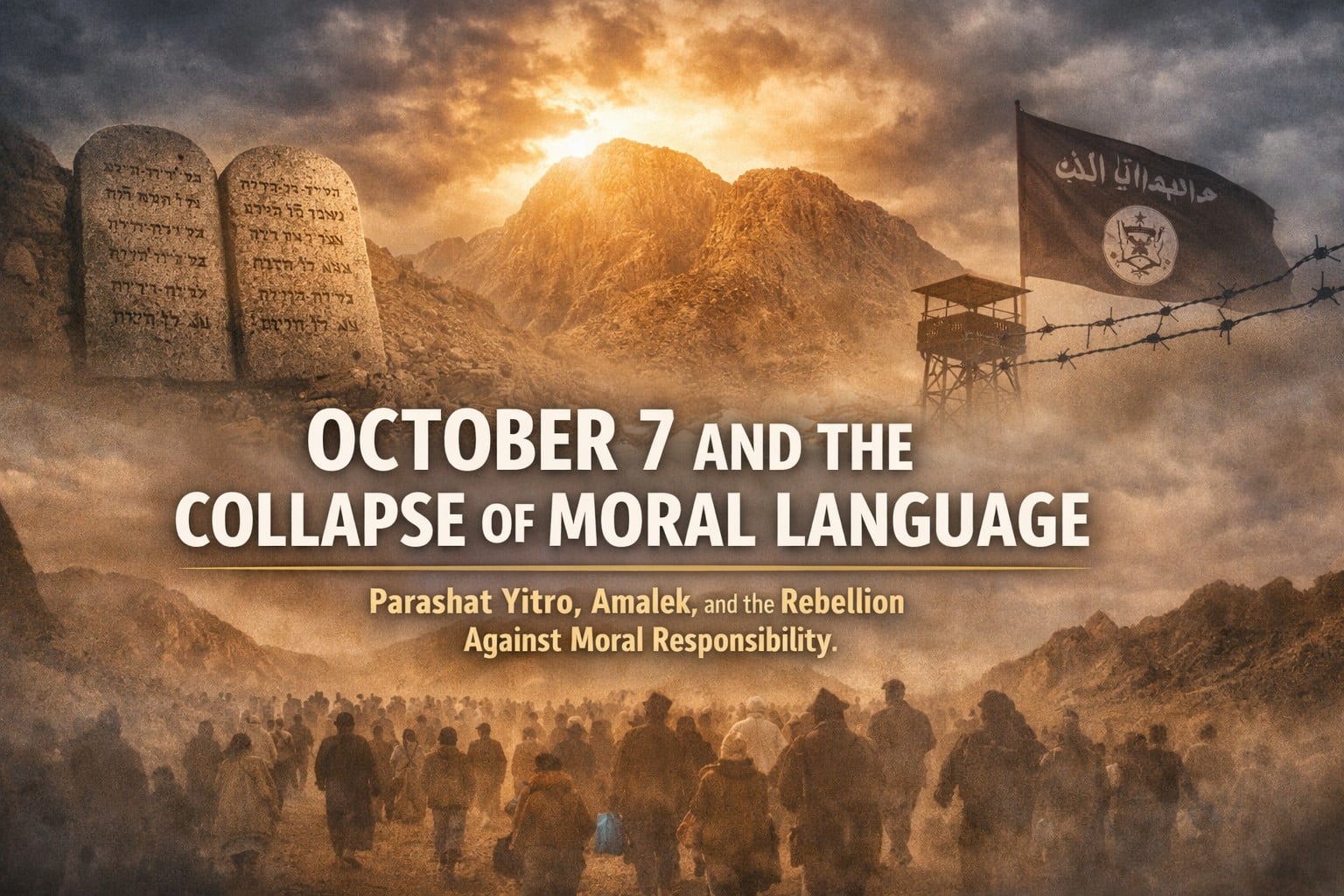
Parashat Yitro marks one of the most consequential moments in human history.
The Exodus is complete.
The sea has split.
The people are free.
And yet the Torah does not linger on freedom. It does not pause to celebrate liberation. Instead, it moves swiftly to Sinai.
The message is unmistakable: freedom alone is not enough.
Without moral law, liberation collapses into chaos. Without boundaries, power becomes destructive. Sinai is not a spiritual flourish—it is a divine reset.
Why Sinai Comes When It Does
The Torah’s sequence is deliberate.
In Bo, the Jewish people are freed from bondage.
In Beshalach, that freedom is tested—fear resurfaces, resentment grows, and Amalek attacks.
Only then does Yitro arrive, and only then is the Torah given.
Miracles rescue, but they do not guide. The splitting of the sea inspires awe, but not direction. Between redemption and responsibility lies a dangerous gap—and into that gap enters Amalek.
Amalek does not attack strength.
Amalek attacks confusion.
From Fate to Covenant
Rabbi Jonathan Sacks framed this distinction with enduring clarity:
“Fate is what happens to us. Covenant is what we choose.”
Egypt and the sea are fate.
Sinai is covenant.
At Sinai, the Jewish people cease to be defined by what was done to them and become defined by what is demanded of them. They move from survival to responsibility.
That movement—from fate to covenant—is precisely what Amalek resists.
October 7 and the Collapse of Moral Language
October 7 did not only expose the brutality of Hamas. It exposed something deeper and more disturbing: a world that has lost its moral vocabulary.
Babies were murdered.
Women raped.
Civilians burned alive.
Hostages taken.
And yet the global response was not clarity, but confusion. Not condemnation, but contextualisation. Not moral outrage, but moral inversion.
This was not a failure of information.
It was a failure of values.
Parashat Yitro speaks directly to this moment. Sinai is given because humanity cannot be trusted to define morality by instinct, emotion, or consensus. When morality becomes subjective, the violent sanctify their cause and the powerful excuse themselves.
The Ten Commandments as Moral Architecture
The Ten Commandments are not a list of religious rituals. They are the architecture of a moral civilisation.
They begin not with human rights, but with moral authority:
“I am the Lord your God…”
This is not theology for its own sake. It is a warning. When God is removed from the moral equation, something else takes His place—ideology, grievance, power, or the mob.
From there, the commandments move deliberately:
- The sanctity of life
- The sanctity of family and loyalty
- The sanctity of property and trust
- The sanctity of truth
- The discipline of desire
None of these are self-evident in moments of rage or fear. All of them restrain power. All of them protect the vulnerable.
October 7 showed what happens when these restraints collapse—and when the world is unable to say, without qualification, this is evil.
“You Shall Not Murder” Is Not Complicated
The commandment “You shall not murder” does not come with footnotes.
It does not say:
- unless the victim is Jewish
- unless the killer feels oppressed
- unless it advances a cause
- unless it fits a narrative
The inability of much of the world to state this plainly after October 7 is evidence of how far we have drifted from Sinai.
When murder becomes contextual, everything else follows.
Running Away or Running Toward
There is a quiet but telling verse earlier in the Exodus story:
“The king of Egypt was told that the people had fled.”
Rav Avraham J. Twerski zt”l, quoting Rabbi Yosef Shaul Nathanson zt”l, notes that Pharaoh did not hear that the Jewish people were going somewhere. He heard that they were running away.
And when escape defines movement, the past still holds power. What we flee has a way of chasing us.
That insight explains why Pharaoh pursues Israel—and why Amalek soon follows. Miracles may break chains, but without direction they do not yet break dependency.
That question confronts us again today.
Is Israel merely a reaction to antisemitism?
Is Aliyah an escape from danger?
Or are we running toward something higher?
Rabbi Sacks insisted that Jewish survival without Jewish purpose is incomplete. A people can endure hardship through fate—but it can only flourish through covenant.
Sinai answers that question decisively.
Amalek Then—and Its Modern Echoes
Parashat Yitro offers the Torah’s enduring response to Amalek—not only as a figure in the ancient past, but as a recurring pattern in history.
In different eras, the same rebellion reappears.
The Church Inquisition claimed divine authority without restraint, overriding the sanctity of life in the name of absolute certainty.
Nazism erased moral accountability altogether, replacing “You shall not murder” with racial ideology and state power.
Radical Islamism sacralises violence itself, transforming murder into virtue and death into aspiration.
These movements differ in language and theology, but they share a common refusal: the refusal to accept that morality limits power.
A Rebellion Against Moral Responsibility
At its core, this is a rebellion against Sinai.
The Ten Commandments restrain desire, limit violence, sanctify life, protect truth, and insist that not everything one can do is something one may do. They bind kings, priests, ideologues, and mobs alike.
That is why they are resisted.
Each of these movements replaces covenant with ideology, responsibility with grievance, and moral law with self-interest and power. Each treats accountability as an obstacle rather than a safeguard.
This is not only hatred of Jews.
It is hostility toward the idea that morality itself is binding.
Yitro: The Alternative
Against this stands Yitro.
Yitro is not born Jewish, and whether he ultimately did or did not formally join the covenant is debated by the sages. Some traditions suggest conversion; others see him as remaining an outsider. But the Torah’s point does not hinge on that question.
What matters is what Yitro does before Sinai.
He listens.
He recognises limits.
He understands that power without restraint destroys itself, and that leadership without accountability collapses.
That posture—recognition before belonging—is what makes Yitro endure.
Parashat Yitro offers the Torah’s answer to Amalek.
After mockery comes recognition.
After attack comes listening.
After power comes humility.
What is often missed is that Yitro still exists today.
In our own time, we encounter modern Yitro figures—outsiders who may or may not share Jewish faith or identity, but who refuse to surrender moral language in the face of barbarity. They insist that murder is murder, rape is rape, and responsibility cannot be explained away by grievance or ideology.
Voices such as Mike Huckabee, Douglas Murray, Eran Molan, Dr. Phil, Bill Maher, and Rawan Osman come from radically different worlds—religious and secular, left and right, Western and Middle Eastern. They disagree on many things, and they do not speak with one voice.
And that is precisely the point.
Yitro does not begin with allegiance.
Yitro begins with moral clarity.
The Torah does not ask the world to become Jewish.
It does not demand conversion, conformity, or unanimity.
It asks only this:
When confronted with moral truth, will you respond like Amalek—mocking, erasing, and excusing?
Or like Yitro—listening, recognising, and accepting limits?
That choice remains the dividing line.
A Moral Reset
October 7 did not create this crisis. It revealed it.
A civilisation that cannot condemn rape and murder without hesitation has already lost its moral compass.
What is needed now is not louder slogans, not performative outrage, not new theories.
What is needed is a moral reset.
Sinai does not offer comfort.
It offers responsibility.
How Do We Go Forward?
Sinai does not stand alone. Immediately after revelation comes Mishpatim—the descent of moral law from the mountain into daily life: courts, commerce, labour, justice.
The Ten Commandments are not meant to remain engraved on stone, admired from a distance. They are meant to govern society.
Because miracles may save a people—
but only moral law sustains a civilisation.
And that is why Parashat Yitro matters now more than ever.
Related Topics
Related Posts