NAnews - Nikk.Agency Israel News
When Hamas Thanks Moscow and Russia Celebrates in Tel Aviv
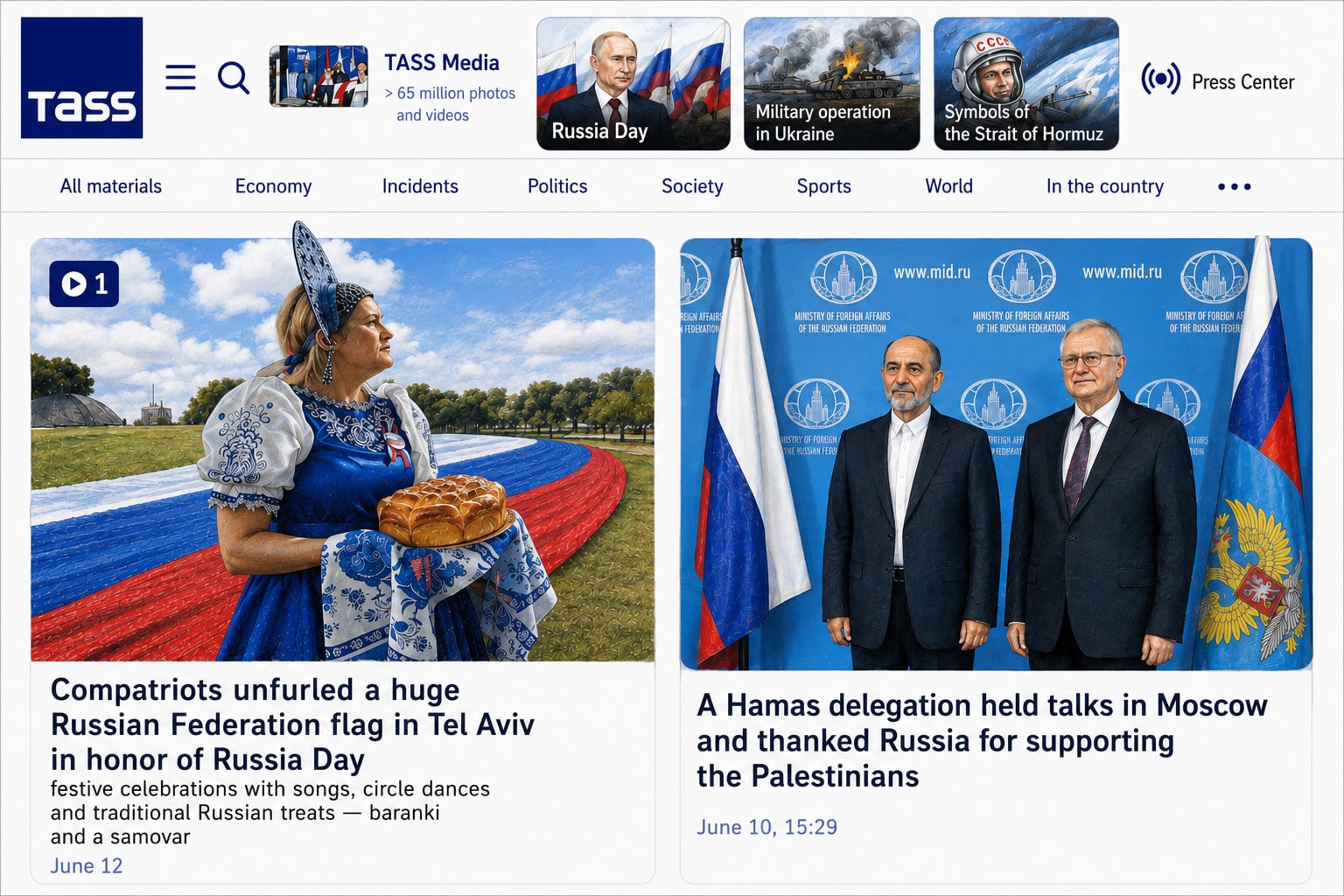
When Hamas Thanks Moscow and Russia Celebrates in Tel Aviv. the image was created using AI
How does it look from Jerusalem?
Sometimes Russian Z-propaganda, in all its arrogance and stupidity, creates a clearer picture than any opposition journalist, “foreign agent,” “Banderite,” or any other enemy it likes to invent.
This time, the picture was drawn by TASS itself.
On one page about Israel and the Middle East, Russia’s state news agency placed two stories that, taken together, say more than any official statement.
In one story, published on June 10 at 15:29 and followed by another report at 16:21, Russian Deputy Foreign Minister Georgy Borisenko met in Moscow with Mousa Abu Marzouk, deputy head of the Hamas political bureau. Representatives of Hamas then thanked Russia “for supporting the Palestinians.”
In another story, published on June 12 at 10:19, Russian-speaking “compatriots” in Tel Aviv unfurled a giant Russian tricolor of more than 600 square meters in honor of Russia Day. After that, according to the same Russian information stream, there were “festive celebrations with songs, round dances and traditional Russian treats — baranki and a samovar.”
This did not happen in a vacuum.
It happened after October 7.
It happened in Israel, a country where Hamas murdered, burned, raped, kidnapped children, women, elderly people and entire families. It happened while Israel is still fighting a war against the terrorist organization that carried out that massacre.
So the question is simple: how should a Russian flag look in Israel when, in the same informational frame, Moscow officially receives Hamas and Hamas publicly thanks Russia?
This is no longer just “culture.”
It is not merely a “holiday.”
It is not harmless “nostalgia.”
It is not simply a “Russian-speaking community event.”
It is the state symbol of a country that is waging war against Ukraine, building a strategic relationship with Iran, receiving Hamas in Moscow, and still trying to present itself as a fighter against terrorism.
Seriously?
In Moscow — Hamas.
In Tel Aviv — the Russian tricolor.
Between them — terrorists thanking Russia.
Chief Rabbi of Ukraine Moshe Reuven Azman has already said it very precisely: “Tell me who your friend is, and I will tell you who you are.”
That is exactly how it looks.
For Ukrainians in Israel, this pattern is painfully familiar. First comes the “holiday.” Then the “compatriots.” Then “culture.” Then the flag. Then the justification of Moscow. Then the phrase: “It is not so simple.”
No. It is actually very simple.
After Bucha, Mariupol, Russian missiles hitting Ukrainian cities, Moscow’s partnership with Tehran and its meetings with Hamas, Russian state symbolism in Israel cannot be neutral.
Especially in Tel Aviv.
Especially after October 7.
The problem is not language. The problem is the symbol
There is an important distinction here.
The Russian language does not belong to the Kremlin. Russian-speaking Israelis are not a political monolith. Many of them support Israel, support Ukraine, serve in the IDF, help evacuees, volunteer, donate, speak out against Putin’s aggression and understand perfectly well what the Russian state has become.
The problem is not the language.
The problem is the symbol.
The problem is when the flag of the Russian Federation is displayed in Israel as if it were just a colorful piece of fabric, detached from the actions of the state it represents.
But flags are not neutral decorations. They carry political meaning. They represent governments, alliances, wars, crimes, diplomatic choices and moral positions.
And today, Russia’s diplomatic choices are visible.
Russia receives Hamas.
Hamas thanks Russia.
Iran, Russia’s strategic partner, backs Hamas and other terror proxies across the region.
Ukraine fights Russian aggression.
Israel fights Hamas and the Iranian terror network.
These are not separate planets. They are connected fronts of the same geopolitical struggle.
For years, Moscow has tried to sell itself as a power that “fights Nazism” and “opposes terrorism.” But then the same Moscow hosts representatives of Hamas and listens as they thank Russia. At some point, propaganda collapses under the weight of its own contradictions.
For Israelis, this should not be an abstract foreign-policy discussion.
October 7 changed the moral vocabulary of this country. It showed what Hamas is, not in theory, not in diplomatic language, not in press releases, but in blood, fire, screams, burned homes, hostages and destroyed families.
So when Hamas is welcomed in Moscow, and two days later a giant Russian flag is unfurled in Tel Aviv, it is impossible to pretend that these are unrelated events.
Russian propaganda may want people to see “Russia Day,” songs, round dances, baranki and a samovar.
But many Israelis and Ukrainians see something else: a state symbol placed in the heart of Israel at the very moment when the same state is politically engaging with the enemies of Israel and Ukraine.
A political question for Israel
And here another urgent question begins to mature inside Israeli politics.
As Israel moves toward the election season expected in autumn 2026, more and more voters will be looking not only at slogans about security, but at the deeper strategic map. The party or political bloc that honestly includes support for Ukraine and closer strategic cooperation with the European Union in its platform may gain additional votes — especially from those Israelis who understand that the Iran–Russia axis is not a distant theoretical issue.
Israel needs more than decorative rhetoric.
It needs a new security formula: the United States as the main ally, the European Union as a strategic partner, and Ukraine as an important direction — not as some “distant war somewhere in Europe,” but as part of the same confrontation with aggressive authoritarianism and terror networks.
Because today Ukraine is holding back Russian aggression. Israel is fighting Hamas and the Iranian-backed terror system. And at the same time, Moscow receives Hamas representatives and hears their gratitude.
This is no longer a matter of sympathy.
It is a matter of strategy.
NAnews — Israel News | Nikk.Agency follows this issue not as an abstract media discussion, but as part of a wider Israeli-Ukrainian security context. For our readers in Israel, Ukraine, Europe and the Jewish world, the connection between Moscow, Tehran, Hamas and Russian influence operations is not theoretical. It affects how we understand security, alliances, propaganda, public symbols and the moral choices facing Israeli society.
NAnews is published in several languages and speaks to audiences that often stand at the crossroads of Israel, Ukraine and the wider democratic world. That is why stories like these must be read carefully, not as isolated headlines, but as signals of a deeper political reality.
Moral clarity after October 7
It is also a matter of moral clarity.
A country cannot claim to fight terrorism while receiving representatives of Hamas. A political culture cannot pretend to be “just festive” while displaying the flag of a state whose diplomacy embraces Israel’s enemies. And Israeli society cannot afford to ignore the symbols being normalized in its public space.
No one should claim that every person who attended a Russia Day event in Tel Aviv supports Hamas. That would be false and too primitive.
But everyone who publicly brings Russian state symbolism into Israeli public space today must understand what that symbol carries with it.
It carries Bucha.
It carries Mariupol.
It carries Russian missile strikes on Ukrainian cities.
It carries Moscow’s alliance with Tehran.
It carries the reception of Hamas representatives at the Russian Foreign Ministry.
And now it also carries one very clear image: Hamas in Moscow, thanking Russia, while the Russian tricolor is displayed in Tel Aviv.
That image cannot be erased by songs, round dances, baranki or a samovar.
The Russian tricolor in Tel Aviv and Hamas in Moscow are not two disconnected news items.
They are one image.
One message.
One warning.
And Israel has every right to hear it.
Related Topics
Related Posts