October 7 Leads to Silencing Holocaust Survivors
For the past two years, a deeply troubling dynamic has been taking shape: accusing Jews of lying about the scale and brutality of the October 7 massacres, and then extending that suspicion to their entire history. Contemporary suspicion fuels historical suspicion. The denial of October 7 now feeds Holocaust denial — and vice versa. Refusing to acknowledge the magnitude of the crimes committed by Hamas leads some to relativize, or even rewrite, the extermination of the Jews of Europe.
The underlying logic is painfully clear: if Jews are said to be “exaggerating” October 7, then they must also have lied about the Holocaust. In this rhetorical slide, contemporary trauma is transformed into supposed proof of an age-old falsification.
The consequences are already visible. The conflict in the Middle East now serves as a pretext to prevent Holocaust survivors from testifying. A recent case in New York offers a striking illustration.
Silencing a Survivor in the Name of “Neutrality”
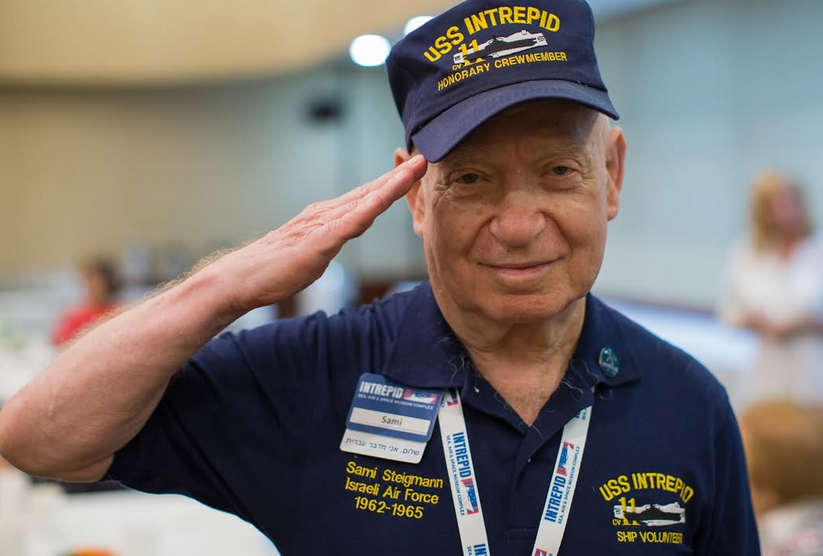
In Brooklyn, the principal of a public middle school (MS 447) rejected a parent’s request to invite Sami Steigmann, 85, a Holocaust survivor, to speak to students about antisemitism. The reason given: his pro-Israel views were deemed “not appropriate” in a public school setting.
The principal insisted that lectures on the Holocaust and on fighting antisemitism remain welcome—while simultaneously excluding the voice of a man who is himself a direct victim. A contradiction that many observers immediately denounced.
Yet Sami Steigmann neither devotes his website nor his biography to current Israeli-Palestinian politics. His message centers on his personal experience, the memory of the Holocaust, the dangers of hatred, and the transmission of history to younger generations. He is, nevertheless, a proud Jew who has occasionally stated publicly—during lectures available online—his support for Israel’s right to defend itself, particularly against Hamas. Nothing more, nothing less.
On November 18, however, the principal, Arin Rusch, wrote to the parent explaining that Steigmann’s views would not be “appropriate” for the school. The decision sparked widespread outrage.
“Censorship of Survivors”: Outrage from the Teaching Community
Moshe Spern, president of the Union of Jewish Educators—and grandson of a survivor—responded angrily in an email to the District 15 school administration. He denounced what he called an unacceptable act of censorship: “Have we reached the point where Holocaust survivors are censored because of their views on Israel?” he asked.
He described the principal’s stance as “atrocious,” “discriminatory,” and “personally offensive.” Preventing a survivor from speaking because he supports the existence of Israel, he argued, amounts to conditioning the memory of the Holocaust on ideological conformity. It is to deny victims the right to have a voice—especially when that voice is unsettling precisely because of its fidelity to Jewish history and heritage.
The Journey of a Witness
Born in Ukraine on December 21, 1939, Sami Steigmann survived as a child, along with his parents, the forced labor camp of Mogilev-Podolsky, in Transnistria. In his testimony, he recounts having been subjected to Nazi medical experiments, suffering ever since from chronic pain in his head, back, and neck—sometimes to the point of being unable to walk.
At an age when many seek rest, he devotes his energy to speaking, warning, and teaching. His message is humanist and nonpartisan: he recounts, he alerts, he transmits.
A Disturbing Turning Point
That his testimony should now be rejected—at a time when antisemitism is rising—is an alarming signal. In some circles, the Holocaust is becoming a conditional memory: acceptable only if it carries no resonance with the present, no situated humanity, no openly assumed Jewish identity. As if survivors were tolerated only on the condition that they remain spectral—disconnected from current events, stripped of opinion, attachment, or loyalty.
October 7 has acted as a catalyst. Instead of strengthening vigilance against hateful discourse, it has unleashed a new suspicion: one that recasts survivors as political agents whose speech must be controlled. A chilling inversion—today it is the heirs of the victims who are suspected, censored, neutralized.
When Contemporary Denial Feeds Historical Denial
The stereotypes echo one another. The rhetoric that minimizes the October 7 massacre—torture, beheadings, rapes, mass executions—mirrors the logic of Holocaust relativization. In both cases, the accusation is the same: Jews are said to have exaggerated, fabricated, and manipulated.
This dangerous mechanism is not new. Instrumentalizing the present to delegitimize the past has long been one of the central drivers of Holocaust denial. But today it finds renewed force, fueled by a polarized climate, militant networks, and radicalized ideological positions.
Transmitting, Despite Everything
In the face of this movement, the voices of survivors remain essential. Their testimony is not only an act of remembrance; it is a bulwark against the falsification of reality—yesterday and today.
Silencing a survivor is to grant a symbolic victory to those who seek to erase history. It is to forget that the Holocaust is not a closed chapter, but an ongoing responsibility. And it is to refuse to recognize that antisemitic hatred, yesterday as today, feeds on the same conspiracies, the same inversions, the same accusations.
In these troubled times, listening to Sami Steigmann—and to all the others—is an ethical necessity. Because their voices remind us of a simple truth: memory is never neutral, but it can be just. And when it is prevented from being spoken, it is always falsification that gains ground.