
When October 7 denial meets Holocaust distortion
Two years after the October 7 massacre — its atrocities extensively documented and independently verified — one might expect global condemnation of Hamas’s crimes to be a given. Instead, polarization has only deepened. In public discourse, the attack is now denied, minimized, or recast as legitimate “resistance.” At ArabCon 2025 in Dearborn this past September, Professor Rabab Abdulhadi went so far as to declare that she “will never condemn the Palestinian resistance,” portraying the assailants as merely “returning to their villages.”
Her remarks are not an isolated case. They exemplify a broader rehabilitation of Hamas that fuels a dynamic of relativization of the crimes committed that day. It is within this climate that the memory of the massacre now collides with justification and denial.
The Hamas attacks of October 7, 2023, on Israeli soil were marked by unprecedented brutality, amounting to the deadliest massacre of Jews since 1945. The shock prompted comparisons with the Holocaust. Yet such analogies, by equating Hamas’s atrocities with the Shoah, obscure the specific nature of the event: a terrorist assault by an armed Islamist organization.
Unlike the Nazis, who concealed their crimes, Hamas flaunted its violence, filming the killings and rapes to broadcast them, following a macabre strategy already employed by contemporary Islamist jihadists. Still, despite this overwhelming evidence, denial was immediate. Online conspiracy theories dismissed the atrocities as fabricated, echoing the strategies of Holocaust deniers. In turn, denial of October 7 fed into Holocaust denial itself, reinforcing a narrative of suspicion against Jewish suffering past and present.
The return of denial
Denialist rhetoric spread rapidly after October 7. Roger Waters, former Pink Floyd bassist and major online figure, declared in an interview that “there is no evidence of the rapes.” Lucas Gage, a neo-Nazi voice in the US, dismissed the attacks, adding: “If Jews are lying about Hamas right in your face, what makes you think they didn’t lie about their greatest enemies before them?”
This logic mirrors the classic mechanisms of Holocaust denial: Jews are said to have provoked World War II, as Israelis are now accused of causing their own massacre. Hitler is portrayed as never intending genocide, as Hamas is presented as having no exterminatory plan. The six million victims are dismissed as a “myth,” as Israeli civilian deaths are belittled. The gas chambers supposedly never existed, as the October 7 rapes are declared fabricated.
Such claims are not mere disputes over facts. They build an inverted narrative where the victim becomes the culprit. For figures like American “alt-right” host Stew Peters, this meant pushing false flag theories—claims that Israel provoked or allowed the attack — and even inviting Holocaust denier Fred Leuchter onto his show, before openly calling for a “final solution” for Jews. The line between denying present violence and glorifying Nazism has never been thinner.
The trivialization of the Holocaust
Just as “HoloCovid” spread during the pandemic, the Gaza war unleashed a flood of Holocaust analogies. Israel was compared to Nazi Germany, and the #HolocaustGaza hashtag went viral. These slogans reduce the Holocaust to a universal metaphor of oppression.
If the Holocaust becomes an all-purpose comparison, Jews cease to be recognized as victims, and antisemitic violence loses its historical context. The leader of Spain’s far-left Podemos party, Ione Belarra, compares Israel’s actions in Gaza to Nazi gas chambers, an analogy that erases the singularity of history while fueling hatred.
Here, the line between distortion and denial becomes porous. Holocaust deniers have always been distorters first: they rewrite history to undermine its meaning. And repeated distortion, even without explicit denial, slides toward outright negation and, ultimately, the rehabilitation of Nazism. To reduce the Holocaust to a metaphor is already to absolve Hitler and his accomplices.
Convergence of extremes
October 7 also revealed how antisemitic tropes converge across ideological lines. For decades, Holocaust denial has blurred distinctions between neo-Nazis and radical anti-Zionists. Today, social media accelerates this convergence. The anti-Zionist historian Ilan Pappé even allowed one of his books to be prefaced by Youssef Hindi, a French conspiracist tied to a French far-right group —an illustration of how these ideological spheres increasingly intersect.
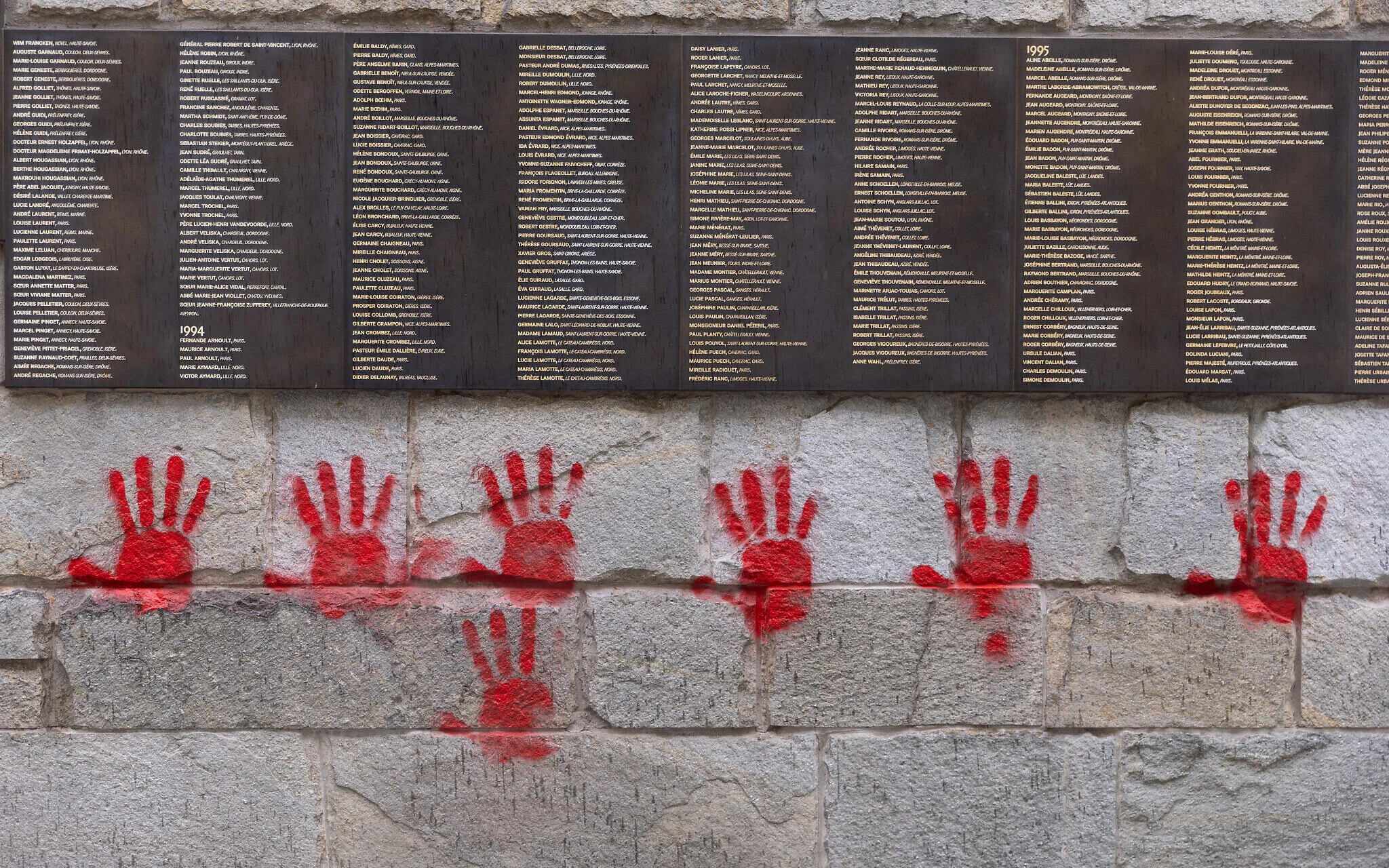
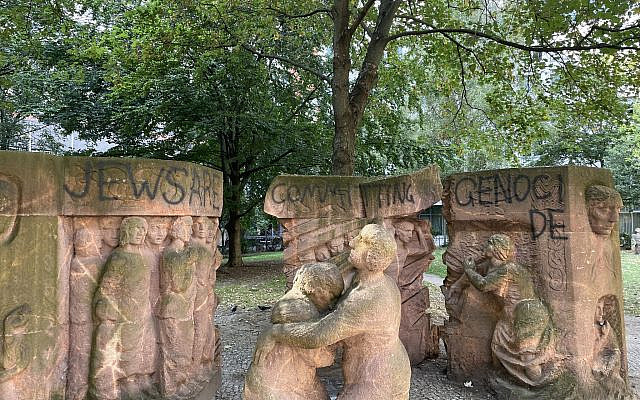
This dynamic has consequences. Holocaust memorials and synagogues are vandalized with “Free Palestine” graffiti during every flare-up in the Middle East, as Jews and Israelis are cast as indistinguishable targets of the same hatred. October 7 did not invent this inversion, but it gave it a global stage where denial, distortion, and delegitimization now circulate seamlessly.
Why it matters
The danger of this continuum is clear. When history is falsified to justify hatred, the path to violence is open. As gunman Stephen Balliet attacked a synagogue in Halle, Germany, in 2019, he declared, “Hi, my name is Anon, and I think the Holocaust never happened.”
In the face of this distortion, institutions, educators, and civil society must protect the integrity of Holocaust history. Preserving its truth is essential, not only for remembrance but to counter the antisemitism that seeks to turn victims into perpetrators.
–