


October 7, the Yom Kippur War: My Personal Wound
Rami Halperin 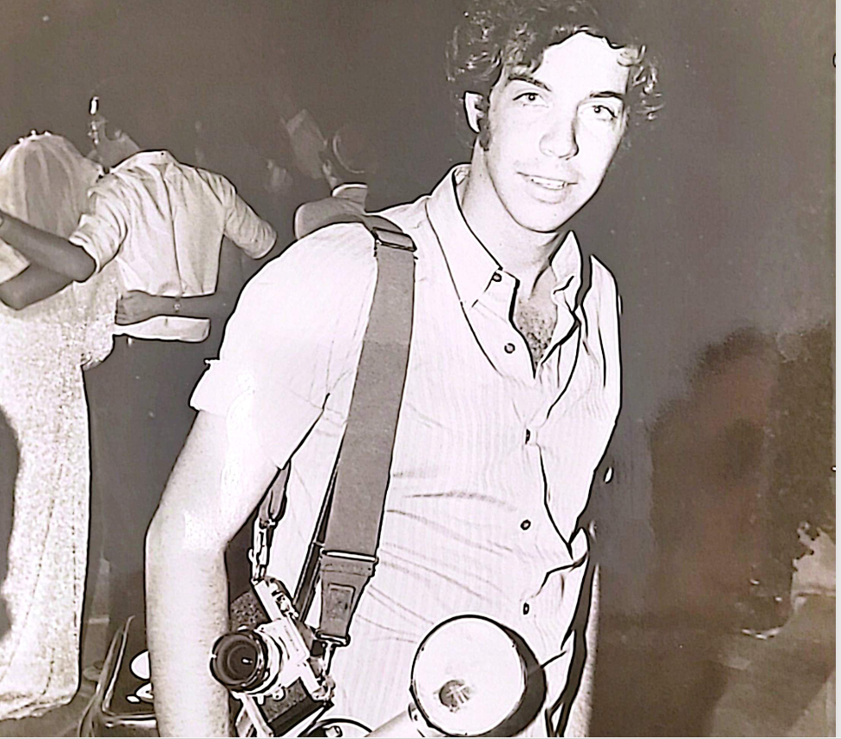
For as long as I can remember, the large photograph of a handsome young man, with a camera resting on his shoulder, hung on the wall in my grandmother’s bedroom, seeming to look right at me. The photograph remained there until the last day of her life. But, she didn’t talk about the son who was killed in the war, the battlefield, or her bereavement. Instead, she showed admirable strength and pride. The name of the young man was Rami Halperin. He was my uncle. I was born after the Yom Kippur War, a daughter not only of my own family but also of a larger family, ‘The Children of Winter 1973’. My grandmother was eager to have a grandchild who would fill the void. I was named after the young son and soldier who was killed. The letters of his name, R, A, M, and I, were incorporated into my name in a different order. I always knew that I was carrying the personal and national trauma, the tragic loss. My professional journey has followed his path. As my dear friend and colleague, Prof. Stephen Sussman describes: “Reading about your uncle Rami was very moving. He used his camera to document people, injustice, and ultimately the Yom Kippur War. I could not help thinking about the connection between his life and yours. He documented the events of his time through photographs. You document the events affecting Israel and the Jewish people through your writing, research, and voice. In that very meaningful way, he lives on through you”. Rami was a photographer at the magazine HaOlam HaZeh (This World). He started photographing at the age of 12. Rami mostly liked taking photos of Jerusalem and he knew the city very well. Three months before Yom Kippur War broke out, he completed the mandatory military service and joined HaOlam HaZeh. When the war broke out, he decided to volunteer and join his friends in their unit on the battlefield. The camera was with him as he documented the fighting. He was shooting and photographing, and vice versa, described an article published in the magazine, after his death. The photographs he left behind are combination of private and collective testimonials, such as intimate moments of soldiers preparing for a fight and tanks at the battlefield with soldiers who are no longer with us, and soldiers who survived and remember their friend, the photographer and fighter who was killed, at age 21, in the tank with his camera resting on his shoulder. 50 years later, the terrorist organisation Hamas carried out the brutal massacre the State of Israel ever knew. This time bereavement didn’t knock only on the doors of soldiers’ families. This time, more than 1,200 civilians and soldiers were murdered and kidnapped, including children, infants, youth, and elderly. Many of them lived in the residential areas of Gaza Envelope. One of the many victims was Aviya Hetzroni, who was murdered by Hamas terrorists at the age of 69, when they broke into his home in Kibbutz Be’eri on October 7, 2023. They also murdered his young grandchildren, Yanai and Liel and their aunt Ayala. Aviya and Rami fought together during Yom Kippur War in the same unit. Aviya was enlisted during his mandatory service. The two young soldiers belonged to a generation who was born and grew up during wars. They believed in peace and were committed to their duty with all their heart. Rami and Aviya served in Unit Y, Armoured Infantry, Battalion 184, Brigade 14. Unit Y was the first unit to come under attack during the surprise assault by Egyptian and Syrian forces. The soldiers have a vivid memory of this moment:” We were at a point of time just before 7th of October (1973), when we were supposed to complete 3 moths of serving at the north and central fronts. 3 months with field mice, yellow scorpions…and it was so peaceful. We read, caught fish that were swimming in the canal….and then, five minutes before two, four Egyptian planes flew in a low altitude over our stronghold, on their way to bomb Battalion 184. The earth shook. The fire and plumes of smoke visible in the distance signalled the outbreak of war along the entire Sinai front. We were forced to fight against thousands of Egyptian soldiers and tanks that crossed the canal with almost no disturbance”. A year before October 7, Aviya Hetzroni promised his grandchildren that Zelda M-113 of Unit Y, during Yom Kippur War, will be positioned at Yad La-Shiryon, Home of Israel ‘s Armored Corps, in Latrun. On 18 September 2026, Aviya’s dream was fulfilled by his friends, who launched the arrival of Zelda M-113, in a ceremony in Latrun. Hanoch Livne, Rami’s close friend who visits his grave every year devotedly, was at the ceremony. Ziva Zohar, who was a friend of Rami and Aviya and a commander, and her husband, Dubi Zohar who fought with them, spoke with me in length about the significance of this ceremony, as fulfilling the ‘will’ of Aviya to commemorate his friends, before he was murdered on October 7. Ziva was the driving force behind this effort. “Our role as long as we breath is to keep their memory alive, if they are being remembered, they are alive. We, the soldiers of the unit meet quite often, many of us are old and ill, but once we meet we all 19 years old again. A stranger will not understand. Only these soldiers who fought shoulder to shoulder, can understand these experiences”. Today, 50 years after Yom Kippur War and three years to the October 7 massacre, the history repeats itself. In the Comradeship Avenue, located in Kibbutz Be’eri, there is commemoration stone for the soldiers who were killed in 1973. A short poem by Avi Aloni, who was a fighter at Unit Y is carved on the stone: “A body and a mound and iron and that’s it. Silent that is out of boundary. In the minutes of after everything”. I will complete my blog with the last paragraph of the article published at HaOlam HaZeh: “In Rami’s room there is a poster announcing: “war is a dangerous thing to children, flowers and all sorts of living things”. “Also, to photographers”.
The last photo Rami took, 18/10, noon, in the background: The Water Pumps
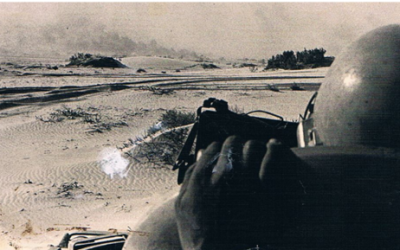
Photos: Credit: HaOlam HaZeh and Yoram Brin, Battalion 184