
An Engineer’s Perspective on Israel and Jewish Life
October 7: We Cannot Return to October 6
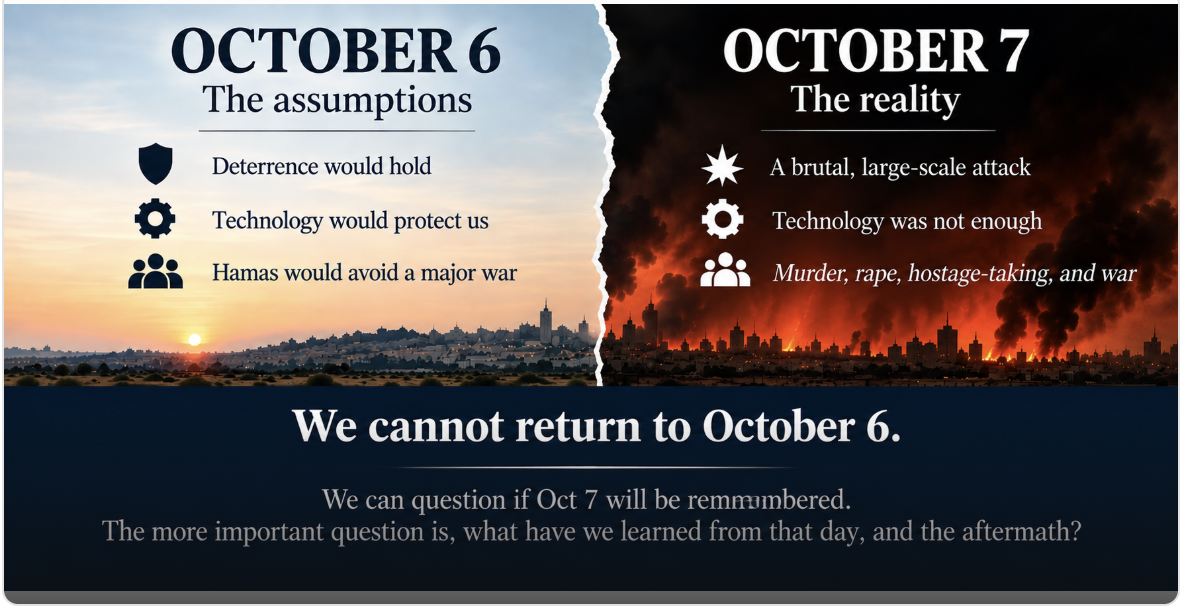
We now mark three years since October 7, 2023.
We remember the horror of that day: Hamas terrorists pouring across Israel’s border, peaceful communities attacked, whole families murdered, young people slaughtered at the Nova music festival, and more than 250 people taken hostage.
But on this third anniversary, remembering what happened is not enough.
We also need to ask a harder question:
What did October 7 teach Israel, and what can the rest of us learn?
For Israel, October 7 was not only a horrific terrorist attack. It exposed a catastrophic failure in the assumptions of its political and security leadership: that Hamas was deterred, that its preparations would be detected, and that Israel’s defenses would hold.
The lesson reaches beyond Israel. Even the most sophisticated defenses can fail when leaders grow too certain that they understand an adversary’s intentions.
Israel entered October 7 as one of the most technologically sophisticated nations on earth. It possessed extraordinary intelligence capabilities, advanced surveillance systems, a formidable military, precision weapons, missile defenses, cyber capabilities, and a technologically sophisticated barrier separating Israel from Gaza.
And yet, on that Saturday morning, none of it was enough.
Why? How could it be so?
The investigations conducted since October 7 have identified numerous intelligence and operational failures. Warning signs were misunderstood or discounted. Hamas’s capabilities were underestimated. Israeli intelligence possessed information about plans for a large-scale Hamas assault but did not translate that information into adequate preparation. The sophisticated border defenses in which Israel had invested enormous resources were overwhelmed.
But beneath those individual failures was something even more consequential.
Israel misunderstood its enemy
For years, an assumption had taken hold that Hamas could be deterred and contained. Hamas governed Gaza. It had responsibilities. Economic incentives mattered. Work permits for Gazans and money flowing into Gaza were believed to give Hamas reasons to avoid a major confrontation. Hamas laid the tracks of assumptions that Israel followed, and believed.
Israel could manage the threat.
That assumption was catastrophically wrong.
Hamas had not abandoned its objective. Israel had come to believe that it had.
The danger of assumptions
As an engineer, I find this aspect of October 7 particularly important.
I have spent much of my professional life thinking about complex systems—how we design them, how we make them more reliable, and what we can learn when they fail.
When a bridge collapses, an airplane crashes, or a communications network suffers a catastrophic outage, it is tempting to identify the component that failed and replace it.
But the most important investigations go deeper.
They ask whether the system was designed around an assumption that turned out to be wrong.
A component can be repaired.
A mistaken assumption can recreate the catastrophe.
That distinction, to me, is essential to understanding October 7.
Israel certainly suffered failures of intelligence, command, preparedness, and response. Those failures must be investigated honestly, and accountability must follow wherever the facts lead.
But imagine that every camera on the Gaza border had functioned perfectly. Imagine better sensors, faster communications, and more soldiers positioned nearby.
Those improvements might have changed the outcome dramatically.
They still would not answer the fundamental question:
Why did Israel believe that Hamas would not attempt such an attack?
Technology can tell us a great deal about what an adversary is doing.
It cannot compensate for misunderstanding what an adversary intends to do.
The lesson of October 6, 2023
This is where I believe October 7 should change our thinking.
The great danger in confronting an ideological enemy is assuming that it thinks as we do.
Western societies naturally tend to believe that people ultimately seek many of the same things: security, prosperity, economic opportunity, and a better future for their children.
Often they do.
But ideological movements do not necessarily assign those goals the same priority. Hamas is one example.
Sometimes ideology, religion, nationalism, or revolutionary purpose can outweigh economic self-interest. Sometimes leaders are prepared to impose extraordinary suffering upon their own people to advance objectives outsiders regard as irrational.
And sometimes an adversary means what it says.
Hamas has never hidden its fundamental hostility toward Israel. Its stated goal of eliminating Israel, and the genocidal ideology underlying that goal, should have been taken seriously, not only by Israel, but by the world.
Yet Israel increasingly behaved as though Hamas’s ideology could be subordinated indefinitely to the practical responsibilities of governing Gaza.
October 7 demonstrated the danger of confusing temporary restraint with changed intentions. Israel did not fully grasp that Hamas could appear deterred while patiently preparing a coordinated attack, rehearsing its methods and gathering detailed knowledge of the communities it intended to assault.
That lesson extends far beyond Hamas.
Deterrence requires understanding not merely an adversary’s capabilities but its values, objectives, and willingness to bear costs. Economic incentives can influence behavior, but they cannot automatically erase ideology. Superior technology can provide extraordinary advantages, but it cannot substitute for strategic judgment.
And intelligence is useful only if leaders are prepared to question the assumptions through which intelligence is interpreted.
The most dangerous words
Organizations develop conventional wisdom. Governments do it. Militaries do it. Corporations do it. Universities do it.
I have seen versions of this throughout my own career.
Eventually certain propositions cease being hypotheses and become facts that everyone simply “knows.”
Hamas is deterred.
The barrier will hold.
We will receive sufficient warning.
The enemy does not want a major war.
Each proposition may have seemed reasonable when first adopted. Each may even have been supported by evidence.
The danger begins when people stop asking whether those assumptions are still true.
One of the most valuable people in any organization is therefore the person willing to ask an uncomfortable question:
What if we are wrong?
That question is especially important when new evidence contradicts an established belief. Human beings naturally give greater weight to information that confirms what they already believe. Large organizations can magnify that tendency because challenging a deeply embedded consensus can be professionally difficult.
October 7 demonstrated the devastating price.
The tragedy was not simply that Israel lacked information. Some important information existed. The deeper problem was that information was interpreted through a conception of Hamas that proved disastrously mistaken.
The facts were forced to fit the assumption when the assumption should have been forced to fit the facts.
Technology is not strategy
There is another lesson here for Israel, and it particularly resonates with me as an engineer.
Israel’s technological achievements are extraordinary. Having spent a lifetime in research and innovation, I enormously admire what Israelis have accomplished.
But technological superiority can create its own vulnerability if it produces excessive confidence.
Sensors are not a strategy.
Artificial intelligence is not judgment.
Surveillance is not understanding.
A billion-dollar barrier is not security if the assumptions behind the barrier are wrong.
The more sophisticated our technology becomes, the more tempting it is to believe that enough information, enough computing power, and enough intelligence can eliminate uncertainty.
They cannot.
Ultimately, national security still depends upon human beings making judgments about other human beings, including people whose values and motivations may be radically different from their own.
October 7 was a brutal reminder of that reality.
What should October 7 mean?
Three years later, there will continue to be fierce arguments about the war that followed October 7, about decisions made by Israel’s political and military leaders, and about responsibility for the failures that preceded the attack.
Those arguments are necessary in a democracy.
But the enduring lesson should be larger than any particular government, general, or intelligence chief.
October 7 should become a permanent warning against intellectual complacency.
Nations must continually test their assumptions.
Intelligence organizations must reward dissent rather than merely tolerate it.
Technology must support judgment rather than replace it.
And when an enemy repeatedly tells us what it believes and what it intends, we should take those words seriously, even when doing so is uncomfortable.
There is a natural human desire after a catastrophe to return to normal.
Israel should certainly aspire to normality: to security, prosperity, peace, and ordinary life.
But intellectually, there is one place Israel must never return.
October 6.
Because the most important question on this third anniversary is not simply whether we remember October 7.
Of course we remember.
The harder question is whether we have learned from it.
History does not give nations many opportunities to discover that their most fundamental assumptions are wrong. October 7 gave Israel that terrible knowledge at an unbearable price.
The obligation now is not to remain frozen on October 7. Many Israelis understandably feel that time stopped that day. But to prevent another October 7, we must examine what Israel believed on October 6, why it discounted the warnings, and where its confidence in its defenses went wrong.
We must remember October 7 without allowing the assumptions of October 6 to return.
Related Topics
Related Posts