Advocating for Jewish Well-Being in This Era of Antizionism
Old Pattern, New Era: How to Break the Cycle of Jew Hatred
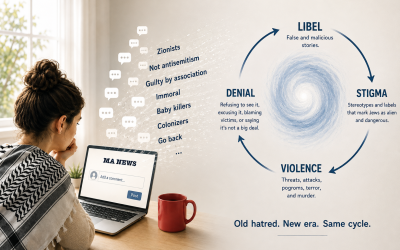 I’m really enjoying my leafy new digs in Massachusetts. The air is crisp and the promise of a new year awaits. However, It’s disturbing how easily the beauty of nature and human connection can get knocked sidewise when you go online.
A local news site published guest letters about Tuesday’s upcoming state elections. One of them listed the “genocide,” an oft lobbed libel as part of why a particular candidate should be supported.
Below are some of the comments that followed a letter I initiated:
- Zionism is “a political ideology” that some Jewish people subscribe to.
- Jewish people who support Israel are “guilty of genocide by association,” while Israel is “causing the hatred of Jewish people.”
- “The Jewish religious faith” is separate from Israel, and people who support Israel are “immoral.”
- “Israel certainly has burned the holocaust bridge.”
- An “antizionist therapist” can work successfully with Jewish and Zionist clients.
I won’t get into the bullying that ensued on the site’s local Facebook page but suffice it to say there will always be a core group of Jew haters you can never reach.
For those who claim “some of my best friends are Jews.” Or, “My problem is with Israel, not the Jews.” This bait and switch strategy is as old as time. No one is falling for it.
Some of the people making these comments grossly mischaracterize Zionism. They ignore or don’t know that Zionism is deeply connected to Jewish identity and peoplehood. The majority of Jews all over the world hold their connection to Israel dear. More precisely, a Zionist can be anyone of any ilk, all that’s required is that you agree that Israel, just like every other country deserves to exist.
Pew Research Center found that only 11 percent of American Jews describe being Jewish as a matter of religion alone, with far more pointing to ancestry and culture as part of their Jewish identity.
Who gets to define the Jewish people? Surely, it should be the tiny valiant minority, us Jews ourselves?
Problems in Translation
Libels depicting Jews as “all-powerful” and “controlling the world” make it easy for others to lose sight of just how few of us there actually are. And those old libels have proven remarkably adaptable. They can emerge from opposite ends of the political spectrum, dressed in different language but ultimately converging in Jew hatred. We are living in a kind of funhouse, with mirrors reflecting inversions every which way.
For those who have fallen under the spell of social media, propaganda and antizionism, empathy and compassion can be a tough sell. Modern antizionism has important roots in Soviet propaganda campaigns that deliberately recast Zionism as racism, colonialism and imperialism. Unless people have the intellectual humility to question what they have been fed, it can be very difficult to break through.
Finally, we are left with something much more basic: ignorance.
Some people think being Jewish is solely a religion. In reality, Jewish peoplehood extends back thousands of years and encompasses shared history, culture, traditions, collective memory, languages, ancestry and a connection to our ancient homeland, Israel.
Some Jews are religious. Some are secular. Some are atheists. Jews come from different countries, speak different languages, hold different political views, and practice Judaism in very different ways, or not at all. There is no single way to be Jewish. Yet we remain part of the same ancient people.
So how do we reach those open to learning?
Knowledge
Before asking people what they think about Jewish peoplehood, perhaps we should first establish what they actually know about it.
We also need to continue building the academic literature on Jewish identity and Jewish peoplehood. Antijudaism, antisemitism and antizionism should all be part of that work because Jew hatred takes different forms.
Education: Jewish Peoplehood Literacy
The general public needs to understand the enormous diversity among Jews and allow Jews themselves to define which parts of their identity matter to them.
We need programs that teach this fuller understanding of Jewish peoplehood.
If you’re a therapist working with Jewish clients, an educator teaching Jewish students, or an institution claiming to practice cultural competence, it’s imperative that you know something about the people you serve.
Programs like Levari are one way of doing this work. Other organizations and Institutes are doing it too. Jewish Peoplehood Literacy should become part of multicultural education in mental health, social work, education and other professions.
Some People Simply Hate Jews
Then there are the people I mentioned earlier, the ones we may never reach. Some simply hate Jews.
Others may have absorbed beliefs from an ideological or social environment and have little interest in questioning them. Education assumes some openness to new information. Extremism doesn’t always work that way.
People land on Jew hatred in different ways. Some inherit it. Some start with ignorance, others with ideology. Some may simply want to belong. Whatever the reason why, the person being targeted still needs protection.
The Shield
The shield is the law. Civil rights and anti-discrimination protections do not require someone to understand you before you are entitled to protection. They don’t require empathy. The law establishes the boundary between acceptable and discriminatory behavior.
I do believe there are people who can be reached. People who, given the opportunity to understand the full complexity of who Jews actually are, might become curious enough to question what they think they know.
For everyone else, there is the shield.
Related Topics
Related Posts