Olim – How Should We Vote on October 27 2026?
An English-speaking Olim’s overview of Israel’s political landscape
On October 27, 2026, Israelis will not simply be choosing between political parties. They will be choosing between competing visions for the country’s security, identity, sovereignty and future.
For many English-speaking Olim, understanding those choices is not easy. Israeli politics is complicated even for fluent Hebrew speakers, and coalition politics means that the party you vote for is only part of the equation. The other question is: who will that party govern with?
I have been asked by many people who they should vote for and what I think about the different parties. I am not a political expert, but I take politics seriously because, however distant it may sometimes feel, it ultimately affects almost every aspect of our lives.
Israel is far from perfect. There is a great deal to fix. Previous governments have made mistakes. The current government has made mistakes. October 7 exposed enormous failures, and those failures require accountability and lessons. But the desire for change should not be separated from the question of what comes next.
The question is not simply: “Do we want change?” It is: “What kind of change are we choosing, who will implement it, who will they govern with, and what will the consequences be?”
I have tried to approach this as objectively as possible. You may agree with some of it and disagree with other parts. You may disregard it entirely. Most importantly, its important to do your own research.
Understanding the Political Landscape
Israeli politics is complicated, particularly for Olim who do not regularly follow Hebrew-language news. There are historical references, political nuances, coalition considerations and agreements that can be difficult to follow even for fluent Hebrew speakers. The main parties can broadly be grouped according to their current political positioning.
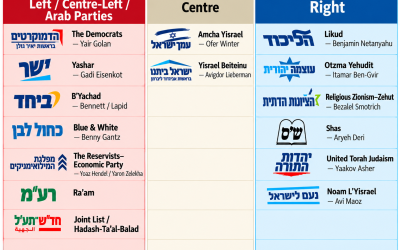 On the left, centre-left and Arab side are The Democrats, led by Yair Golan; Yashar, led by Gadi Eisenkot; B’Yachad, led by Naftali Bennett and Yair Lapid; Blue & White, led by Benny Gantz; The Reservists–Economic Party; and Arab parties including Ra’am and the Joint List/Hadash-Ta’al-Balad.
At the centre are Amcha Yisrael, led by Ofer Winter, and Yisrael Beiteinu, led by Avigdor Lieberman. On the right are Likud, led by Benjamin Netanyahu; Otzma Yehudit, led by Itamar Ben-Gvir; Religious Zionism–Zehut, led by Bezalel Smotrich; Shas, led by Aryeh Deri; United Torah Judaism, led by Yaakov Asher; and Noam L’Yisrael, led by Avi Maoz.
But these labels only tell part of the story. Israel uses proportional representation. No party governs alone. Governments are formed through coalition negotiations after the election. That means voters need to ask two questions: “What does this party believe?” and “Who is it prepared to govern with?” Those questions are especially important when considering the parties currently positioning themselves as alternatives to Likud.
The Basic Political Divide
A party’s position on the political spectrum does not necessarily tell us where it will end up after an election.
Avigdor Lieberman and Yisrael Beiteinu
For instance, Avigdor Lieberman and Yisrael Beiteinu have repeatedly refused to join Netanyahu-led governments, including after election cycles in which Lieberman held a pivotal position between the competing blocs. His refusal to join a Netanyahu-led coalition contributed to the political difficulties and repeated election cycles of 2019–2020.
Ofer Winter is known to have a relationship with Lieberman, and Lieberman publicly welcomed Winter’s entry into politics in 2026. That relationship is relevant when considering where Amcha Yisrael could ultimately position itself.
Avigdor Lieberman and Yisrael Beiteinu occupy a centrist position and have traditionally focused on secularism, national security and reducing Haredi political influence. In the current election, Lieberman is part of the broader opposition landscape alongside parties such as B’Yachad and Yashar. This is important because political positioning and actual coalition behaviour are not necessarily the same thing.
Gadi Eisenkot
Gadi Eisenkot is particularly important to examine. Although he presents himself as centrist or right-of-centre, his positions and proposed policies are, in my view, fundamentally left-wing.
Before the war, Eisenkot joined Brothers in Arms, an organisation that called on reservists to refuse to serve in protest against the government’s judicial reforms. After October 7, he continued to support the establishment of a Palestinian Arab state. He was also reported to have supported allowing up to 150,000 Gazans into Israel daily – post October 7 – in order to improve their economic situation, a position for which he was heavily criticised.
Four days after the pager attack, he was also reported to have wanted Hezbollah brought to the negotiating table.
These positions matter because they reflect a fundamentally different approach to security and conflict from the one many believe Israel needs.
Eisenkot, and, I would argue, the left side of the political aisle more broadly, represents the security conception that led Israel astray before October 7.
Naftali Bennett and Yair Lapid
B’Yachad, led by Naftali Bennett and Yair Lapid, is positioned as a broad alternative bringing together parties from the centre and centre-left. Bennett has said he would not rely on Arab parties. But coalition mathematics can ultimately make such positions difficult to maintain if the numbers do not add up. His previous government demonstrated how political circumstances can lead parties to work with political forces they had previously ruled out.
Bennett has also taken a position against the Haredi parties.
The question for voters is therefore not simply what B’Yachad says it wants to do, but what coalition it could ultimately form if it has the opportunity to lead a government.
Yair Golan and The Democrats
Yair Golan (who commented during the most recent war that Israel should not be killing babies as a hobby, and refused to condemn the anti-IDF film Naza) and The Democrats are part of the opposition seeking to replace Netanyahu. Their potential partners include Yashar, B’Yachad, The Reservists–Economic Party and Yisrael Beiteinu.
Golan has publicly argued that the opposition should be prepared to work with the Arab party Ra’am. He has also explicitly ruled out a coalition with Likud and the Haredi parties.
The Lessons We Need to Learn from Jewish History
Jewish history contains thousands of years of exile, persecution, expulsion and vulnerability. Jews were massacred during the Crusades. Jewish communities were expelled from England, France, Spain and elsewhere. During the Black Death, Jews were falsely accused of causing the plague and massacred in numerous communities. In Eastern Europe, Jews experienced repeated pogroms and persecution. Then came the horrors of the Holocaust.
In the Middle East, Jewish communities experienced periods of prosperity and made enormous contributions to the societies in which they lived. But they also experienced legal and social restrictions associated with dhimmi status, as well as persecution, forced conversion, massacres and expulsion.
Following the establishment of modern Israel, large Jewish communities were ultimately expelled from many Muslim-majority countries, often forced to leave behind their homes, property, wealth and livelihoods.
For centuries, Jewish security was often dependent on the goodwill of whoever held political power. When political circumstances changed, Jews could quickly go from neighbours, citizens and members of society to targets.
Modern Israel changed that equation. It gives the Jewish people the ability to defend themselves and determine their own national future.
Yet Israel has also experienced repeated terrorism and violence from its Arab citizens, including pre-state, the 1929 Hebron massacre where Jews were massacred by Arabs with whom they lived side by side, the Arab Revolt of 1936–39, attacks during 1947–48, terrorism in the 1970s and 1980s, suicide bombings in the 1990s, the Second Intifada, the 2015–16 wave of attacks, the Arab violence of May 2021 in mixed Muslim-Jewish cities such as Lod and Haifa, terrorism, shootings and stabbings between 2023 and 2026 and, ultimately, the massacre of October 7.
The lesson many in Israel have drawn is that Israel cannot outsource its sovereignty or security. That does not mean Israel should have no allies. It does not mean diplomacy is irrelevant. It means that ultimately, responsibility for protecting Israel and the Jewish people must remain in Jewish hands.
Arab Parties and the Coalition Question
A vote for Eisenkot, Bennett, Yair Golan or Lieberman could very likely contribute to a government relying on Arab parties, whether those parties formally join the coalition or support it from outside. That could give significant political influence and access to government resources to parties whose positions may fundamentally conflict with Israel’s sovereignty and security.
Mansour Abbas of Ra’am condemned the October 7 attacks, but his position on Hamas has raised significant questions. In July 2026, when repeatedly asked whether Hamas is a terrorist organisation that should be destroyed, Abbas declined to give a direct answer. He has also previously described Hamas as “part of the Palestinian people” and referred to Hamas members as his brothers on Arab television. He is known to say one thing to the Israeli public and something entirely different in Arabic.
Likewise, both Ahmed Tibi from the Arab Hadash–Ta’al–Balad list and Hadash chairman Ayman Odeh have declined to call Hamas a terrorist organization and have repeatedly called for “struggle” against the “occupation” and Israel’s soldiers in Judea & Samaria (West Bank), describing attacks against Israel’s soliders as “heroic” and “legitimate”, with Tibi labelling Israel’s soldiers as “thugs”.
The major concern with the Arab parties is that political power and public funds could be used in ways that undermine Israel’s security or, in the worst case, facilitate or support terrorism directed against Israel, its soldiers and its citizens.
What About the Haredim?
The Haredi draft has become one of the most divisive political questions in Israel. There is a legitimate argument that defending Israel must be shared more broadly by all parts of Israeli society.
However, the decline in enlistment among secular Israelis, alongside the very limited contribution of Arab citizens to military or national service, receives little to no attention in the public debate. These issues all deserve serious examination when considering how national service should be shared.
At the same time, the Haredi enlistment picture is changing. The IDF reported that 4,298 Haredim enlisted during the 2025 recruitment year, compared with 2,811 in 2024, an increase of 53% under the Likud government.
It is also important to understand the practical challenge. The army cannot simply absorb every potential recruit immediately. After October 7, many Haredim came forward wanting to enlist and contribute to the war effort. However, they were unable to be integrated because of practical limitations within the existing system, and some were sent home. These stories received little attention, leaving many Israelis unaware that there were individuals who wanted to serve but struggled to find a path to do so.
The real question is how to build a sustainable framework in which every Israeli contributes meaningfully to the country, whether through military service, national service or another recognised form of civic contribution. The Likud is working toward addressing this challenge.
Parties may use strong slogans and present this as a major political point of difference. But when it comes to actually implementing policy, it is not clear how different their approach would be in practice from Likud’s, given the legal, social and practical challenges involved.
The debate therefore needs to move beyond slogans and focus on what can realistically be implemented, and how.
Wanting Change Is Understandable
I completely understand why people want change. Benjamin Netanyahu has served as prime minister for a very long time. Alongside the achievements of this government, mistakes have been made – serious mistakes.
October 7 was an enormous failure across multiple levels: Israel’s security system, intelligence, military and political leadership. There is no justification for pretending otherwise. There must be accountability and lessons learned.
Beyond October 7, there are also many areas of everyday Israeli life that clearly need improvement: housing, education, infrastructure, bureaucracy, the cost of living, public transportation, government efficiency and the relationship between different sectors of Israeli society.
People are entitled to want something different. But wanting change and understanding the consequences of change are two different things.
The question is not simply whether change is needed. It is what that change would actually mean – and what would come next.
Government Achievements Despite the Challenges of War
The current government’s achievements are rarely discussed, but they should also be noted briefly. Despite a multi-front war and enormous costs, Israel’s economy has remained remarkably resilient. According to the Bank of Israel, GDP grew 2.9% in 2025, compared with 1.0% in 2024, while inflation fell to 2.6%, returning within the Bank’s target range. Israel’s defence exports have also reached successive records: $13.1 billion in 2023, $14.795 billion in 2024 and $19.2 billion in 2025.
The defence establishment has also dramatically expanded domestic production and procurement since October 7. The 2024 defence procurement programme involved multi-year acquisitions worth approximately NIS 220 billion, with more than NIS 150 billion directed into the Israeli economy through domestic procurement. These figures reflect not only defence exports but the development of Israel’s domestic defence-industrial capacity.
All of this has taken place alongside extensive Israeli military operations against Hamas, Hezbollah and other Iranian-backed groups, from the pager operation that penetrated Hezbollah’s communications network, to the degradation of Hezbollah’s military infrastructure, and Operation Rising Lion, which saw Israel strike Iranian nuclear and ballistic-missile facilities deep inside Iran. At the same time, Israel has continued to confront threats from Hamas, Hezbollah, the Houthis and other Iranian-backed forces across the region.
Your Vote on October 27, 2026, Counts
In my view, the “change” or alternative being offered by the left-leaning parties is simply not good enough. I believe it risks bringing back the weak assumptions, policies and thinking that failed us on October 6. I am not convinced that the necessary lessons have been fully absorbed.
Ultimately, this election is about more than one person – Benjamin Netanyahu will eventually leave the stage. More importanly, the elections are about competing visions for Israel and the country we want to build and preserve. It is about all of us. It is about the kind of country we want Israel to be and the direction we want to take into the future.
It is about Israel’s identity. Will Israel continue to define itself as a Jewish state rooted in Jewish history, values and national sovereignty, or move toward a different conception of itself as a country defined primarily by all of its citizens?
The latter approach risks perpetuating the same underlying conception that has repeatedly led us astray: the assumption that if we simply become more like the other nations, or alternatively, create the economic or other conditions for Arabs to live alongside us, or even within Israel, peaceful coexistence will necessarily follow.
Our experience in recent years has shown that this is not the case. Israel’s history has shown us this is not the case.
Our decisions need to be grounded in realism rather than wishful thinking, with security, national resilience and a clear understanding of the threats facing Israel at the centre of the discussion.
We may want change. But we also have to be realistic about what that change means and what its consequences could be.
For me, after considering the alternatives, I have made my choice. I will vote Likud. That does not mean I believe Likud has been perfect. It has made mistakes – serious ones, and those mistakes must be acknowledged and addressed. But I believe the choice should be based not simply on a desire for change, but on where that change leads and who will be responsible for carrying it out.
In Conclusion
Jewish history teaches us that sovereignty is precious, and that Jewish sovereignty is particularly precious. It comes with enormous responsibility, because the ability of the Jewish people to determine their own future in their ancestral homeland is something generations of Jews were denied.
The Torah commands: “You shall take possession of the land and settle in it.” Numbers 33:53
The Ramban understands this as a continuing positive commandment to possess and settle the Land of Israel. He goes further, explaining that the command includes not leaving the Land in the hands of other nations and that Jewish settlement and control of the Land remain obligations across generations.
Jewish history teaches us the consequences of losing that sovereignty and allowing decisions about our security and future to be placed in the hands of others. We should never willingly surrender our sovereignty or our ability to determine our own future to outsiders or to those who reside in our land.
Before October 27, understand who you are voting for. Look beyond slogans. Listen to the speeches. Examine the policies. Ask not only what they promise, but what they can realistically deliver, and with whom they are prepared to sit with and rely upon.
Because on October 27, we are not simply choosing politicians. We are choosing the direction of the State of Israel, and the kind of country we want to build for the future.
–
Disclaimer: The writer is a member of the Likud Party. The views expressed are her own and do not necessarily represent those of the party.