The views expressed herein are solely mine.
Oman: Tehran’s Gulf Alibi
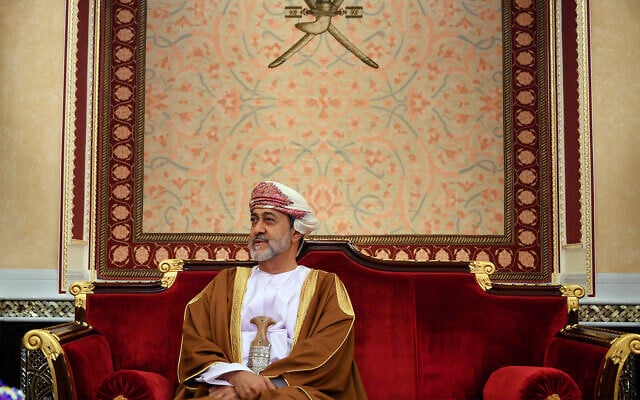
Oman's Sultan Haitham bin Tariq meets with US Secretary of State Mike Pompeo at al-Alam palace in the capital Muscat, February 21, 2020. (Andrew Caballero-Reynolds/Pool via AP).
Even after Iran and its proxies have attacked, armed, or destabilized roughly a dozen Muslim-majority states across the region, Oman still prefers accommodation to clarity. That fact alone should end the fairy tale. A state that watches Iranian aggression burn through the Arab and Muslim world and still rushes to preserve Tehran’s comfort is not practicing wisdom; rather, it is appealing to surrender dressed up as diplomacy.
For years, Washington has treated Oman as a bridge to peace with Iran. Yet that reading was never sober; it was sentimental. Indeed, Sultan Haitham’s decision to congratulate Mojtaba Khamenei after the war had barely subsided exposed the truth in plain sight: Oman is not a neutral broker restraining Tehran. Instead, it is a cautious Gulf monarchy that repeatedly gives Tehran diplomatic cover when the United States and Israel want to end the biggest regional threat.
That distinction matters because Oman’s problem is not one of tone but of alignment. To be sure, Muscat sells itself as calm, pragmatic, and above the sectarian fray, and its Ibadi identity helps sustain that image. However, states do not move according to branding; they move according to interests.
Geographically, Oman sits beside Iran on the Strait of Hormuz, the artery through which a huge share of the world’s seaborne energy passes. Once war shook that corridor, tanker traffic fell and energy markets lurched. Accordingly, Oman’s instinct is predictable: calm Iran, preserve access, and avoid rupture. And to be fair, that may be rational for Muscat. Nevertheless, from a Western perspective, this is clearly not neutrality.
In reality, Muscat consistently behaves less like a mediator and more like Iran’s insurance policy in the Gulf. Repeatedly, Oman hosts talks, passes messages, and advertises “progress,” but the pattern is always the same: the talks buy time, the pressure softens, and Tehran keeps its core position intact.
Patently, Oman does not resolve the crisis; it manages the optics of the crisis. And, when it comes to a regime like Iran, managing optics usually means helping it survive the consequences of its own aggression.
Moreover, that same logic, explains Oman’s deeper ties to Tehran. For years, the two sides have pursued energy cooperation, including an undersea gas pipeline and joint development of the Hengam oilfield along their maritime boundary as part of a strategic investment in long-term interdependence. Hence, when Oman congratulates Iran’s new ruler, it is not acting out of abstract courtesy. Instead, it is defending a relationship it has spent years building.
Even Prime Minister Benjamin Netanyahu’s 2018 visit to Oman now reads less like proof of Omani courage than proof of Omani elasticity. Muscat was willing to host an Israeli prime minister for the first such visit in more than twenty years to talk about peace and regional stability. Nonetheless, that opening never meant Oman was drifting into a genuinely pro-Western camp (or why did they criminalize ties with Israel in 2023?). On the contrary, it meant Oman wanted credit in Washington and Jerusalem while keeping its channels to Tehran fully intact. In other words, Muscat did not open a strategic front against Iran; it expanded its room to maneuver between both sides to benefit the more dangerous side.
For that reason, the West should stop romanticizing Oman. Muscat may be useful for message-passing and deconfliction, but that is not the same as being a trustworthy bridge to peace. Over and over again, Oman blunts consequences and raises the cost of aggression. Thence, that is why its “neutrality” should be named for what it is: not wisdom, not balance, and certainly not peace-making, but a polished form of accommodation that keeps Iran in the game.
Ultimately, Oman’s real function is not to stop the fire but to buy the arsonist time; and that is the point Washington keeps refusing to learn. Manifestly, Muscat does not meaningfully restrain Tehran; it helps launder Tehran’s survival through the language of dialogue, restraint, and regional balance.
In my view, treating Oman as a noble bridge is not merely naïve; it is strategically stupid. A regime that helps Iran absorb pressure is not building peace but prolonging the very disorder that makes peace impossible.
Related Topics
Related Posts